Prolaud compared with other course platforms: Teachable, Kajabi, Skool, Gumroad and more
A category-by-category comparison of Prolaud with course platforms, community tools, creator stores and marketplaces, using prices read from each vendor's own page in November 2026, with an honest section on where each rival is the better buy.
The short answer
Compared with other course platforms, Prolaud is the low-cost, live-first option: Pro is $18/month billed monthly, or $15/month billed yearly ($180 a year), it takes 0% of sales, and students pay into your own Stripe or Razorpay account. Its distinguishing feature is a classroom built into the product, with attendance on each student's record, plus communities with challenges and XP. As of November 2026, Teachable's Starter plan lists $39 a month plus a 7.5% fee, Kajabi starts at $179 a month, Skool's Hobby plan takes 10% plus 30¢ a sale, and Gumroad takes 10% plus 50¢ on direct sales. Prolaud loses where rivals have things it doesn't: a working custom domain today (Teachable, Kajabi, Thinkific, Podia, LearnWorlds), a free plan (Payhip, Systeme.io), a marketplace (Gumroad Discover, Maven), merchant-of-record tax handling (Gumroad), or currencies beyond USD and INR.

Comparison pages written by a vendor have a reputation, and it's earned: the vendor wins every row. This one is written by Prolaud's founder, so start from that assumption and check us. I've tried to make it useful anyway by sticking to three rules. Every rival price and fee is read from that rival's own pricing or help page, dated November 2026, and named. Anything we couldn't confirm on the vendor's own page is left out as a number and listed as unverified. And every rival gets a real answer to "when is this the better choice?", because for plenty of readers it will be.
If you want a description of Prolaud on its own first, read what Prolaud is. If you want the money question answered for your own sales level, is Prolaud worth it? does the break-even arithmetic. This article is the side-by-side.
How was this comparison done?
- Rival figures were read on November 17, 2026 from each vendor's own pricing, help or legal page. Prices are in US dollars and may have changed since; check the vendor's page before you decide.
- Unverified items are left out as numbers. On that day, Udemy's and Skillshare's instructor pages refused automated access, so we quote no revenue split for either. Skool's trial length and yearly price, Circle's monthly-billing price, whether Mighty Networks' $79 is a monthly or annual figure, Podia's monthly prices, and Teachable's trial length (its page shows both 7 and 30 days) are also treated as unconfirmed.
- Prolaud figures come from the same plan catalog our pricing page and billing use.
- "Not listed" means not listed. When a feature isn't on a rival's pricing page, we say so rather than claiming the rival lacks it.
What are the four kinds of platform people compare Prolaud with?
Prolaud overlaps with four different categories, and the right comparison depends on which one you're coming from.
| Category | Examples | What they're built around | Where Prolaud overlaps |
|---|---|---|---|
| Course platforms | Teachable, Kajabi, Thinkific, Podia, LearnWorlds | A course library, a sales site and checkout | Courses, site, checkout, certificates |
| Community tools | Skool, Circle, Mighty Networks | A member feed, groups and events | Communities, challenges, XP, live sessions |
| Creator stores | Gumroad, Payhip, Stan Store, Systeme.io, Shopify | Selling digital products quickly | Storefront, downloads, bundles, memberships |
| Marketplaces and cohort platforms | Maven, Udemy, Skillshare | Bringing buyers to your course | Cohort teaching (but not the marketplace) |
Prolaud vs the field: prices and fees at a glance
Entry-level plans, as each vendor's own page listed them in November 2026. "Per-sale fee" means what the platform itself takes, separate from card processing, unless the row says the two are combined.
| Platform | Entry price | Per-sale platform fee | Free plan |
|---|---|---|---|
| Prolaud | Pro $18/mo billed monthly | 0% on every plan | No; 14-day Studio trial, up to 35 days, no card |
| Teachable | Starter $39/mo billed monthly | 7.5% on Starter; 0% on Builder and Growth with Teachable Payments | No |
| Kajabi | Basic $179/mo billed monthly | 0%; Kajabi Payments 2.9% + 30¢ on Basic; 2% extra on third-party processors on Basic | No; 14-day trial |
| Thinkific | Start $109/mo billed monthly | No extra gateway fee on Thinkific Payments (2.9%); third-party gateway fee varies by plan | No; 30-day trial |
| Podia | Mover $42/mo billed annually | 5% on Mover; none on Shaker or Earthquaker | None listed; 14-day trial, no card |
| LearnWorlds | Starter $49/mo billed monthly | $5 per enrollment on Starter; none on higher plans | No; 30-day trial |
| Skool | Hobby $9/mo | Hobby 10% + 30¢; Pro ($99/mo) 2.9% + 30¢ up to $899, through Skool's own merchant | Not listed |
| Circle | Professional $89/mo billed annually | 2% on Professional | 14-day trial |
| Mighty Networks | Launch $79 (billing basis unclear) | 2% on Launch | 14-day trial, no card |
| Gumroad | No monthly fee | 10% + 50¢ on direct sales; 30% on Discover marketplace sales | No monthly fee at all |
| Payhip | Free Forever $0 | 5% on Free; 2% on Plus ($29/mo); 0% on Pro ($99/mo) | Yes |
| Stan Store | Creator $29/mo | 0% | No; 14-day trial |
| Systeme.io | Free $0 | 0% on all plans | Yes, including 1 course and 500 students |
| Shopify | Basic $39/mo billed monthly | Card rate 2.9% + 30¢ on Basic; a further 2% if you use a third-party payment provider | No; 3 days free, then $1/mo for 3 months |
| Maven | No plan fee shown | 10% of each paid enrollment, plus Stripe fees | Not applicable |
Prolaud vs the field: what's included
| Platform | Live teaching (as its pricing page lists it) | Your own domain | Community |
|---|---|---|---|
| Prolaud | Built-in browser room on every plan; up to 49 people on Pro, 99 on Studio; monthly fair-use allowance | Not yet: a prolaud.com address today, custom domain coming soon | Built in, with challenges, XP and leaderboard |
| Teachable | Not mentioned on the pricing page | Any paid plan | Not compared here |
| Kajabi | Courses in live cohorts on Growth and Pro, not Basic | All plans | Not compared here |
| Thinkific | Live classes through Zoom, all plans | All plans | Not compared here |
| Podia | Events (live and in-person) for everyone | All plans | Not compared here |
| LearnWorlds | Live sessions from Pro Trainer up (its table shows none on Starter) | All plans | Not compared here |
| Skool | "Unlimited live calls" on both plans | "Custom URL" on both plans | The core of the product |
| Circle | Live streams on Professional: 100 attendees, 10 hours | Not checked | The core of the product |
| Mighty Networks | Live streaming on Launch: 20 hours a month, 100 viewers | Not checked | The core of the product |
| Gumroad, Payhip | Not mentioned on their pricing pages | Not checked | Not compared here |
| Stan Store | Not checked | Not mentioned in Stan's pricing article | Not compared here |
| Systeme.io | Not compared here | 1 custom domain, even on Free | Not compared here |
What would each platform charge on the same sales?
Two hypothetical months, applied to every platform the same way: a small month of five $40 sales ($200) and a busier month of thirty $100 sales ($3,000). The figures are platform charges only. Card processing (for example Stripe's US rate of 2.9% + 30¢ on a domestic card, from Stripe's own pricing page) applies on top for every row except Skool, which takes payments through its own merchant and lists one fee per transaction, and possibly Gumroad, whose page doesn't say whether processing is included. These are illustrations of arithmetic, not predictions of what you'll sell.
| Plan | Five $40 sales ($200) | Thirty $100 sales ($3,000) | Note |
|---|---|---|---|
| Prolaud Pro | $18 | $18 | Monthly billing; processor fee extra |
| Prolaud Studio | $42 | $42 | Monthly billing; processor fee extra |
| Teachable Starter | $54 | $264 | Monthly billing; processing extra |
| Teachable Builder | $89 | $89 | 0% with Teachable Payments; processing extra |
| Kajabi Basic | $179 | $179 | Kajabi Payments 2.9% + 30¢ extra |
| Thinkific Start | $109 | $109 | Thinkific Payments 2.9% extra |
| Podia Mover | $52 | $192 | Billed annually; processing extra |
| LearnWorlds Starter | $74 | $199 | $5 per enrollment; processing extra |
| Skool Hobby | $31 | $318 | Paid through Skool's own merchant |
| Skool Pro | $106 | $195 | Paid through Skool's own merchant |
| Circle Professional | $93 | $149 | Billed annually; processing extra |
| Mighty Networks Launch | $83 | $139 | Billing basis unclear on its page |
| Gumroad (direct sales) | $23 | $315 | Page doesn't say if processing is included |
| Payhip Free Forever | $10 | $150 | PayPal/Stripe fees extra |
| Stan Store Creator | $29 | $29 | Processor fees extra |
| Maven | $20 | $300 | Stripe fees extra; no plan fee shown |
Three things stand out. First, on a small month, the per-sale models (Payhip Free, Gumroad, Skool Hobby) are cheap or competitive, which is exactly what they're designed for. Second, once sales grow, every percentage grows with them, while flat-fee plans don't move. Third, Prolaud's flat fee is low because of what it leaves out: no marketplace, no custom domain yet, and only two currencies. The rest of this article is about whether those trade-offs matter to you.
How does Prolaud compare with course platforms?
Teachable, Kajabi, Thinkific, Podia and LearnWorlds are the platforms most people compare us with first. They're mature, course-first products. The main differences are where live teaching sits, whether a fee comes off each sale, and whose payment account the money lands in.
Teachable
As of November 2026, Teachable's pricing page lists Starter at $39 a month (monthly billing) with a 7.5% transaction fee, Builder at $89 and Growth at $189 with 0% when you use Teachable Payments, and Custom by contact. Branding removal is on Growth. Live classes aren't mentioned on the pricing page. A custom domain works on any paid plan.
Where Teachable wins: if your product is a library of self-paced courses, live teaching isn't part of it, and you want a long-established platform with a custom domain working today. On Builder and above the fee argument disappears. Where Prolaud differs: the classroom is built in, the fee is 0% on the cheapest plan too, and payments go into your own Stripe account rather than through a platform payment product. See our Teachable alternative page for the full comparison.
Kajabi
As of November 2026, Kajabi's pricing page lists Basic at $179, Growth at $249 and Pro at $499 a month on monthly billing, with "0% revenue share". Kajabi Payments costs 2.9% + 30¢ on Basic, 2.8% on Growth and 2.7% on Pro (each plus 30¢), and third-party processors carry an extra 2%, 1% or 0.5% depending on plan. Courses in live cohorts are on Growth and Pro, not Basic. Your own domain is included on all plans, and there's a 14-day trial with a 30-day money-back guarantee.
Where Kajabi wins: if your revenue depends on elaborate multi-step marketing funnels with detailed email reporting, and live teaching isn't central. Its marketing depth is real; ours covers the essentials (campaigns, automations, lead forms, abandoned-checkout recovery, coupons) without matching it. Where Prolaud differs: the live room is on every plan rather than from the second tier up, and the entry price is a fraction of Kajabi's. More on our Kajabi alternative page.
Thinkific
As of November 2026, Thinkific's pricing page lists Start at $109, Grow at $219 and Expand at $499 a month on monthly billing. Thinkific Payments is "in line with other processors" at 2.9%, and Thinkific Payments users don't pay a third-party gateway fee; third-party gateways carry a fee that varies by plan, with no figure given. Live classes run through Zoom on all plans, your own domain works on all plans, and there's a 30-day free trial instead of a free plan.
Where Thinkific wins: a self-paced course business that wants a long-refined course builder and site tools, occasional live sessions through Zoom, and a 30-day trial to decide in. Where Prolaud differs: live teaching happens in your own academy rather than a Zoom link, with attendance landing on the student record. See the Thinkific alternative page.
Podia
As of November 2026, Podia's pricing page shows Mover at $42, Shaker at $84 and Earthquaker at $150 a month billed annually. Mover carries a 5% transaction fee; Shaker and Earthquaker have no Podia fees, and Stripe or PayPal charge their own processing. Everyone gets events (live and in-person) and their own domain. No free plan is listed, and the trial is 14 days with no card.
Where Podia wins: simplicity. If you sell downloads and a course or two and want email marketing in the same tool, Podia is deliberately lightweight, and its broadcast email is more complete than ours. Where Prolaud differs: live classes, cohorts and communities with challenges are deeper here, and there's no percentage on the entry plan. See the Podia alternative page.
LearnWorlds
As of November 2026, LearnWorlds' pricing page lists Starter at $49 a month (monthly billing) with a $5 fee per enrollment, then Pro Trainer at $99, Learning Center at $299, and Learning Center & Mobile Apps at $598, with no enrollment fees above Starter. Its comparison table shows live sessions from Pro Trainer upward. Own domain is on all plans, and the trial is 30 days.
Where LearnWorlds wins: training companies and course-first creators who need interactive video, SCORM support, advanced assessments, or a branded mobile app (it has a plan named for mobile apps). Prolaud doesn't import SCORM packages and has no native student app. Where Prolaud differs: live cohorts and the community around them are the center of the product. See the LearnWorlds alternative page.
How does Prolaud compare with community platforms?
Skool, Circle and Mighty Networks are built around a member community, with courses and live events attached. Prolaud is built the other way around: the class and the student record come first, and the community sits around them. If you're comparing community features specifically, our guide to community platforms for course creators goes deeper.
Skool
As of November 2026, Skool's pricing page lists Hobby at $9 a month with a 10% transaction fee and Pro at $99 a month with 2.9%. Its help center adds the detail: Hobby is 10% + 30¢ on all transactions, and Pro is 2.9% + 30¢ on transactions up to $899 and 3.9% + 30¢ above $900, with processing through Skool's own merchant. Both plans list a custom URL and unlimited live calls.
Where Skool wins: when the community is the product. One group, one feed, a leaderboard people come back for, almost nothing to configure, and unlimited calls. On Pro, the fee is close to an ordinary card fee, so money alone isn't a reason to leave. Where Prolaud differs: live classes are a teaching room with a whiteboard, slides, recording and per-student attendance rather than calls, payments go into your own account, and courses, store and certificates sit beside the community. See the Skool alternative page.
Circle
As of November 2026, Circle's pricing page lists its entry plan, Professional, at $89 a month based on annual billing, with a 2% transaction fee (1% on Business and Scale, 0.5% on Circle Plus) and a 14-day trial. Live streams are included on Professional, for up to 100 attendees and 10 hours.
Where Circle wins: a polished community with spaces, events, a website builder and a member experience people enjoy, where live sessions are a weekly Q&A rather than a teaching schedule. In our own view, its community design is more polished than ours. Where Prolaud differs: live teaching is metered by a monthly participant-minute allowance rather than hours, with no fee on sales. See the Circle alternative page.
Mighty Networks
As of November 2026, Mighty Networks' pricing page lists Launch at $79 "per month" (whether that's monthly or annual billing wasn't clear on the page; its calculator showed $950 a year), Scale at $179 and Growth at $354. Transaction fees are 2% on Launch, 1% on Scale and 0.5% on Growth and Mighty Pro. Launch includes live events and streaming, with 20 streaming hours a month for up to 100 viewers, and there's a 14-day trial with no card.
Where Mighty Networks wins: a community-first network where live streams are part of the membership and you want events and community in one branded space. Where Prolaud differs: a lower flat price, 0% on sales, and a classroom aimed at teaching (whiteboard, polls, recording, attendance) rather than broadcasting.
How does Prolaud compare with creator stores?
Gumroad, Payhip, Stan Store, Systeme.io and Shopify are about selling quickly. Courses are one product type among many, and live teaching isn't the focus.
Gumroad
As of November 2026, Gumroad's pricing page lists no monthly fee, 10% + 50¢ per transaction on direct and profile sales, and 30% on sales through its Discover marketplace. Gumroad acts as merchant of record and handles sales tax; the page doesn't say whether payment processing is included.
Where Gumroad wins: occasional sales of a single digital product, where no monthly fee beats any subscription; sellers who want a platform to handle sales tax as merchant of record; and sellers who want the chance of marketplace sales through Discover. Prolaud does none of those three. Where Prolaud differs: a teaching business with courses, cohorts and returning students, where a flat fee and 0% overtake a percentage as sales grow. See the Gumroad alternative page.
Payhip
As of November 2026, Payhip's pricing page lists Free Forever at $0 with a 5% transaction fee, Plus at $29 a month with 2%, and Pro at $99 a month with no transaction fee. Every plan has every feature, unlimited products and unlimited revenue; PayPal and Stripe fees are extra.
Where Payhip wins: a genuinely free starting point with all features, for a seller testing whether anything sells at all. Where Prolaud differs: live classes, communities and student records, and no percentage at any sales level.
Stan Store
According to Stan's own pricing article (updated July 2026; its pricing URL returned a 404), Creator is $29 a month or $300 a year and Creator Pro is $99 a month or $948 a year, with 0% transaction fees from Stan and processor fees on top. There's no free plan; the trial is 14 days, and an unlimited online course builder is on Creator.
Where Stan Store wins: a link-in-bio storefront for creators selling from social media, where a fast mobile checkout matters more than a full academy. Where Prolaud differs: a full academy site with a classroom, community and student records, at a lower entry price.
Systeme.io
As of November 2026, Systeme.io's pricing page lists a Free plan with no card, Startup at $17, Webinar at $47 and Unlimited at $97 a month, and "0% transaction fees on all plans". The free plan includes 1 course, 500 students, 2,000 contacts, 3 funnels, a blog, an affiliate program, unlimited emails and 1 custom domain.
Where Systeme.io wins: a free plan that includes a course, funnels and a custom domain is hard to argue with for someone starting with no budget, and its funnel tools are central to the product. Where Prolaud differs: the live classroom, communities with challenges and XP, and teaching records. If your plan is one course and a funnel, Systeme.io's free tier is the cheaper place to start.
Shopify
As of November 2026, Shopify's pricing page (US view) lists Basic at $39 a month billed monthly or $29 billed yearly, with online card rates of 2.9% + 30¢ and a 2% fee on Basic when you use a third-party processor. Shopify's own Digital Downloads app is free and lists courses as a product type without further course features; the leading course app in its store is a third-party one.
Where Shopify wins: a business that already sells physical products and wants a course as one more item in the same store and checkout. Where Prolaud differs: it is a teaching platform first. A common hybrid is a Shopify store whose course buttons link to a Prolaud academy.
How does Prolaud compare with marketplaces and cohort platforms?
Maven
Maven's help center says its fee is 10% on each paid student enrollment, with Stripe's processing (from 2.9% + 30¢) on top. No monthly plan fee is shown on that page.
Where Maven wins: if you don't have an audience yet and its marketplace would be your distribution. Then the 10% is less a platform fee than a customer-acquisition cost, and Maven's brand carries credibility with professional learners. Where Prolaud differs: once you bring your own audience, a flat fee and 0% leave more of a growing revenue line with you. See the Maven alternative page.
Udemy and Skillshare
Both are marketplaces where the platform brings the learners and sets much of the commercial terms. Their instructor revenue pages refused automated access when we checked on November 17, 2026, so we quote no figures; read their current instructor terms directly. Where they win: reach, if you have no audience and want your course in front of people already browsing. Where Prolaud differs: you own the student list, set your own prices, and keep the sale, but you have to bring the students yourself.
Where does Prolaud lose?
Putting our own gaps in one place, because they're what should rule Prolaud out for some readers:
| If you need… | Prolaud today | Better fit, per the vendor's own page |
|---|---|---|
| Your own domain working now | No; prolaud.com address, custom domain coming soon | Teachable (any paid plan), Kajabi, Thinkific, Podia, LearnWorlds (all plans), Systeme.io (even Free) |
| A free plan | No; a 14 to 35-day trial | Payhip Free Forever, Systeme.io Free, Gumroad (no monthly fee) |
| A marketplace that finds buyers | No | Gumroad Discover, Maven, Udemy, Skillshare |
| Sales tax handled for you | No; you're the seller | Gumroad (merchant of record) |
| Prices in euros, pounds or other currencies | No; USD and INR only | Check each vendor's currency list |
| A native student mobile app | No; browser on any device | LearnWorlds (Mobile Apps plan) |
| SCORM packages | Not imported | LearnWorlds |
| An embeddable checkout on your existing site | No; an embeddable sign-up form, and links to your academy's checkout | Check each vendor |
| API and webhooks on a small plan | Institute only | Check each vendor |
| Live video served from the US or Europe | Media server in Mumbai, India | Test from your students' location |
Which platform should you choose?
Start from what you actually sell, not from the feature list.
| Your situation | Most likely fit |
|---|---|
| You teach live classes or cohorts and want the room, the course, the store and the community in one place, with no cut of sales | Prolaud |
| You sell a self-paced course library and need your own domain today | Teachable Builder, Thinkific or Podia |
| Your business runs on advanced funnels and email reporting | Kajabi |
| Your paid community is the product, calls are a bonus | Skool or Circle |
| You sell occasional digital downloads and want no monthly fee | Gumroad or Payhip Free |
| You have no budget and one course to test | Systeme.io Free or Payhip Free |
| You need corporate-grade authoring, SCORM or a branded app | LearnWorlds |
| You have no audience and want a marketplace to supply one | Maven, Udemy or Skillshare |
| You already run a Shopify store with physical products | Shopify plus a course app, or Shopify linking out to a course platform |
If you're new to all of this, our guide to the best platform for beginners works through the decision from scratch, and course platform fees explained covers every kind of fee you'll meet.
How can you test Prolaud against a rival before deciding?
- Write down your real month: number of sales, average price, live hours, and how many people attend.
- Price it on both platforms using the arithmetic in the cost table above, with your own numbers and each vendor's current page.
- Run a live class on Prolaud's trial with a student on a phone in your students' country, and the same session on the rival's live setup.
- Sell yourself a cheap test product on each, and check exactly what was deducted in your processor dashboard.
- Export your data from each and open the files. What you can take out is what you actually own.
Prolaud's trial is 14 days on Studio with no card, extended to as many as 35 as you publish a course and enroll a student, and an unpaid trial pauses rather than charging. If you're moving across from another platform, the free switching service moves your student list and rebuilds your courses for you. Studio, for reference, is $42/month billed monthly, or $34/month billed yearly ($408 a year).
Run the comparison on your own numbers
Start a 14-day Studio trial, no card, and test the live room from where your students are.
Start your trialSources
- Teachable pricing · Teachable · read 17 November 2026
- Teachable site builder · Teachable · read 17 November 2026
- Kajabi pricing · Kajabi · read 17 November 2026
- Thinkific pricing · Thinkific · read 17 November 2026
- Podia pricing · Podia · read 17 November 2026
- LearnWorlds pricing · LearnWorlds · read 17 November 2026
- Skool pricing · Skool · read 17 November 2026
- Skool subscriptions FAQ · Skool · read 17 November 2026
- Circle pricing · Circle · read 17 November 2026
- Mighty Networks pricing · Mighty Networks · read 17 November 2026
- Gumroad pricing · Gumroad · read 17 November 2026
- Payhip pricing · Payhip · read 17 November 2026
- Stan Store pricing (Stan blog, updated Jul 22, 2026) · Stan · read 17 November 2026
- Systeme.io pricing · Systeme.io · read 17 November 2026
- Shopify pricing (US view) · Shopify · read 17 November 2026
- Digital Downloads app, Shopify App Store · Shopify · read 17 November 2026
- Courses Plus app, Shopify App Store · Architechpro OÜ · read 17 November 2026
- Maven help: Getting paid · Maven · read 17 November 2026
- Stripe pricing (US) · Stripe · read 17 November 2026

Renu Rawat
Founder of prolaud.com. Helping teachers and creators build profitable, independent learning businesses without losing a cut of every sale to platform fees.
About the founderFrequently asked questions
- How does Prolaud compare to Teachable?
- As of November 2026, Teachable's Starter plan lists $39 a month with a 7.5% transaction fee, and 0% from Builder ($89) up with Teachable Payments; live classes aren't on its pricing page, and a custom domain works on any paid plan. Prolaud costs less, takes 0% on every plan and builds the live classroom in, but doesn't connect custom domains yet.
- Is Prolaud cheaper than Kajabi?
- On subscription price, yes. As of November 2026 Kajabi's Basic plan is $179 a month on monthly billing, and live cohorts start on Growth at $249. Prolaud Pro is $18/month billed monthly, or $15/month billed yearly ($180 a year), with live classes on every plan. Kajabi offers deeper marketing funnels and a working custom domain, which Prolaud doesn't match today.
- Is Prolaud a Skool alternative?
- For teachers whose product is a class, yes. As of November 2026 Skool lists Hobby at $9 a month with 10% + 30¢ per transaction and Pro at $99 with 2.9% + 30¢, both with unlimited live calls. Prolaud takes 0%, pays into your own account and has a teaching room with attendance. If the community itself is your product, Skool is often the better fit.
- Which course platforms have no transaction fee?
- As of November 2026, per their own pages: Prolaud (0% on every plan), Kajabi (0% revenue share), Teachable Builder and Growth with Teachable Payments, Podia Shaker and Earthquaker, LearnWorlds above Starter, Payhip Pro, Stan Store and Systeme.io. Card processing still applies on all of them, and some charge extra when you use a third-party processor.
- When is another platform better than Prolaud?
- When you need something Prolaud doesn't do today: your own domain working now, a free plan, a marketplace that finds buyers, a platform that handles sales tax as merchant of record, prices in currencies other than US dollars and Indian rupees, a native student app, or SCORM. Each of those points to a different rival, listed in this article.
- Does Prolaud have a marketplace like Udemy or Maven?
- No. Prolaud doesn't list your courses in a shared catalog or send you buyers. You sell from your own academy site to an audience you bring. That's why it takes 0% instead of a marketplace-sized cut; if you need the platform to supply students, a marketplace is the better fit.
- Where do these competitor prices come from?
- Each figure was read from the vendor's own pricing, help or legal page on November 17, 2026, and is quoted with the vendor named. Figures we couldn't confirm, such as Udemy's and Skillshare's revenue shares, are left out. Prices change, so check the vendor's page before you decide.
Keep reading

What is Prolaud? What it does, who it's for, what it costs, and what it isn't
Prolaud in plain words: an online course platform with the live classroom built in, where students pay into your own Stripe or Razorpay account and Prolaud takes 0%. Here is everything in it, what it costs, and the things it doesn't do yet.
Read
Is Prolaud worth it? An honest review from the founder's chair
The founder's honest answer, with the arithmetic shown: at what sales level a flat plan beats a per-sale cut, who gets real value from Prolaud, who should buy something else, and a trial plan that tells you which one you are.
ReadCourse platform fees explained: subscriptions, transaction fees and payment processing
A pricing page shows one number. Your bill has three layers. Here is how to add them up at your own sales volume, with worked dollar examples.
Read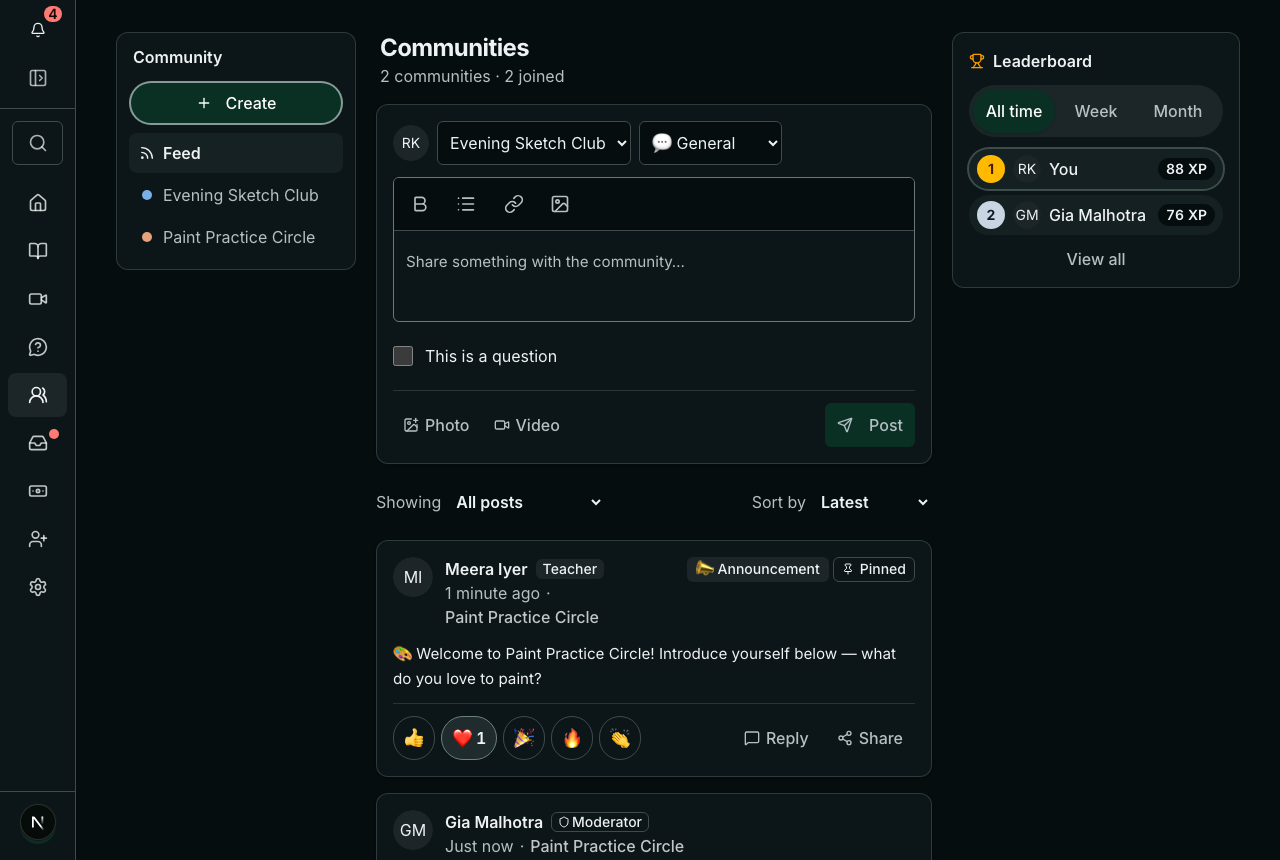
Best community platforms for coaches and course creators (2026)
Skool, Circle, Mighty Networks, TagMango, Communi and Prolaud compared on the things that decide the fit: what earns points, whether challenges are built in, where live sessions happen, your own domain and app, and where the money goes.
ReadWhat are the best platforms for hosting live courses with a community and no commission?
Four tests, eight platforms, one worked example. Which tools give you a live room, a community and your whole sale, as of November 2026, and where each one genuinely wins.
Read