The free abacus game for children
A real soroban your child taps rather than drags. Sixteen levels from reading beads to four-digit carrying — and when they get stuck, the abacus shows them the answer one move at a time.
Start playing below. Nothing to install, nothing to sign up for.
Your child's levels and badges save to this device automatically.
What they actually learn
Sixteen levels, in the order a soroban is really taught. Each one opens when the one before it is finished, so nothing hard arrives early.
1 digit
Bead Reader · Number Builder · Take Away · Small Friends · Small Friends Back
Reading the coins, then adding and taking away inside a single rod — including the five-complement, where the small coins run out and the big one has to be borrowed.
2 digits
Big Friends · Big Friends Back · Two Rods
Crossing ten in both directions: one goes onto the next rod and the ten-complement comes off this one. Then tens and ones together.
3 digits
Three Rods · Carry Master
Hundreds, tens and ones — first with nothing to carry, then with carrying and borrowing through chains of three numbers.
4 digits
Four Rods · Thousands
Up to 9,999, and sums that carry all the way up the abacus.
In their head
Missing Number · Listen Up · Mind Reader · Grand Master
Find the number that's missing, build a number they only heard, and finally work with the coins hidden — which is what a soroban is for.
Six kinds of question, mixed at random
The same maths asked six ways, so a run never turns into a worksheet — and no question is ever repeated inside a run.
Make it
The app names a number; they build it on the coins.
Read it
The coins are set; they read the number off them.
Work it out
A sum, moved on the abacus one coin at a time.
Find what's missing
4 + ? = 5 — the hole is in the middle.
Listen
The number is spoken and never shown.
In your head
The coins are covered. Real mental arithmetic.
When they get stuck, it shows them
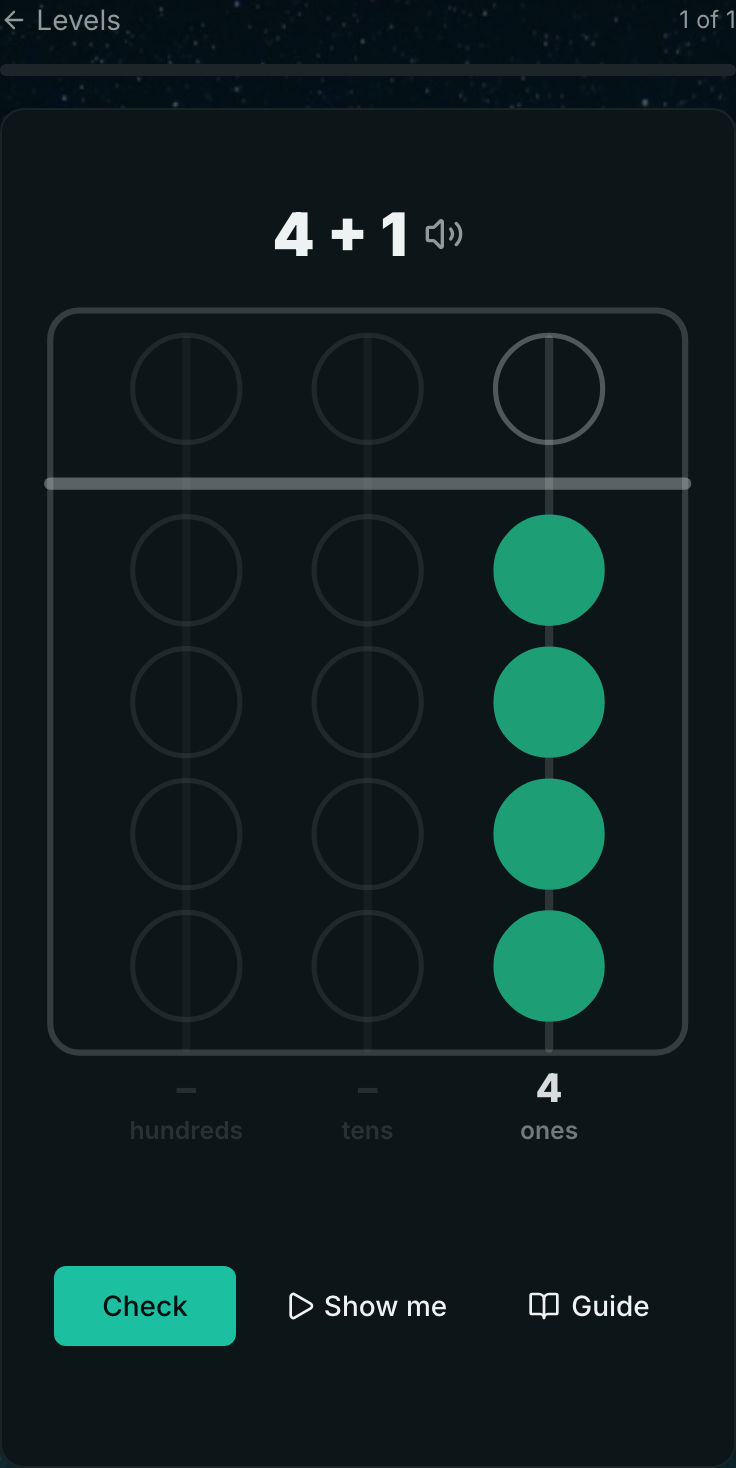
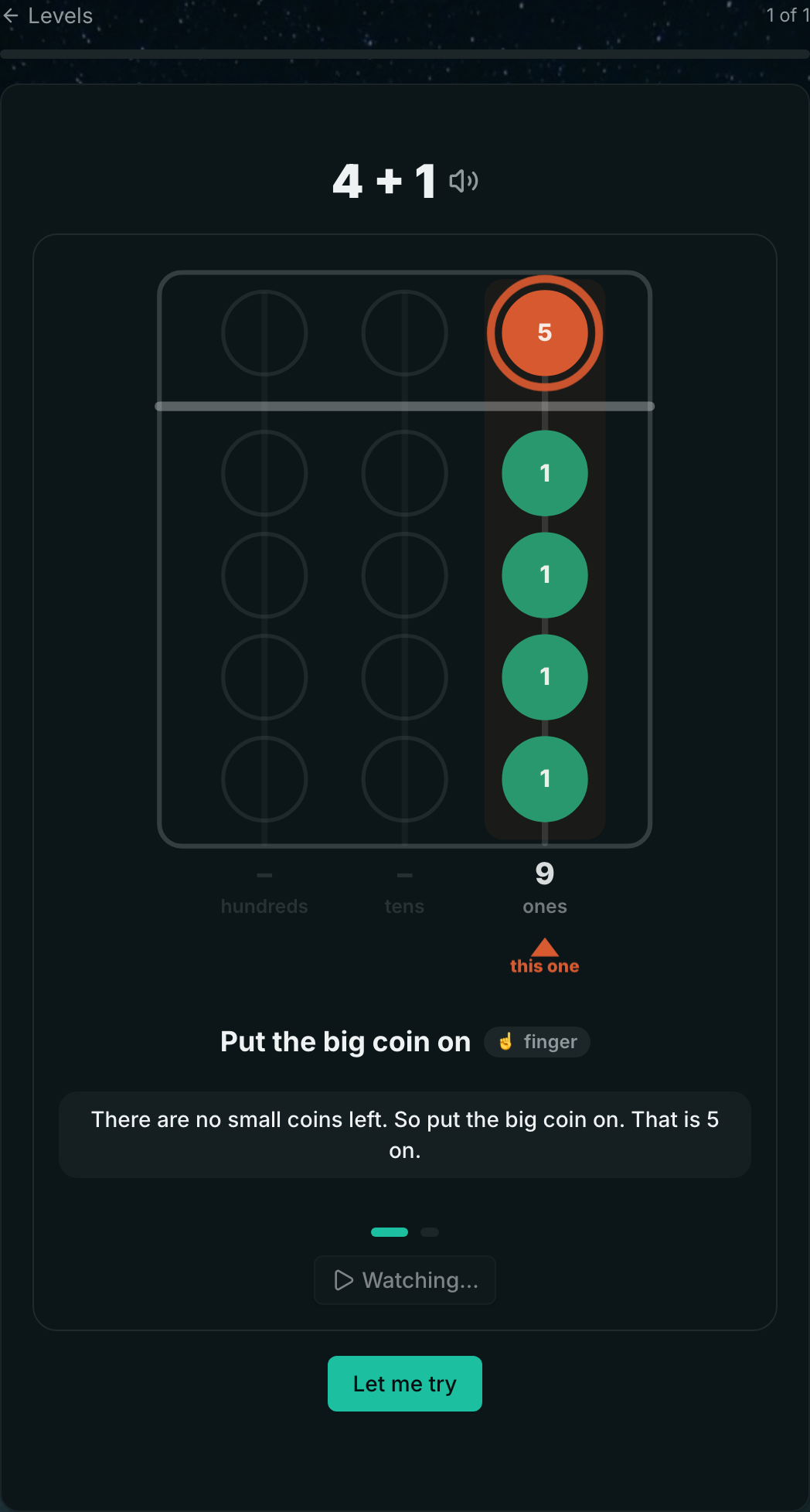
Every question knows the moves that solve it, so the abacus can replay the answer on itself — one move at a time, one short line each, with a ring around exactly the coins that are moving. Here is 4 + 1: there are only four small coins and they are all used, so the 5 goes on and 4 comes back off.
Then they build their own
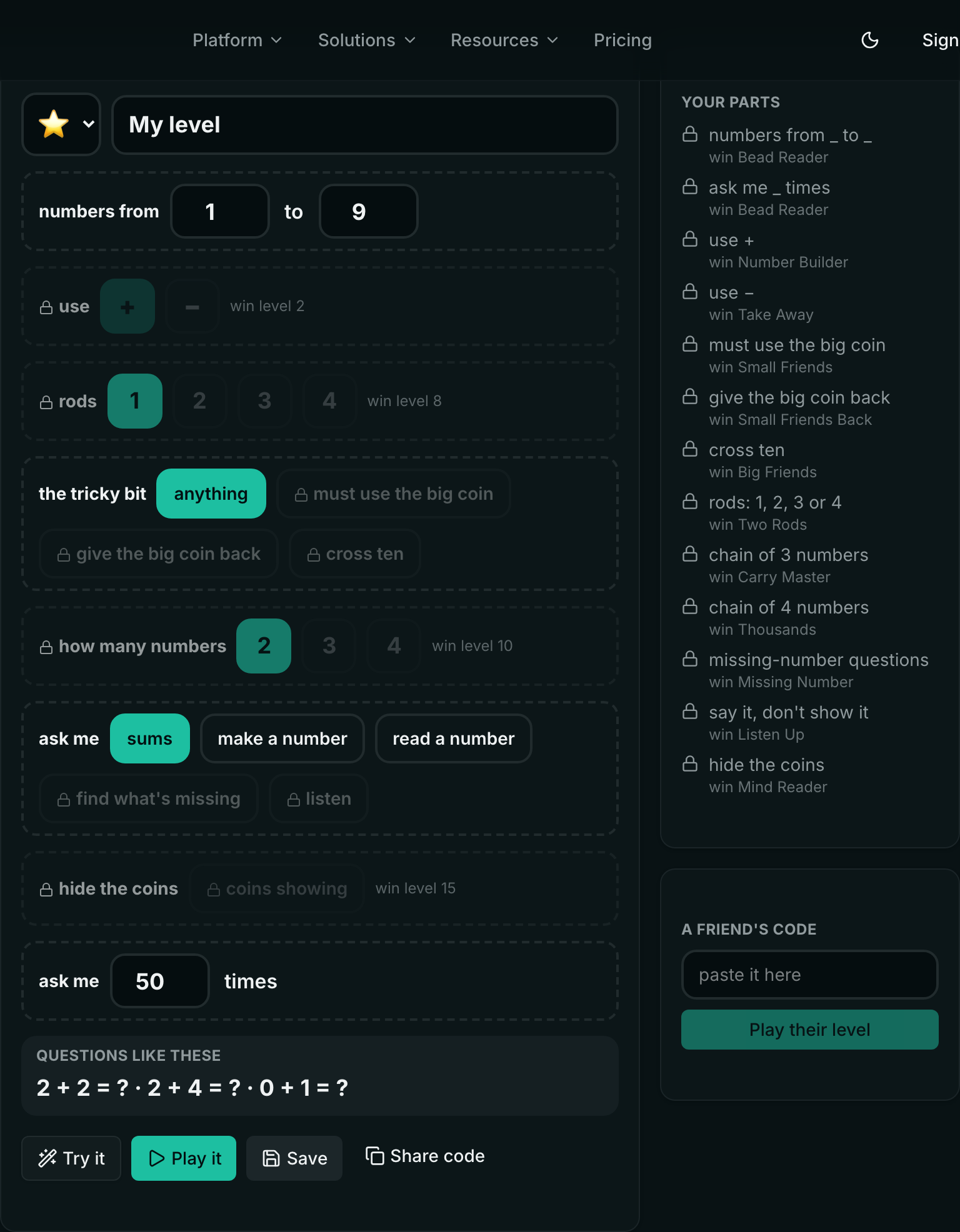
Finishing a level drops a rule block into the Workshop. Children snap blocks together — which numbers, plus or minus, how many rods, whether the big coin has to come out, whether the coins are hidden — and the game rolls endless questions that obey their rules.
Every homemade level compacts to a short share code they can read out to a friend. No account, no link, works written on paper.
It is also, quietly, their first taste of programming: parameters, conditions and loops, without any of the words.
What it never does
No clock
No timer, no countdown, no streak to lose.
No telling-off
The words “wrong” and “failed” appear nowhere.
No reading needed
“Read to me” speaks every question aloud.
No ads
Nothing to buy, nothing to interrupt them.
Keep it on every device
Their levels, stars, badges and homemade levels are already saved on this device. A free account carries them to any other one — and unlocks the rest of the Prolaud arena, where the same coins buy harder English games.
The progress they've made right now comes with them.
Questions parents ask
Is it really free?
Yes. Every level, the Workshop and the coach are free with no account and no card. Progress saves to the device you play on. An account is only needed to carry that progress between devices and to earn coins on the wider Prolaud arena.
What age is it for?
Four to twelve. The youngest use the Read to me switch, which speaks every question and every coaching step, so a child who cannot read yet can play the whole game. The later levels reach four-digit carrying and hidden-abacus mental arithmetic, which is still worth doing at eleven.
Does my child need to know the abacus?
No. The first level is nothing but reading and building numbers, and every level after it introduces exactly one new idea.
Are there ads or in-app purchases?
No ads, nothing to buy, and nothing that interrupts a child mid-question.
Do the questions repeat?
Never inside a run, and a replay avoids what the run before it asked. Questions are generated from each level's rule rather than read off a list, so there is nothing to memorize instead of learning.
Is there a timer or a streak to lose?
No timer, no countdown, no daily streak that punishes a missed day. The only counter is a combo of right answers in a row, and it resets silently.
What happens when they get one wrong?
The game never uses that word. The answer appears quietly and the abacus replays the solution move by move, with one short line per step. Asking to be shown is not a penalty either — it plays the coach and then lets them try it themselves.
Can they make their own levels?
Yes — that's the Workshop. Finishing a level drops a rule block into it, and children snap blocks together to build levels of their own, then share them with a friend as a short code.
Away from the screen? Print it instead.
The same levels as worksheets — pick a level and how many questions, get a PDF with an answer key. Free to photocopy, nothing to sign up for.
Make a worksheetMore free things, no signup: the free shelf — including 35 English games.