Best community platforms for coaches and course creators (2026)
Skool, Circle, Mighty Networks, TagMango, Communi and Prolaud compared on the things that decide the fit: what earns points, whether challenges are built in, where live sessions happen, your own domain and app, and where the money goes.
The short answer
The best community platform depends on what your members pay for. Skool is best for a single, simple paid group where points and levels keep people posting. Circle is best for a large, polished paid membership, especially if you want a custom-branded app on its top plan. Mighty Networks is best when your community runs on events, livestreams and challenges, online and in person. TagMango suits creators who already teach on Zoom and want challenges and a habit tracker on its top plan. Communi is best for a gamified group with no platform fee on sales. Prolaud is best when the teaching is the product: live classes in its own classroom, challenges built from a course, an XP leaderboard and course progress in the feed, direct messages, and 0% commission on every plan, paid into your own Stripe or Razorpay account. Rival facts were read from each vendor's own pages on 15 October 2026.
Full disclosure
We make Prolaud, so we are not a neutral referee. We have tried to be fair: every fact about another platform below was read from that vendor's own pages on 15 October 2026, we quote none of their prices or fee rates, and we say plainly where each one is the better pick. Plans change, so check each vendor's current site before you decide.
A few years ago, choosing a community platform meant choosing a forum. Today almost every serious option has a feed, reactions, a leaderboard, paid membership and some kind of mobile experience. That is good news for coaches and course creators, but it means a feature list no longer tells you much. Read six pricing pages side by side and they start to blur together.
What actually separates them is narrower and more practical: what earns a member points, whether challenges are built in, where your live sessions happen, whose name is on the address and the app, and how the money reaches you. Those five things decide whether a platform fits the business you run, and whether it still fits when you are twice the size.
This guide compares the six platforms coaches and course creators ask us about most: Skool, Circle, Mighty Networks, TagMango, Communi and Prolaud. For each one you get a one-line 'best for', then the same five dimensions in the same order, then an honest note on when it is the right choice. We deliberately leave out prices and fee rates; they change often and you should read them on each vendor's pricing page. If you are weighing one platform in depth, our longer pages on Skool alternatives and Circle alternatives go further than we do here.
The short answer: who each platform is best for
- Skool is best for a creator whose product is one simple paid group, where points from likes and level-locked courses keep members coming back.
- Circle is best for a large, polished paid membership that wants a custom domain on every plan and, on its top plan, a custom-branded mobile app.
- Mighty Networks is best for a community built around events and livestreams, online and in person, with challenges and live courses listed on every plan.
- TagMango is best for a creator who already teaches on Zoom and wants an app-centred community, with challenges and a habit tracker on its top plan.
- Communi is best for a gamified, Skool-style group where the creator wants no platform fee on sales and native live events.
- Prolaud is best for a teacher or coach whose members pay for the teaching: live classes in its own classroom, challenges built from a course, XP for real learning, and 0% commission paid into the creator's own Stripe or Razorpay account.
Skool
Best for: a single, simple paid group where the community itself is the product.
- Community and gamification: a feed with points that come from likes on posts and comments. Points move members up levels, and each group has a leaderboard. Courses can be set to unlock when a member reaches a level, which turns the leaderboard into a reason to keep showing up.
- Challenges: not stated on Skool's pages as of 15 October 2026. If you want them, you would run them by hand with posts and check with Skool for anything newer.
- Live sessions: Skool lists unlimited live calls on every plan.
- Own domain and app: your group gets a custom URL on skool.com. Support for your own domain is not stated on its pages; check with Skool if that matters to you.
- Money flow: Skool lists a transaction fee on sales on each plan. The rate differs by plan, so read it on Skool's pricing page or see our Skool alternatives page.
When Skool is the better pick: when simplicity is the point. If you want one group, one feed, one leaderboard and nothing to configure, Skool is hard to beat, and the level-unlock mechanic is a genuinely clever way to tie participation to content. If your community is already thriving there and your members renew for the feed itself, moving would likely cost you more than it gains.
Circle
Best for: a large, polished paid membership that needs its own domain and, eventually, its own branded app.
- Community and gamification: Circle lists gamification on all plans: points from likes, leaderboards, levels and badges.
- Challenges: not stated on Circle's pages as of 15 October 2026.
- Live sessions: live events and live rooms inside Circle. How much live time each plan includes varies, so check its pricing page if you teach live often.
- Own domain and app: a custom domain on all plans. Members get Circle-branded mobile apps on all plans; a custom-branded app under your own name is offered only on Circle's top, custom-priced plan.
- Money flow: Circle lists a transaction fee on each plan. Read the rate for your plan on Circle's pricing page, or see our Circle alternatives page.
When Circle is the better pick: when you are running a large paid membership, design and configuration matter to you, and an app in the stores under your own brand is on your roadmap. Circle's custom domain on every plan and its path to a custom-branded app make it the most natural fit for a community that wants to look like its own product.
Mighty Networks
Best for: a community that lives on events and livestreams, with courses and challenges alongside.
- Community and gamification: points and leaderboards are listed on all plans.
- Challenges: 'Live Courses & Challenges' is listed on all plans, which makes Mighty Networks one of only two rivals here whose pages describe challenges at all, and the only one that lists them on every plan.
- Live sessions: livestreaming events from inside the platform.
- Own domain and app: a custom domain on all plans. Your own branded apps are offered only on its top plan.
- Money flow: Mighty Networks lists a transaction fee on each plan; read the rate on its pricing page.
When Mighty Networks is the better pick: when events are the heartbeat of your community, especially if you mix in-person gatherings with online sessions, and when you want challenges available without moving to a top plan. It is also worth a look if you expect to grow into a branded app later and want to stay on one platform when you do.
TagMango
Best for: a creator who already runs live sessions on Zoom and wants a community and app around them. Our TagMango alternatives page goes into more detail.
- Community and gamification: gamification is listed from its Advanced plan upward, not on its entry plans.
- Challenges: challenges and a habit and task tracker are listed only on its top plan.
- Live sessions: live sessions run on Zoom, which TagMango opens inside its platform, so the classroom itself is Zoom's.
- Own domain and app: a custom domain is offered as a paid setup, and branded apps are offered as paid setups.
- Money flow: TagMango lists a commission on sales on most plans; check its pricing page for which plans and at what rate.
When TagMango is the better pick: when your teaching already runs on Zoom and you are happy to keep it there, when you want a branded app and are fine paying for that setup, and when you plan to be on its top plan anyway, where challenges and the habit tracker live.
Communi
Best for: a gamified, Skool-style community where keeping all of the sale matters.
- Community and gamification: points, levels, badges and leaderboards.
- Challenges: not stated on Communi's pages as of 15 October 2026.
- Live sessions: native live events and webinars inside the platform.
- Own domain and app: a custom domain is offered, though its pages are inconsistent about which plans include it, so confirm before you buy. Communi has its own iOS app; a branded app under your name is not stated.
- Money flow: Communi says it charges no platform fee on sales; your payment processor's fees still apply. It also sells a lifetime deal on its own site, which some creators prefer to a monthly plan; read the terms there.
When Communi is the better pick: when you want the Skool-style mechanics of points, levels and leaderboards, native live events, and no platform cut on your sales. Test it with a small group first and confirm the domain question for your plan.
Prolaud
Best for: a teacher, tutor or coach whose members pay for the teaching, with the community wrapped around the classroom.
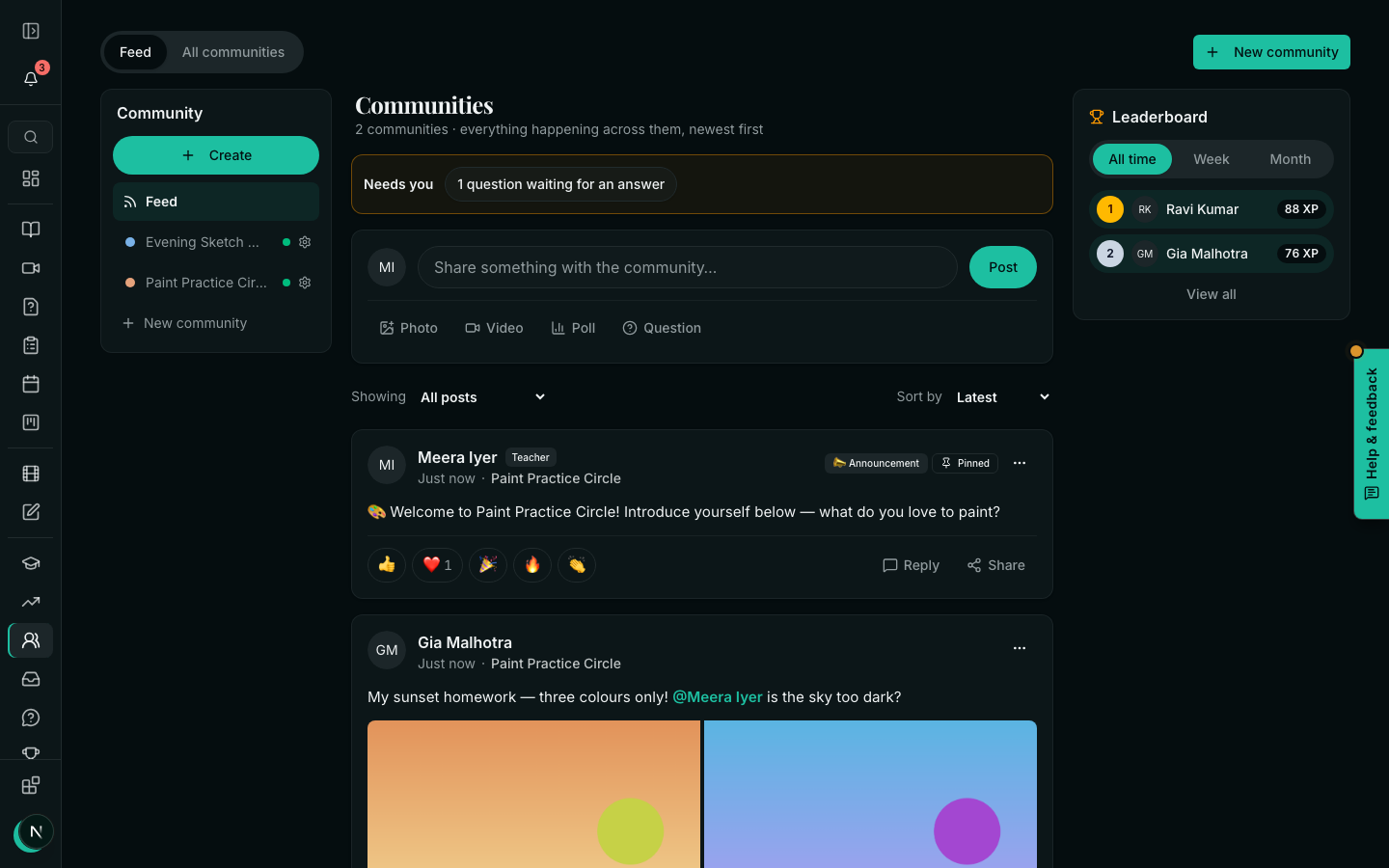
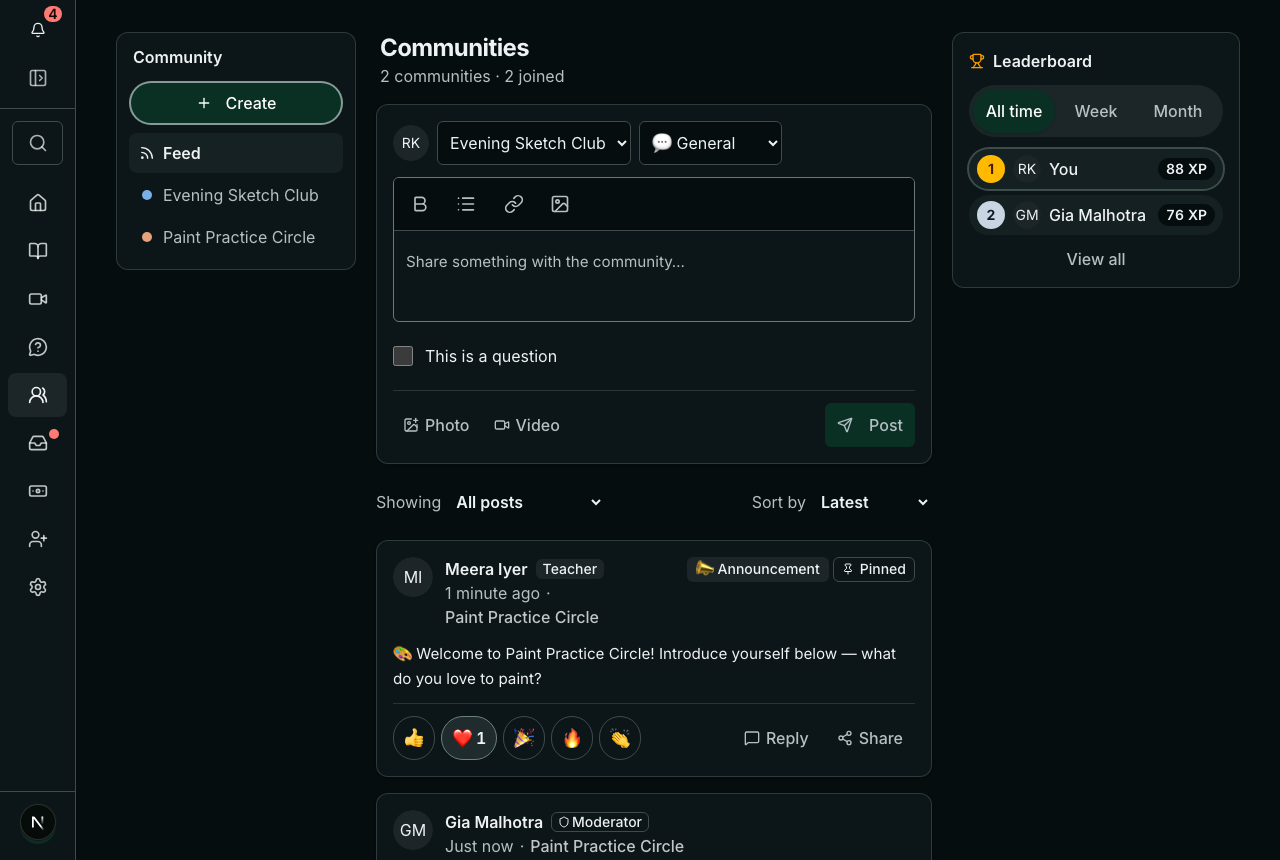
- Community: a community wall with photos, video links, polls, questions, reactions and replies, organized into spaces under headings. Each post shows how many people viewed it, there is a quiz of the day, and the teacher gets a 'Needs you' strip. Members can be made moderators, and you can require approval to join and to post. You can import members into a community from a CSV file.
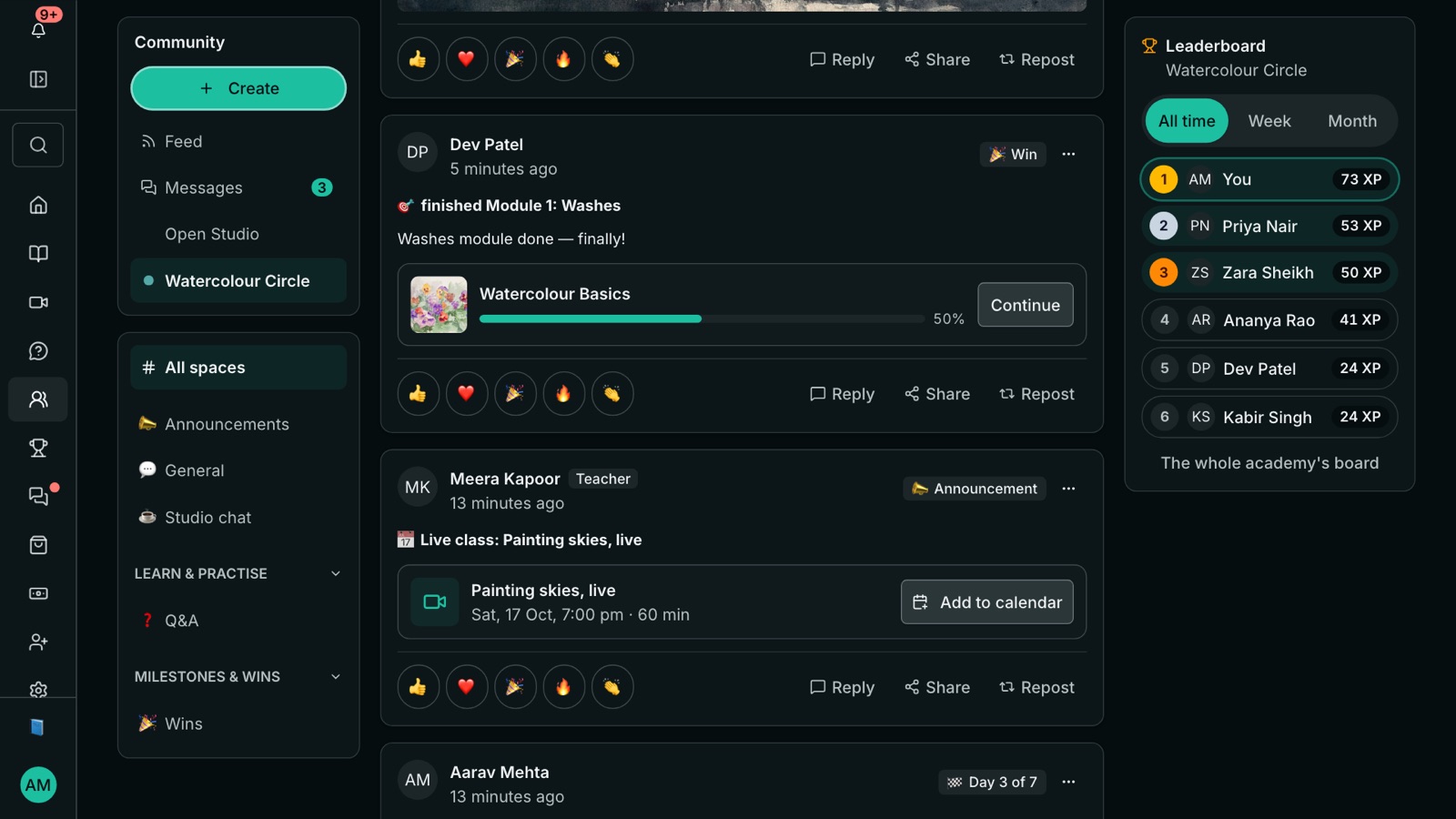
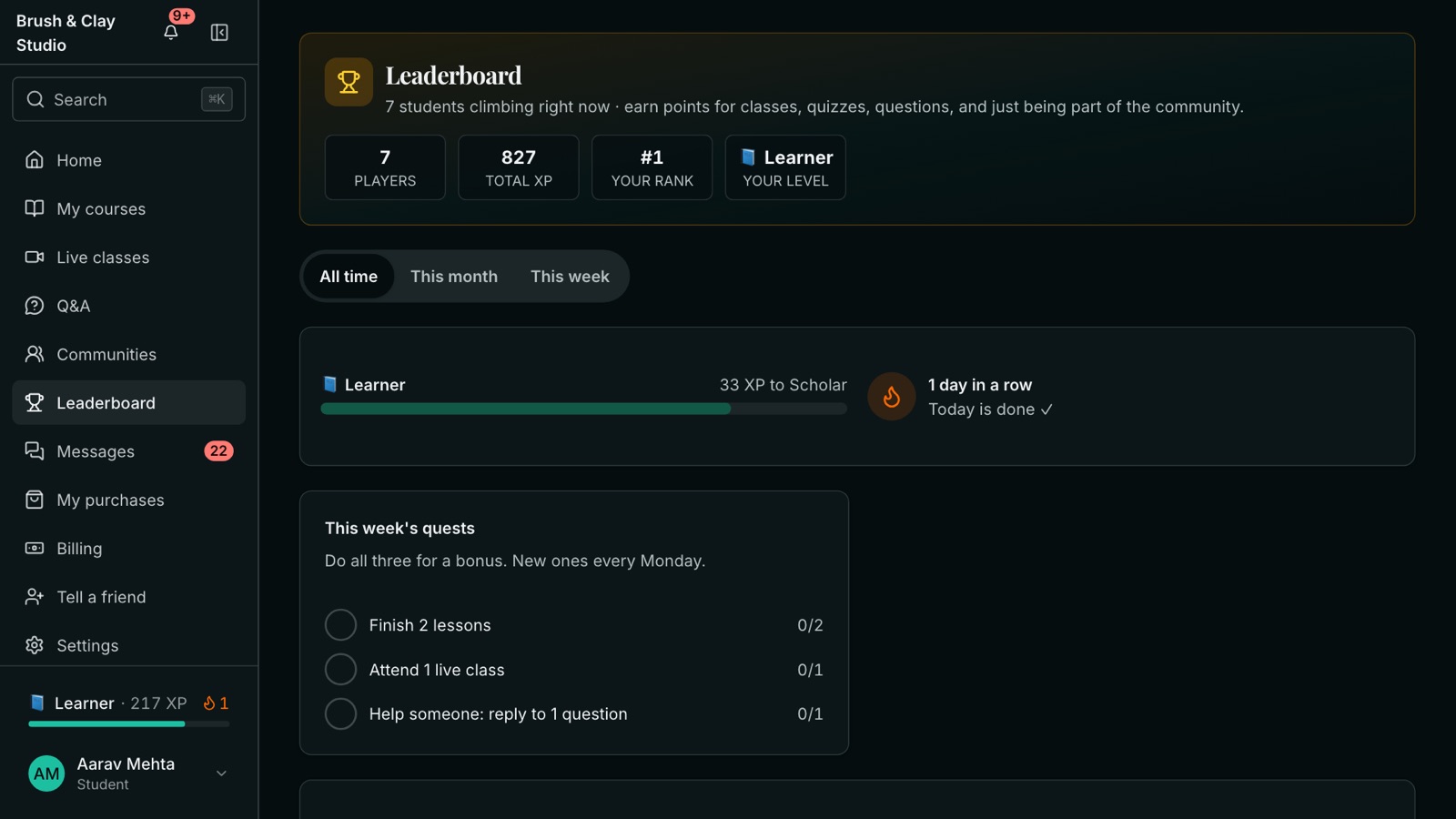
- Gamification: XP for real learning: lessons, live classes, quizzes and assignments earn XP, and so does helping other members. Levels can be renamed to suit your subject, and there are streaks, weekly quests, badges, houses, a reward shop where members spend coins, a kids mode, and one academy-wide leaderboard.
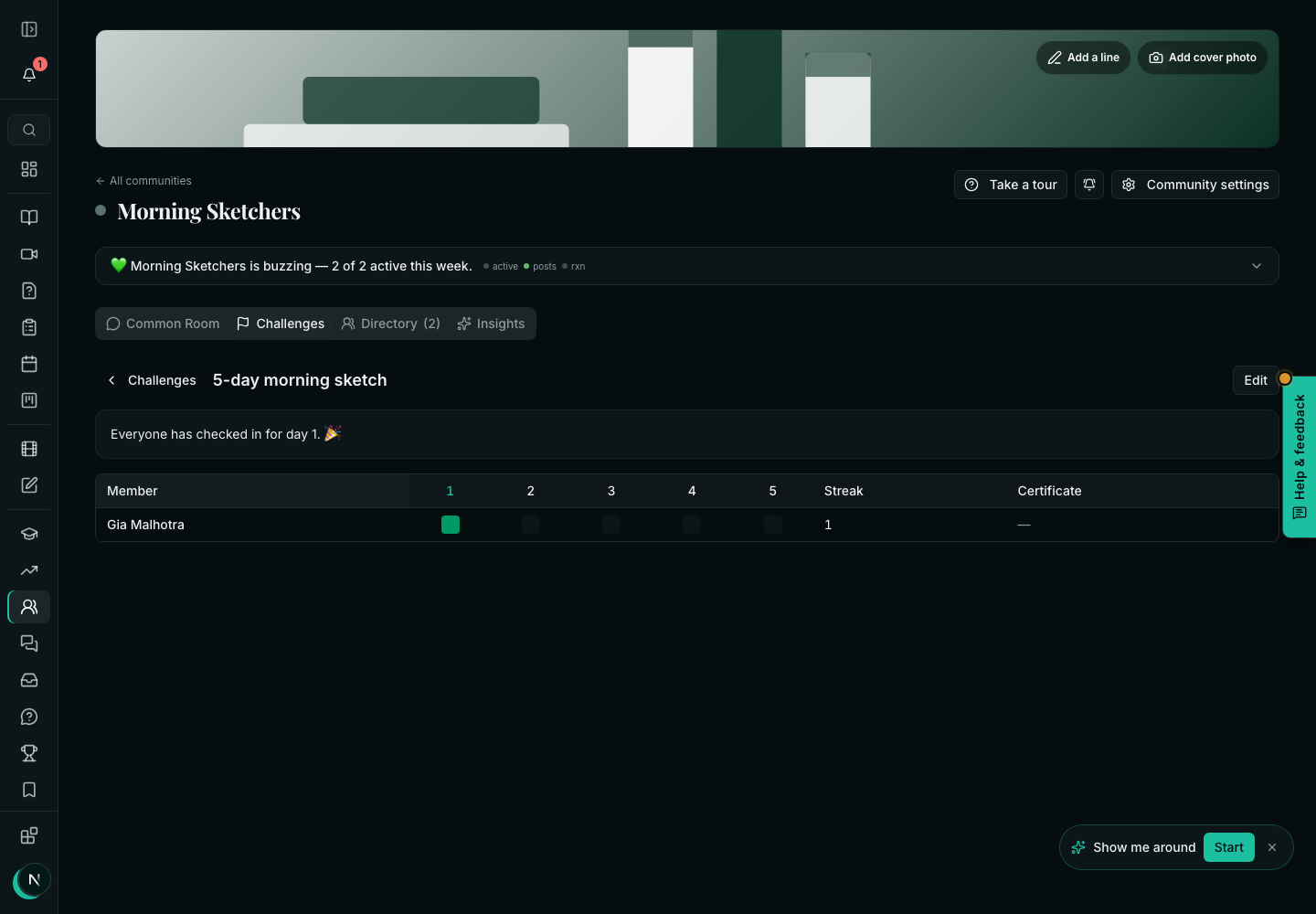
- Challenges: built in. Run a 5, 7, 21 or 30-day challenge or an open-ended habit; build one from a course so that completing a lesson counts as the check-in; collect check-ins with a photo or a few words; track streaks, send reminders, review a progress grid and approve check-ins. Finishers get an automatic certificate with a public verification link, you can sell a challenge on its own page, and on the last day you can offer the next course.
- Live sessions: live classes run in Prolaud's own classroom, with a whiteboard, attendance and recordings, and a recap is posted to the community afterwards.
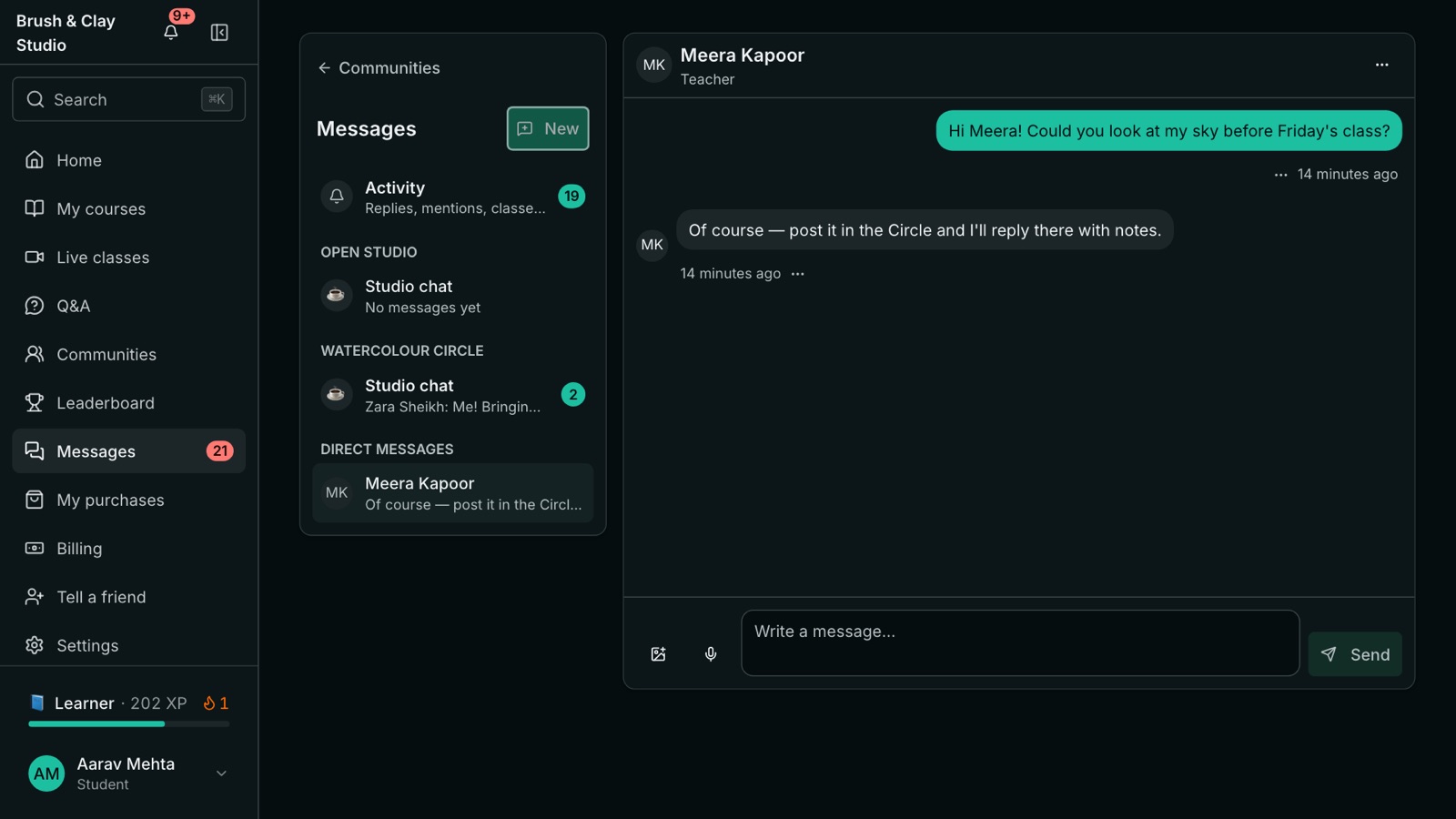
- Around the lessons: a 'Discuss this lesson' thread under each lesson, course progress shared to the community only with the student's consent, Messages with chat spaces, direct messages under your academy's rules, voice notes, pinning and holding, and an Activity inbox, plus Sparks, short vertical videos.
- Knowing your members: a community pulse that shows who has gone quiet and why, and 'Ask about your community', where AI answers your questions from your community's own facts.
- Own domain and app: your academy at its own address on prolaud.com; connecting your own domain is coming soon. Members need no app download; they add the web app to their home screen.
- Money flow: 0% commission on sales on every plan. Buyers pay into your own Stripe account, or Razorpay in India, so only your payment processor's fee applies. See zero-commission course platforms for why that matters over time.
The screens below are from a demo academy we built for our walkthrough video, Brush & Clay Studio, seen as one of its students. They show the three things buyers ask about most: a leaderboard, progress, and talking to the teacher.
When Prolaud is the better pick: when your members come for classes, courses, practice and feedback, and you want the community, the challenges and the rewards to push them back into the learning rather than just into the feed. When it is not: if you want one simple group and nothing else, Skool is simpler. If your members expect an app in the stores under your own brand, Prolaud's answer is a web app on the home screen, so look at Circle's or Mighty Networks' top plans or TagMango's paid app setup. And if you run many separate groups that each need their own leaderboard, note that Prolaud has one leaderboard across the academy.
Side by side
The same five dimensions in one table. No prices or rates appear here by design: read those on each vendor's pricing page. Rival entries reflect each vendor's own pages as read on 15 October 2026.
| Platform | Gamification | Challenges | Live sessions | Own domain | App | Fee on your sales |
|---|---|---|---|---|---|---|
| Skool | Yes: points from likes, levels, group leaderboards, level-unlocked courses | Not stated | Yes, unlimited live calls | Custom skool.com group URL; own domain not stated | Not covered here; check Skool | Yes, a transaction fee on each plan |
| Circle | Yes, all plans: points from likes, leaderboards, levels, badges | Not stated | Yes, live events and live rooms | Yes, all plans | Circle-branded apps on all plans; custom-branded only on top plan | Yes, a transaction fee on each plan |
| Mighty Networks | Yes, all plans: points and leaderboards | Yes, all plans ('Live Courses & Challenges') | Yes, livestreaming events | Yes, all plans | Own branded apps only on top plan | Yes, a transaction fee on each plan |
| TagMango | From its Advanced plan | Top plan only, with habit and task tracker | Zoom-based | Paid setup | Branded apps as paid setups | Commission on most plans |
| Communi | Yes: points, levels, badges, leaderboards | Not stated | Yes, native live events and webinars | Yes; which plans is unclear on its pages | Its own iOS app; branded app not stated | No platform fee; processor fees apply |
| Prolaud | Yes: XP for learning and helping, renamable levels, quests, badges, houses, reward shop, one academy-wide leaderboard | Yes: fixed-length or habit, from a course, with certificate | Yes, its own classroom with whiteboard, attendance, recordings | Own prolaud.com address today; your own domain coming soon | No download; web app on the home screen | No: 0% on every plan, into your own Stripe or Razorpay |
Follow the money
Of the five dimensions, money flow is the one creators most often skim and most often regret. Two questions matter. First, does the platform take a fee on each sale on top of the plan you pay for? Second, whose account does the buyer's payment land in? A fee that looks small on a pricing page is charged on every renewal, every course and every upsell, and it grows with your community. Before you commit, take your real monthly sales, then double them, and work out what each platform's listed fee would come to at both sizes.
Among the six here, Communi says it charges no platform fee on sales, and Prolaud takes 0% commission on every plan and sends the payment straight to your own Stripe or Razorpay account. Skool, Circle and Mighty Networks list a transaction fee on each plan, and TagMango lists a commission on most plans. That does not make the fee-charging platforms wrong choices; it makes the fee a real line in your budget that deserves the same attention as the plan price.
How to choose
Start with what your members pay for
If members pay to belong, to be in the room with you and with each other, the feed and the leaderboard are the product. A focused community platform such as Skool or Communi fits that well. If members pay to learn something, to finish a course, pass an exam or build a skill, the classroom is the product and the community is how you keep them going between lessons. That second case is where a platform built around teaching, like Prolaud, earns its place.
Decide where live teaching happens
A monthly Q&A can live almost anywhere. Several live classes a week is different: you want the classroom inside the same place as the community so members do not juggle links, attendance is recorded where their progress is, and recordings sit next to the discussion. Skool, Circle, Mighty Networks and Communi all list live sessions of their own; TagMango's run on Zoom, which it opens inside its platform; Prolaud's run in its own classroom with a whiteboard, attendance and recordings, and post a recap to the community.
Look closely at what earns points
Points from likes reward posting, and posting is a fine thing to reward in a pure community. But if your members joined to learn, a leaderboard topped by your most prolific poster can quietly send the wrong message. Ask what each platform lets you reward: likes, attendance, lessons finished, quizzes passed, help given. Prolaud awards XP for lessons, live classes, quizzes, assignments and helping others, so the people at the top are the people doing the work.
Decide whether challenges matter
A well-run challenge is one of the most reliable ways to bring a quiet community back to life and to turn free members into paying ones. If challenges are central to your plan, prefer a platform that lists them, and check which plan they sit on. On the pages we read, Mighty Networks lists challenges on all plans, TagMango only on its top plan, and Prolaud includes them with check-ins, streaks, approvals and an automatic certificate. Skool, Circle and Communi did not state a challenge feature.
Be honest about the app question
An app in the stores under your own name is a real asset for some brands, and it usually sits on a top plan or a paid setup: Circle and Mighty Networks offer one on their top plans, and TagMango as a paid setup. Many creators find that members are just as happy with the platform's own app or a web app on the home screen. Decide whether a branded store app is a must-have before you let it pick your platform.
Run a real trial, not a tour
- Invite five real members and ask them to post, reply and join a live session from their phones.
- Run a three-day mini challenge and see how check-ins, reminders and the leaderboard feel from the member's side.
- Make one member a moderator and see what they can and cannot do.
- Sell one product end to end and follow the payment until it reaches your bank account.
- Export your member list, so you know you can leave if you ever need to.
- Read the fee for your plan on the pricing page, then work it out at twice your current size.
Where each rival is the better pick
We would rather you pick the right platform than pick ours. Plainly:
- Choose Skool for simplicity: one group, points from likes, levels that unlock courses, and almost nothing to set up.
- Choose Circle for a large paid membership that wants its own domain from day one and a custom-branded app on its top plan.
- Choose Mighty Networks if your community mixes in-person and online events and you want challenges on every plan.
- Choose TagMango if your live teaching already runs well on Zoom and you want branded apps as a paid setup.
- Choose Communi if you want Skool-style gamification and native live events with no platform fee on sales.
- Choose Prolaud if the teaching is the product and you want the community, challenges and rewards to drive learning, with 0% commission into your own account.
Switching platforms without losing members
Whichever direction you move, the pattern that works is the same. Move the people, not the posts: member lists export as spreadsheets and import by email, while old feeds rarely move cleanly between platforms. In Prolaud you can import members into a community from a CSV file. Rebuild the thing your members love most first, whether that is your best challenge, your weekly thread or your class schedule, so it is waiting when they arrive. Then invite everyone at once with one link and one date when the old community closes, and overlap the two for a few weeks, posting in the new place first and using the old one only to point people across.
A good first week in the new home is a short challenge. It gives every member one clear thing to do each day, it fills the new feed with check-ins, and it shows you within days who has made the move and who needs a personal nudge.
Try the community wall, challenges and live classroom free
Start with a 14-day free trial, no card needed. 0% commission on every plan, paid into your own Stripe or Razorpay account.
Start free
Renu Rawat
Founder of prolaud.com. Helping teachers and creators build profitable, independent learning businesses without losing a cut of every sale to platform fees.
About the founderFrequently asked questions
- What are the best platforms for building a student community?
- Five are worth a look. Prolaud, if your students pay for the teaching: each course gets a community next to its lessons and live classes, with challenges built from a course, XP for real learning and 0% commission. Skool, for one simple paid group with points and levels. Circle, for a large, polished membership. Mighty Networks, if the community runs on events and livestreams. TagMango, if you already teach on Zoom and want an app-centred community.
- What is the best community platform for course creators in 2026?
- It depends on what your members pay for. For one simple paid group, Skool. For a large, polished membership with a custom domain on every plan and a custom-branded app on its top plan, Circle. For a community built on events and challenges, Mighty Networks. For a gamified group with no platform fee on sales, Communi. For a teaching business where live classes, courses and challenges sit inside the community, Prolaud, which takes 0% commission on every plan.
- Which community platforms have challenges built in?
- On the vendors' own pages as read on 15 October 2026, Mighty Networks lists 'Live Courses & Challenges' on all plans, and TagMango lists challenges and a habit and task tracker on its top plan only. Skool, Circle and Communi did not state a challenge feature. Prolaud has challenges built in: fixed-length or habit challenges, challenges built from a course, check-ins with a photo or words, streaks, reminders, approvals and an automatic certificate with a public verification link.
- Which community platform takes no commission on sales?
- Communi says it charges no platform fee on sales, though payment processor fees still apply. Prolaud takes 0% commission on every plan, and buyers pay into your own Stripe or Razorpay account. Skool, Circle and Mighty Networks list a transaction fee on each plan, and TagMango lists a commission on most plans; read the rates on their pricing pages.
- Can I use my own domain for my community?
- Circle and Mighty Networks list a custom domain on all plans. TagMango offers one as a paid setup. Communi offers one, but its pages are inconsistent about which plans include it. Skool gives your group a custom skool.com URL, and support for your own domain is not stated on its pages. Prolaud puts your academy at its own address on prolaud.com today; connecting your own domain is coming soon.
- Do I need a branded mobile app for my community?
- Usually not at the start. Circle and Mighty Networks offer custom-branded apps only on their top plans, and TagMango offers branded apps as paid setups. Communi has its own iOS app. Prolaud needs no download: members add the web app to their home screen. Decide whether a store app under your own name is a must-have before letting it choose your platform.
- Which community platform has live classes built in?
- Skool lists unlimited live calls, Circle has live events and live rooms, Mighty Networks has livestreaming events, and Communi has native live events and webinars. TagMango's live sessions are Zoom-based. Prolaud runs live classes in its own classroom with a whiteboard, attendance and recordings, and posts a recap to the community afterwards.
- How is Prolaud's gamification different from points for likes?
- On Skool and Circle, points come from likes. Prolaud awards XP for real learning, meaning lessons, live classes, quizzes and assignments, and for helping other members. Levels can be renamed, and there are streaks, weekly quests, badges, houses, a reward shop with coins, a kids mode and one academy-wide leaderboard.
- Is Skool or Circle better than Prolaud?
- For some creators, yes. Skool is simpler if you want one group and nothing else. Circle is a stronger fit for a large paid membership that wants a custom-branded app on its top plan. Prolaud is the better fit when members pay for your teaching and you want challenges, XP for learning and live classes inside the community, with 0% commission. Our pages on Skool alternatives and Circle alternatives compare each in more depth.
Keep reading

How to Build a Community Around Your Online Course (2026)
The lonely learner quits. The one who feels part of something finishes, gets results and brings a friend. Here's how to build the community that makes that happen.
Read
How to Get Students to Come Back and Finish an Online Course
Most people who buy an online course never finish it. Here's why they drop off, how to measure your completion rate honestly, and the features and habits that bring students back every week.
Read
Zero-Commission Course Platforms: Which Take 0% of Your Course Sales?
Commission is the quiet tax on every sale you make. Here's what it really costs over a year, how to spot a true zero-commission platform, and how to keep what you earn.
Read