For creators
The teacher's guide: question banks, papers, marks and invigilation
What a teacher actually does in an examination cycle: contribute questions, agree the shape of the paper, mark, and — if you invigilate — judge what the system flagged. Everything here is scoped, so you see the courses you are assigned and not the rest of the institution.
Last updated Aug 28, 2026
Your term, in order
- Before teaching starts — check the courses you are assigned, and that their internal and external maximums match what your department agreed. A wrong maximum is much cheaper to fix now than after marks are entered against it.
- During the term — record attendance as sessions held and sessions attended. Do it weekly; reconstructing a register in week fourteen is how detentions get contested.
- Set quizzes and assignments as you go. Anything auto-graded gives the student a result immediately and you a signal about who is drifting.
- Before the examination — contribute questions to the bank, tagged by difficulty and topic, then agree the blueprint. Validate it against the bank; that is the step that catches an impossible paper.
- During the examination — if you invigilate, watch the board and judge what it flags. Nothing auto-fails anybody.
- After — enter internal and external marks. Your head of department publishes; you cannot, deliberately.
- If a mark is contested — it goes through revaluation, which keeps the original and records the change.
Building the question bank
A question carries its type, its marks, its difficulty and its topic. Those last two are not decoration — they are what a blueprint draws against, so a bank tagged carelessly produces papers that are technically valid and pedagogically wrong.
- Multiple choice, multiple response, true/false, fill in the blank, matching, short answer and long answer.
- Difficulty — easy, moderate, hard.
- Topic — free text, but be consistent; the blueprint matches on it.
- Status — draft, active or retired. Retiring a question stops it being drawn into new papers without breaking the sittings that already contain it.
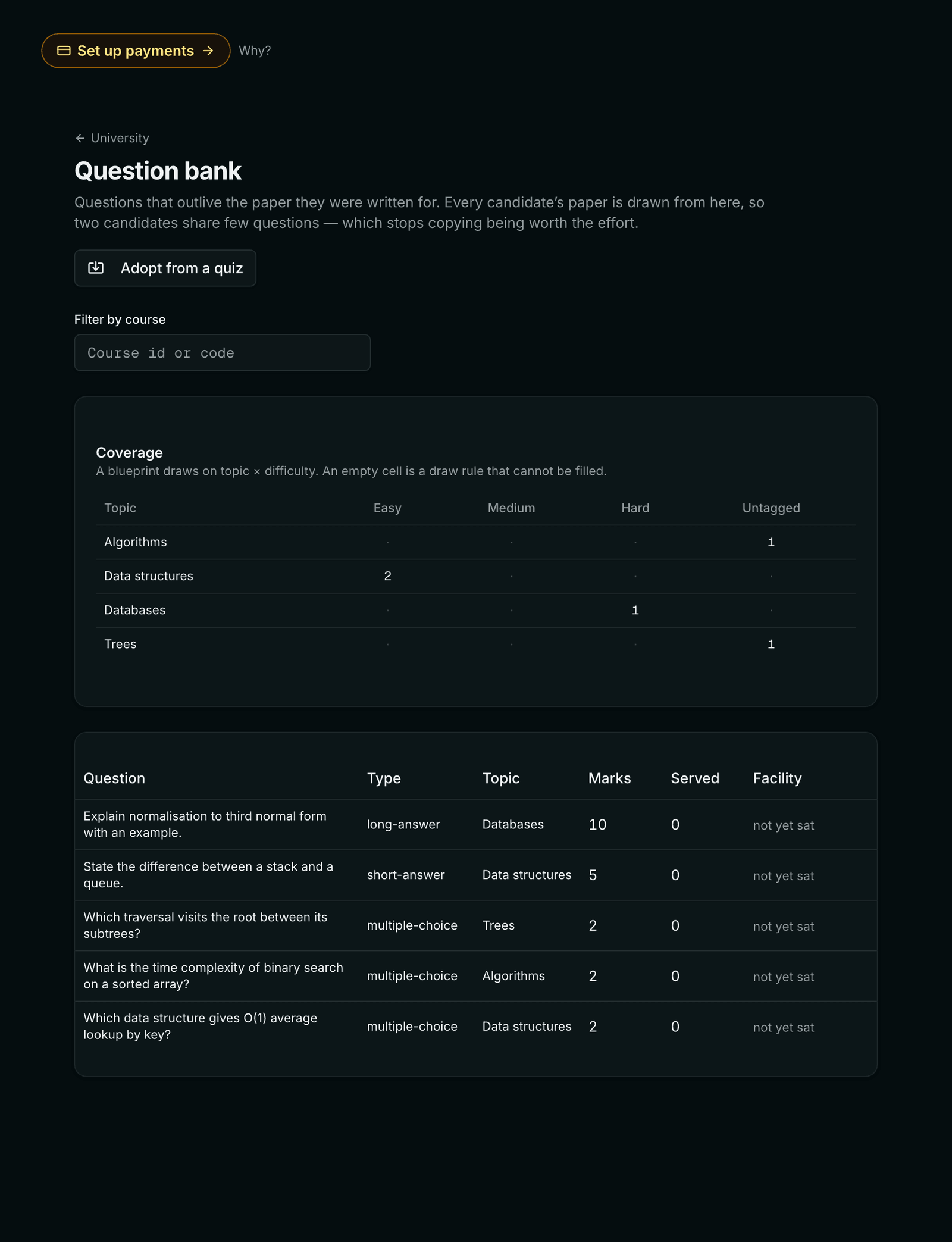
Assembling a paper from a blueprint
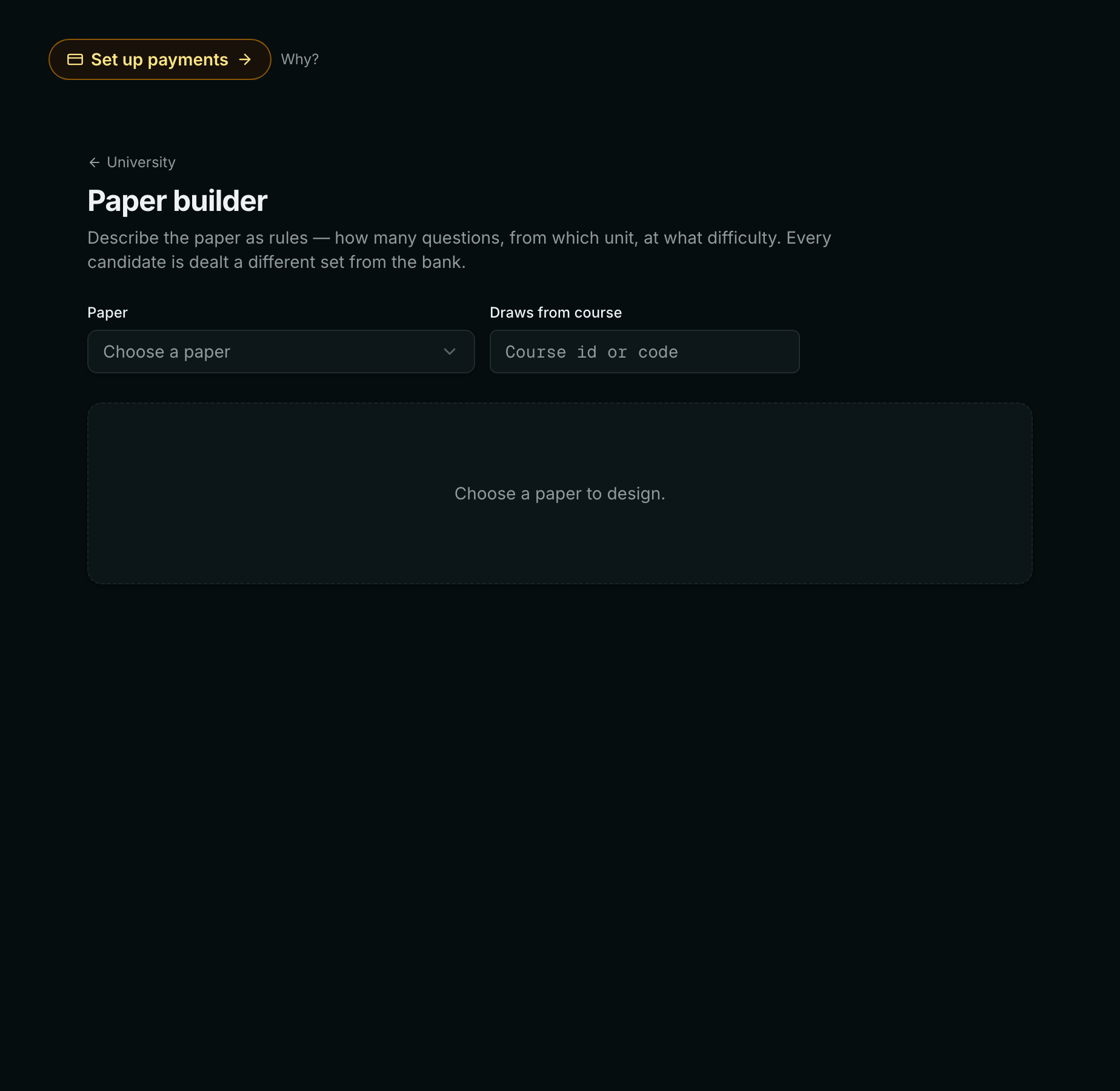
A blueprint says what the paper should contain — so many hard questions from this topic worth this much, so many moderate from that one — and the system draws a different paper for every candidate from the bank that satisfies it. The paper builder validates the blueprint against the bank before you commit: if you have asked for eight hard questions on a topic that has five, it tells you now rather than at nine on the morning of the examination.
Options are permuted per candidate, and so is the matching column. The permutation is a genuine derangement rather than a shuffle — an ordinary shuffle can return the original order, which on a three-pair matching question happens about one time in six and hands that candidate the answer key in the correct order.
Entering marks
Marks are entered per course as internal and external against the maximums the programme sets. The screen shows the rule being applied — both minimums and the aggregate — so a fail is legible at the moment you enter it rather than a surprise when results publish.
An evaluator can enter and change marks up to publication. After publication a mark is frozen, and a correction goes through revaluation, which keeps the original and records what changed. That is deliberate: an examination result you can quietly edit is one you cannot defend.
Invigilating a sitting
The invigilation board shows sittings in progress with a review priority rather than a verdict. That distinction is the whole design: a proctoring score presented as a judgment gets used as one, and the software is not entitled to decide that a candidate cheated.
What it records, and what each signal actually means:
- Focus lost — the window lost focus or was hidden. It does NOT mean they looked something up: a notification steals focus too.
- Paste — text was pasted into an answer, recorded as a length only; the text itself is never stored. It does NOT mean the text came from outside the paper.
- Camera stopped — the webcam was switched off, unplugged or taken by another app mid-paper. It does NOT mean it was deliberate; a driver crash looks identical.
- Heartbeat gap — the client stopped reporting for a while. It does NOT mean they disconnected deliberately: a dropped connection looks identical.
- Identity mismatch — a reviewer thought the photo and the ID did not match. This is a person's call, never a machine's.
You judge each event — benign, suspicious, or confirmed — and record a verdict for the sitting. Your verdict and its reason are attached to the candidate's record for the academic board, which is who decides what happens next.
- Can I see marks for courses I do not teach?
- No. An evaluator sees the courses they are assigned; a head of department sees their own department. A coordinator has read-only oversight of sittings on their programmes and cannot see or change marks at all.
- Can I change a mark after results are published?
- Not directly — a published result is frozen. Raise a revaluation; it recomputes the SGPA, CGPA and marksheet immediately, and keeps the original alongside a record of what changed.
- Does every candidate get a different paper?
- Yes, if you assemble from a blueprint. Each is drawn from the bank to the same specification, and the options and matching columns are permuted per candidate.
- Is the answer key ever sent to the candidate's browser?
- No. The paper is assembled on the server, delivered without answers, and graded on the server. The browser never holds the key at any point in the sitting.
Related