How to run a cohort-based course: a week-by-week playbook
A cohort is a promise that specific things happen on specific days. Here is how to size it, price it, fill it and run it as a weekly rhythm, from enrollment to certificate to cohort 2.
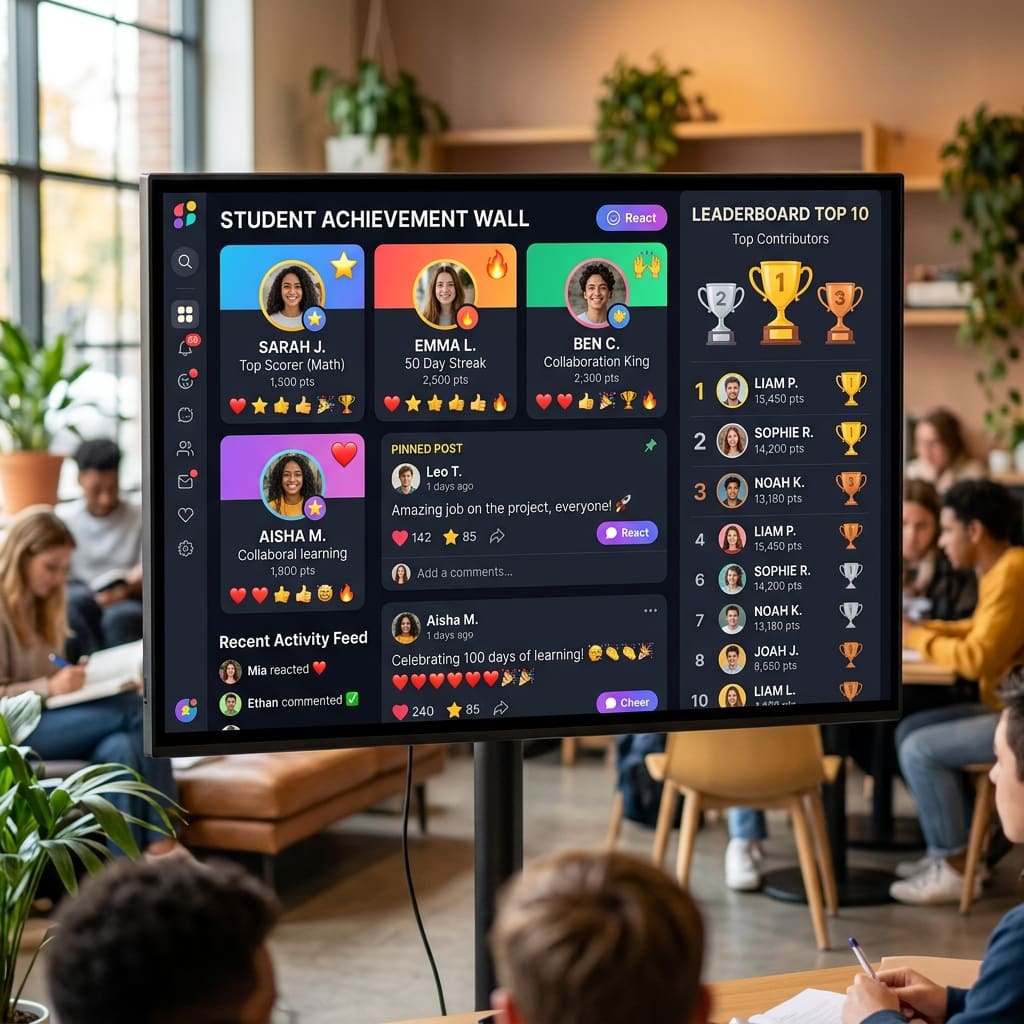
A cohort-based course is a course with a start date, an end date and a fixed group of students who go through it together. Everyone enrolls in the same window, meets live on the same schedule, hands in the same assignment by the same deadline and finishes in the same week. That is the whole definition. The rest of this playbook is how to run one without it eating your life: how many students to take, what to charge, how to open and close enrollment, and what happens in each week from the first session to the certificate.
The content is rarely what makes a cohort hard. You already know your subject. What is new is the calendar: a cohort is a promise that specific things will happen on specific days, to a group of people who paid on the understanding that they would. Run it as a rhythm that repeats and it is manageable. Improvise it week by week and it becomes a second full-time job by week three.
What a cohort-based course is, and when it beats self-paced
A self-paced course is a library: recorded lessons a student can start any day and finish whenever they like. A cohort-based course is a class: a group, a schedule and a teacher who responds. They are different products, and the same material can be sold as either. The honest comparison looks like this.
| Self-paced course | Cohort-based course | |
|---|---|---|
| Starts | Any day the student buys | On a fixed date, with a group |
| Pace | Set by the student | Set by the calendar |
| Feedback | Usually none, or automated quizzes | From you and from peers, every week |
| Your time | Heavy once, then light | Heavy every time it runs |
| What the student pays for | Access to the material | Material plus deadlines, feedback and a group |
| Grows by | Selling more copies | Running more cohorts, or adding help |
A cohort is the better format when at least two of these are true:
- The skill needs feedback. Writing, design, speaking a language, coding, teaching itself: anything where a student cannot tell from the inside whether their work is good.
- The value is in finishing something. A portfolio piece, a business plan, a passed exam. Deadlines and an audience are what get it finished.
- Students learn from each other. Seeing how eleven other people solved the same problem is often worth as much as the lesson.
- You do not yet know exactly what the course should be. Teaching it live to a small group shows you where people get stuck before you record anything.
Stay self-paced when the material is reference knowledge that students dip into, when the price has to stay low, when your students cannot commit to a fixed hour each week, or when you cannot. That last one matters. A cohort you cancel twice does more harm to your name than a recorded course you never updated. If you are deciding between the two, our guide to self-paced course best practices covers the other side.
Size and price your first cohort
Cohort size is not limited by how many people fit in a video call. It is limited by how much feedback you can give in a week without the quality dropping. So start from the feedback, not from the revenue target.
Here is the arithmetic for a made-up but typical case. Sarah Mitchell is planning a six-week course on presenting data, with one assignment a week. She times herself reviewing a sample submission properly, with written comments, and it takes about twenty minutes. Twenty minutes per student per week gives her this:
| Students | Feedback minutes per week | Feedback hours per week |
|---|---|---|
| 8 | 160 | 2 h 40 min |
| 12 | 240 | 4 h |
| 20 | 400 | 6 h 40 min |
| 30 | 600 | 10 h |
Sarah has about four hours a week for feedback on top of teaching, so her first cohort is twelve. If she wanted thirty, the answer is not to work ten hours of evenings. It is to change the design: shorter rubric-based feedback, peer review in some weeks, or a paid teaching assistant. Decide that before you sell the seats, not in week two.
Pricing from your hours backward
For a first cohort, the most useful pricing check is your own effective hourly rate. Add up the hours the cohort will really take, then divide. In Sarah's case each teaching week is a 1.5-hour live session, 1 hour of preparation, 4 hours of feedback and 1 hour in the community: 7.5 hours. Six weeks of that is 45 hours. Enrollment, onboarding and the wrap-up add roughly 10 more, so 55 hours in total.
| Price per seat | Revenue from 12 seats | Divided by 55 hours |
|---|---|---|
| $250 | $3,000 | About $55 an hour |
| $400 | $4,800 | About $87 an hour |
| $600 | $7,200 | About $131 an hour |
This does not tell you what students will pay. It tells you which prices are worth your time, which is the half of the question you can answer today. The other half you learn by opening enrollment. If the first cohort fills quickly at $400, the second can cost more. If it does not fill, the fix is usually a clearer promise or a warmer audience rather than a lower price.
Call the first one what it is
A first cohort is a pilot, and students respect being told so. Name it a founding cohort, keep it small, price it a little below where you expect to land, and ask in return for detailed feedback and permission to quote results. Do not invent a regular price to discount from. If the next cohort will cost more, say that it will, and then make sure it does.
Open and close an enrollment window
A cohort has a deadline built in, and that is its main sales advantage: there is a real reason to decide now. Use it honestly. Enrollment opens on a date, closes on a date, and the close is real. Letting people in during week two tells everyone who enrolled on time that the deadline was decoration, and it leaves the late student permanently a week behind.
A workable timeline for a six-week course is two to three weeks of open enrollment, a few days of onboarding, six teaching weeks and one wrap-up week. Shorter enrollment windows work if you already have an audience that knows you. Longer ones tend to delay the decision rather than add sign-ups, because a deadline that is far away is easy to ignore.
Your enrollment page has to answer five questions before anyone will pay:
- When, exactly? Start date, end date, the day and time of the live session, and the time zone written out.
- How many hours a week? Live time plus assignment time, stated plainly. A student who knew it was five hours a week before paying is far less likely to be surprised in week three.
- What will I have at the end? A finished thing, named: a portfolio case study, a recorded talk, a working app.
- What if I miss a session? Your recording and catch-up policy, in one sentence.
- What if it is not for me? The refund terms and the date they end.
Application or open enrollment?
Open enrollment means anyone who pays is in. An application means a short form first, and you choose. Use an application when the cohort only works if students start at a similar level, or when a single mismatched student would slow the group. Keep it to three questions: what they do now, what they want to be able to do in six weeks, and whether they can make the live time. Reply within two working days. An applicant who waits a week for an answer has usually moved on.
Either way, cap the seats and say the number. When the cohort is full, switch the button to a waitlist for the next one. That list is the start of cohort 2.
Week 0: onboarding
The days between enrollment closing and the first session decide how week one goes. Send one welcome message with everything in it, rather than five messages with one thing each:
- The full schedule with dates, plus a calendar invite for every live session so the time converts to each student's own zone.
- Where the group talks, and a first prompt to answer there: who you are, where you are joining from, what you want to have built by the end.
- A short piece of pre-work, thirty minutes at most, so nobody arrives cold.
- How to test their camera, microphone and login before the first session, not during it.
- The completion criteria for the certificate, so the rules are known from day one.
The weekly rhythm
Every teaching week has the same four beats on the same days. Students should be able to answer "what happens on Thursday?" without checking. That predictability is what lets busy adults fit a cohort around a job.
1. The live session
One live session a week, 60 to 90 minutes, is enough for most cohorts. Use it for what recordings cannot do: working through examples together, answering questions, reviewing student work in front of the group. Anything that is pure explanation can be a short recorded lesson watched beforehand. If you are new to teaching live, the companion guide on how to teach live classes online covers the session itself, minute by minute.
2. The assignment
One assignment a week, released at the end of the live session and due before the next one. Make it a piece of the final project wherever you can, so that week six is assembly rather than a new mountain. State how long it should take. An assignment with no time estimate takes one student forty minutes and another the whole weekend, and the second one will not be back for week four.
3. The feedback
Feedback is the part students cannot get from a video, so it is the part to protect. Promise a turnaround you can keep, such as written comments within two working days of the deadline, and keep it every week. Use a short rubric of three or four criteria so the feedback is consistent from student to student and faster for you to write. One specific thing that works and one specific thing to change is more useful than a paragraph of general encouragement.
4. The community
The group space is where questions get answered between sessions and where students see each other's work. It needs a small amount of structure or it goes quiet: a thread for each week's assignment, a prompt from you on a fixed day, and a habit of answering questions in the open rather than in private messages, so everyone benefits from the answer.
| Day | What happens | Who does the work |
|---|---|---|
| Monday | Live session; assignment released at the end | You teach, students take part |
| Tuesday to Thursday | Students work; questions in the group space | Students, with you checking in once a day |
| Thursday night | Assignment deadline | Students |
| Friday and the weekend | Written feedback returned; strong examples shared with permission | You |
| Sunday | A short note: what is coming on Monday and what to bring | You |
The week-by-week playbook
Here is the whole six-week cohort on one page. Adjust the topics to your subject; keep the shape.
| Week | Focus | Live session | Assignment | Your job |
|---|---|---|---|---|
| 0 | Onboarding | Optional 20-minute tech check | Introduce yourself; finish the pre-work | Welcome message, invites, reply to every introduction |
| 1 | Foundations and habits | Core idea, first worked example, how the cohort runs | A small, easy win due before week 2 | Fast, generous feedback; message anyone who did not submit |
| 2 | First real skill | Teach, then practice together | First piece of the final project | Feedback against the rubric; share two strong examples |
| 3 | The hard middle | Common mistakes from week 2, then new material | Second piece of the project | A personal check-in with anyone who has gone quiet |
| 4 | Putting it together | Live critique of student work | Full draft of the project | Detailed feedback; this is the heaviest review week |
| 5 | Revision | Open questions; an advanced topic by request | Revise the draft using the feedback | Lighter feedback; open the waitlist for the next cohort |
| 6 | Final project | Presentations or a showcase | Submit the final version | Final feedback, certificates, exit survey |
| 7 | Wrap-up | None | None | Retrospective, permissions to quote, plan cohort 2 |
Two weeks deserve more attention than the others. Week 1 sets the habits: if the first assignment is small enough that everyone submits it, submitting becomes what this group does. Week 3 is the dip. The novelty has worn off, the work has become harder, and regular life has reasserted itself. Schedule your personal check-ins for that week in advance. A two-line message sent the same day ("I noticed you missed the deadline. Is the workload the problem, or the timing?") does more than any amount of general encouragement posted to the group.
Run the session, the assignment and the group in one place
Prolaud puts live classes, assignments, a cohort community and certificates in one workspace, so checking on week three means reading one list rather than cross-checking five tabs.
See how live cohorts workAttendance and accountability
Accountability in a cohort is mostly visibility. When students know that someone will notice a missed session or a missed deadline, most of them do not miss it. You do not need penalties. You need to actually notice, and to say so quickly.
- Record two things per student, per week: whether they attended the live session and whether they submitted the assignment. That is the whole dashboard.
- Act on the first miss, not the third. One missed session or deadline gets a short, friendly personal message the same day.
- Put students in groups of three for the length of the cohort. A small group that expects your draft on Thursday is a stronger deadline than you are.
- Ask for a public commitment in week 1: what each person will have finished by week 6. Refer back to it by name.
- Make catching up possible. A student who misses week 3 should know exactly what to watch and what to submit to be back on track by week 4.
Be careful what you count as attendance. Joining a call for five minutes is not attending it, and a number you may later have to defend should be measured properly. We wrote a separate piece on measuring live class attendance honestly. In Prolaud, attendance for each live class is recorded as the class runs, and the assignments list shows how many submissions are still waiting to be graded, so those two columns fill themselves in.
Handling time zones
The moment your cohort has students in more than one country, the live time becomes the hardest design decision. There are three workable answers.
- One slot, chosen for the majority, with recordings for everyone else. Simple, and fine if most students share a region.
- Two alternating slots. Odd weeks suit one region, even weeks the other, so no group always gets the bad hour.
- One teaching slot plus a shorter office hour at the opposite end of the day, for questions from students who watched the replay.
Some arithmetic helps you choose. Noon Eastern is 9:00 AM Pacific, 5:00 PM in London and 6:00 PM in Berlin, which makes late morning Eastern the usual answer for a group spread across North America and Europe. The same hour is the middle of the night in Sydney, so a cohort with students in Australia needs the second or third option. An evening slot such as 8:00 PM Eastern is 5:00 PM Pacific and the following day in Sydney, but it is after midnight in Europe.
The clocks do not change on the same day
The United States and Europe switch to and from daylight saving time on different weekends. For a few weeks each spring and about a week each fall, the gap between New York and London is four hours rather than five. If your cohort runs across one of those dates, tell students in advance which city's clock the session follows, and rely on calendar invites rather than a time typed into a message.
Whatever you choose, always write the time with its zone, give it in two zones on the enrollment page, and send a calendar invite for every session. Ask for each student's time zone at enrollment so that you know the spread before you fix the slot for the next cohort.
Recordings: a safety net, not the course
Record every live session and post it within a day. Students get sick, travel and have jobs, and a cohort with no replay punishes them for it. Tell students at the start that sessions are recorded and who will be able to watch them.
The risk is that the replay becomes the default and the live room empties. Three habits prevent that. Make the live session something a recording cannot fully replace, with live critique, questions and practice. Ask anyone who watches the replay to post one takeaway or one question in that week's thread, and count that toward the completion criteria. And decide in advance how long recordings stay available after the cohort ends, so that "lifetime access" is a choice you made rather than something you drifted into.
On Prolaud you start the recording from inside the host view of the class, and it appears in your recordings library afterward. Whatever tool you use, check before week 1 where the file ends up and who can open it.
The final project and the certificate
A cohort should end with something each student made. Define the final project in week 1, not week 5, and build it in pieces through the weekly assignments so that the last week is revision and presentation. Good final projects are specific, finishable in the time available and useful to the student outside the course: something they could show an employer, a client or their own students.
End with a showcase. Each student gets three to five minutes in the last live session to present, and the group responds. Twelve students at five minutes each is a full hour, so plan the session length around the headcount. Presenting to peers is a stronger finish than uploading a file, and it produces the examples you will use to explain the course to the next cohort.
Write the certificate criteria down before enrollment opens and apply them exactly. A reasonable set for a six-week cohort:
- Attended live, or watched the replay, for at least five of the six sessions.
- Submitted at least five of the six weekly assignments.
- Submitted and presented the final project.
Be accurate about what the certificate is. It certifies that this person completed this course to this standard, issued by you. It is not an accredited qualification unless you are an accredited body, and saying so plainly costs nothing. Prolaud issues certificates from a template, one at a time or in bulk for the whole cohort, and each carries an ID that anyone can check on a public verification page. If your subject has right and wrong answers, a short quiz can back the same criteria.
What to measure
Six numbers tell you whether the cohort worked. All of them are simple division, and all of them should be computed the same way each time so that cohort 2 can be compared with cohort 1.
| Measure | How to compute it | What it tells you |
|---|---|---|
| Fill rate | Seats sold ÷ seats offered | Whether the promise and the price match your audience |
| Live attendance, by week | Students present ÷ students enrolled | Whether the slot and the sessions are working |
| Submission rate, by week | Assignments received ÷ students enrolled | Whether the workload is right, and which week breaks |
| Completion rate | Students who met the certificate criteria ÷ students enrolled | Whether the course delivers what it sold |
| Refund rate | Refunds ÷ seats sold | Whether the enrollment page described the course honestly |
| Your hours | A running total, logged weekly | Whether the price is worth it to you |
A worked example, with invented numbers. Twelve students enroll. All twelve attend week 1. In week 3, nine attend live and eight submit: 75% and 67%. Nine meet the certificate criteria at the end, so completion is 9 ÷ 12, or 75%. The week 3 figures tell you more than the final one. They say the drop happened in the middle, which points at the week 3 workload or the week 3 topic rather than at the course as a whole.
Add one question to the exit survey that is not a number: "What nearly made you quit, and when?" The answers are the to-do list for the next cohort. For more on reading these figures, see our guide to course completion rates.
Turning cohort 1 into cohort 2
The second cohort should be easier to sell and easier to run than the first. That only happens if you use the wrap-up week on purpose.
- Hold a retrospective within a week of the last session, while you still remember. List what to keep, what to cut and the single worst week. Fix that week first.
- Collect results with permission. Ask finishers whether you may show their project and quote their words, and use only what they actually said and made.
- Open the waitlist before cohort 1 ends. Week 5, when students are doing their best work, is a better moment to ask than a month after the course is over.
- Ask each finisher for one introduction: a colleague or friend the course would suit.
- Turn your best live explanations into pre-work. If you explained a concept well in week 2, the recording can be the lesson next time, and the live session can go straight to practice.
- Invite one or two strong finishers back as mentors. They get a deeper pass through the material; you get help with feedback, which is the thing that limits your size.
- Revisit the price using your logged hours and the fill rate, not a guess.
Then set the next start date before the momentum fades. A cohort program with a published calendar, such as four start dates a year, is easier to plan around, for students and for you, than one that reopens whenever you feel ready.
Common mistakes in a first cohort
- Too much content. A cohort is paced by what students can practice in a week, not by what you can explain in an hour. Cut a third of what you planned.
- No hard deadlines. "Submit when you can" turns a cohort back into a self-paced course with meetings.
- Slow feedback. Comments that arrive after the next session have missed the moment when they were useful.
- Admitting late joiners. They start behind, stay behind and dilute the group.
- Teaching to the fastest student. Set the pace by the middle of the group and give the fastest a stretch task.
- Ending without an ending. No showcase, no certificate, no next step: the cohort just stops, and so does the word of mouth.
Set up your first cohort
Schedule the live sessions, set the weekly assignments, give the group a place to talk and issue certificates at the end, all from one dashboard.
Start with ProlaudKeep reading
- How to teach live classes online: setup, structure and keeping students engaged
- Live class attendance, measured honestly
- Student retention in online courses: how to get students to finish
- Online course completion rates, and how to improve them
- Live cohorts on Prolaud: classes, assignments and community together

Renu Rawat
Founder of prolaud.com. Helping teachers and creators build profitable, independent learning businesses without losing a cut of every sale to platform fees.
About the founderFrequently asked questions
- What is a cohort-based course?
- A cohort-based course is a course that a fixed group of students takes together between a set start date and a set end date. It usually combines a weekly live session, a weekly assignment with a deadline, feedback from the teacher and a shared space where the group talks. The contrast is a self-paced course, where each student starts whenever they buy and works through recorded lessons alone.
- How many students should a first cohort have?
- As many as you can give real feedback to each week. Time yourself reviewing one piece of student work, multiply by the number of students, and compare the result with the hours you actually have. At twenty minutes per student, twelve students is four hours of feedback a week and thirty students is ten. The right number comes from your own timing, not from a rule, and it is better to start one or two seats under it than over.
- How long should a cohort-based course be?
- Long enough to finish one meaningful project and short enough that students can see the end when they enroll. Four to eight weeks is a sensible range for a skill taught to working adults. Shorter than four leaves little room for feedback and revision. Longer than eight asks for a commitment that is hard to make in advance, so consider splitting the material into two cohorts instead.
- How much should I charge for a cohort-based course?
- Start with your own hours. Add up live teaching, preparation, feedback, community time, enrollment and wrap-up, then divide the revenue at each candidate price by that total to see your effective hourly rate. That gives you the prices that are worth your time. What students will pay is learned by opening enrollment: if a small first cohort fills quickly, the next can cost more.
- Should I record the live sessions?
- Yes. Record every session, post it within a day and tell students in advance that you are recording. Recordings let students who are sick or traveling keep up. To stop the replay becoming the default, make the live session interactive, and ask anyone who watches the replay to post one takeaway or question in the group.
- What if my students are in different time zones?
- Pick one of three designs: a single slot that suits the majority with recordings for the rest, two alternating slots so that no region always gets the bad hour, or one teaching slot plus a shorter office hour at the opposite end of the day. Always write the time with its zone, send a calendar invite for every session, and remember that the United States and Europe change their clocks on different weekends.
- Can I turn a self-paced course into a cohort-based course?
- Yes, and it is often the easiest way to start. Keep the recorded lessons as pre-work, then add the four things a cohort needs: a start and end date, a weekly live session for practice and questions, a weekly assignment with a deadline, and feedback. The recordings carry the explanation, which frees the live time for the work only a group can do.
- What completion rate should I expect from a cohort?
- There is no single reliable benchmark, because completion depends on the price, the length, the audience and how you define finishing. Define it yourself before enrollment opens, for example sessions attended, assignments submitted and a final project presented, then measure your own first cohort and try to beat that number in the second. Track attendance and submissions by week so you can see where students dropped, not just how many.
- Do I need an application process?
- Only if the cohort depends on students starting at a similar level. A three-question form that asks what they do now, what they want to be able to do by the end, and whether they can make the live time is enough. Answer within two working days. If the course suits a wide range of students, open enrollment with a seat cap is simpler and works just as well.
Keep reading
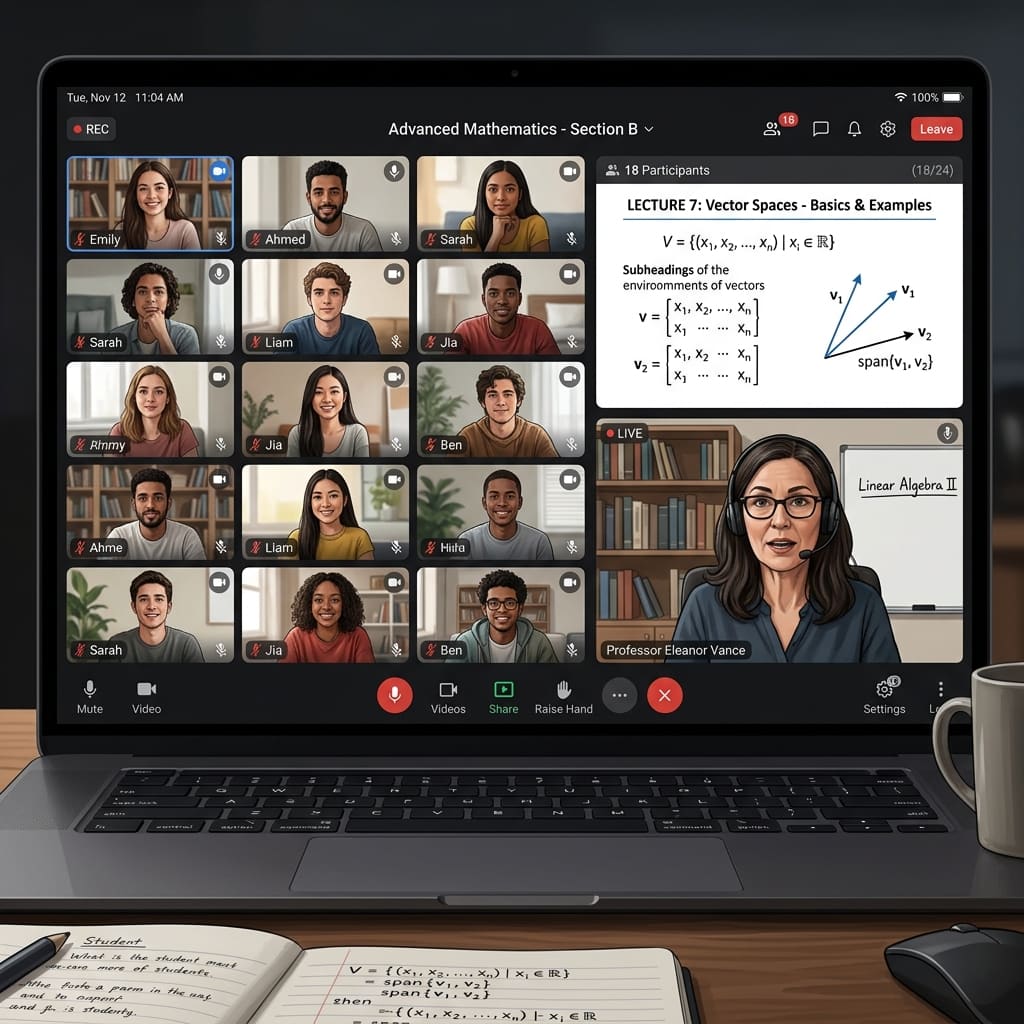
How to teach live classes online: setup, structure and keeping students engaged
Clear sound, a session plan that keeps students doing something, a way for them to respond, and a record of who came. The practical setup for teaching live online, with a pre-class checklist.
Read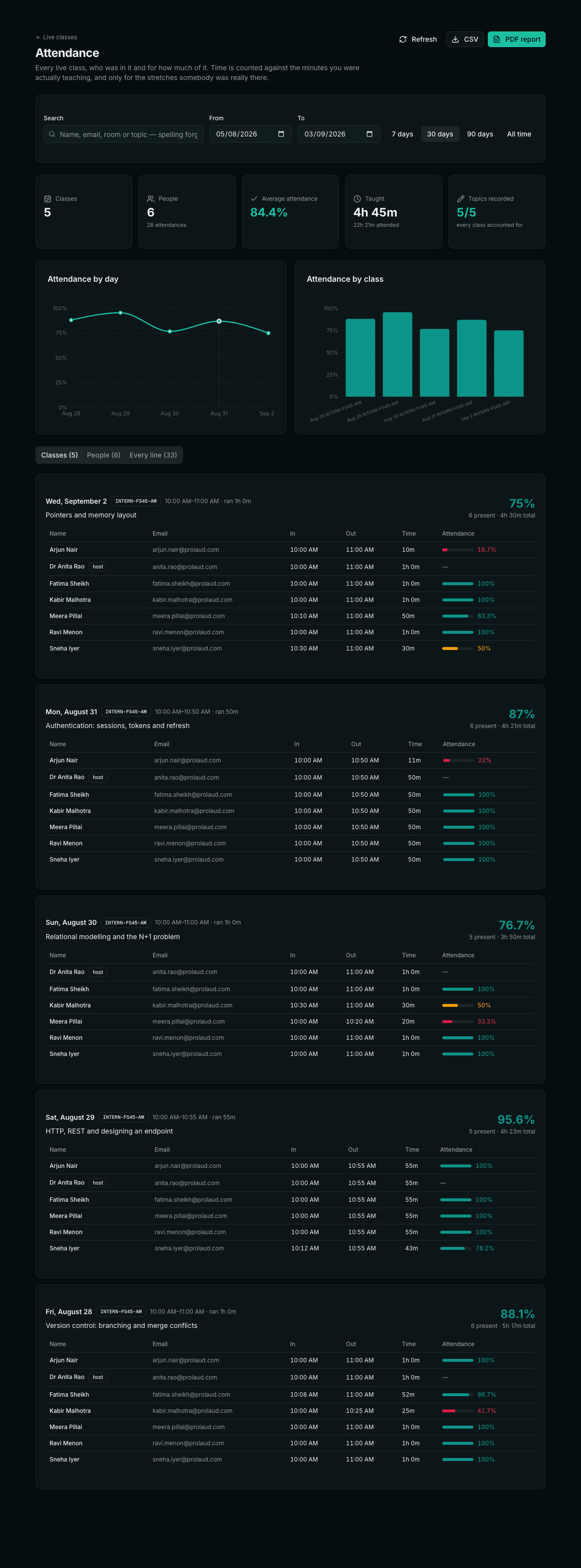
Live class attendance, measured honestly
A join-to-leave span is not attendance, and the scheduled hour is not the denominator. What an honest live-class register actually measures — and why what you taught belongs on the same row.
Read
How to Improve Student Retention in Online Courses
Completion is the metric nobody brags about — because most courses have terrible numbers. Here's why students quit, and the levers that actually get them to the finish line.
Read
Online Course Completion Rates: How to Measure and Improve Them
Completion rate is the metric most creators never measure — and the one that quietly decides reviews, refunds and referrals. Here's what's good, how to measure it, and how to lift it.
Read