How to Get Students to Come Back and Finish an Online Course
Most people who buy an online course never finish it. Here's why they drop off, how to measure your completion rate honestly, and the features and habits that bring students back every week.
The short answer
Students return and finish when every visit has an obvious next step and something to show for it. The features that do that are progress tracking with a clear next lesson and a saved place; reminders that reach students in-app, by email and on WhatsApp; short lessons; quizzes with instant feedback; streaks and points for learning; milestones that end in a certificate; and other people to learn with, through a community and live classes. Prolaud, which publishes this guide, builds these into one academy: XP for lessons, live classes, quizzes and challenge check-ins, with levels, streaks, weekly quests, badges and a leaderboard; 5- to 30-day community challenges with daily check-ins and a certificate for finishers; a community wall with chat and direct messages; live classes whose attendance lands on the student's record; and verified certificates, at 0% commission on sales. Of all of them, community moves completion most.

Here's a number the course industry doesn't put on its sales pages: most people who buy an online course never finish it. They start with the best intentions, hit a busy week, lose momentum, and the course quietly joins the graveyard of half-watched tabs. It's not because the content was bad. It's because finishing a course alone, on your own willpower, is genuinely hard.
This matters far more than creators realise. Students who finish get results; students who get results leave reviews, refer friends, and buy your next thing. Students who quit refund, stay silent, and never come back. Retention isn't a soft metric — it's the difference between a course that builds a business and one that leaks customers out the back. This guide covers both halves of the problem: why students drop off and the levers that hold them, and how to measure your completion rate so you know whether the levers worked.
The screenshots below are from Brush & Clay Studio, a fictional demo watercolour academy we built on Prolaud, so you can see what each feature looks like to a student and a teacher. The advice applies whatever platform you use.
What a course completion rate is, and how to calculate it
Your completion rate is the share of enrolled learners who finish the course: completions ÷ enrolments × 100. Decide upfront what 'finish' means for you — watching the last lesson, passing a final quiz, or submitting a final project — and measure consistently against that definition. It matters more than it sounds: 'reached the last lesson' and 'passed the final assessment' can give very different numbers, so pick one and stick to it.
Retention is the wider idea. Completion is the finish line; retention is everything that keeps a student coming back between enrolment and that line. A course can have students who log in weekly for two months and still never finish, which is a retention win and a completion problem. You want both numbers, because they tell you different things.
What a good completion rate looks like
There's no single benchmark worth quoting: published figures vary enormously with how 'finish' is defined, how the course was priced, and who was counted. What holds up across formats is the order. Free self-paced courses complete worst, paid self-paced courses do better, adding a community lifts completion further, and live cohorts — with their shared schedule and accountability — complete best of all.
That order is the useful part, because every step up it is a design choice rather than better videos. The best benchmark you have is your own: measure your current rate, change one thing, and measure the next intake against it.
Why paid courses complete better than free ones
People finish what they pay for. A free course costs nothing to abandon, so it's abandoned freely — there's no sunk cost and no consequence to quitting. A paid course, even a modestly priced one, carries a psychological weight: the learner has invested, so they're motivated to get their money's worth.
The lesson isn't 'never offer anything free' — free workshops and intro lessons are great top-of-funnel tools. It's that if completion (and therefore results, reviews and referrals) matters to you, charging even a small amount changes behaviour, and it compounds with every other lever below. Price is itself a retention lever — see how much to charge.
Why students don't finish
Before fixing retention, understand the leak. Students rarely quit because the course is bad — they quit because of how solo, self-paced learning works against human nature.
- Isolation. Learning alone, nobody notices if you stop — so stopping is easy.
- No deadlines. "Whenever you like" quietly becomes never.
- The messy middle. The early excitement fades and the finish feels far away.
- Stuck and silent. Hit a hard concept with no one to ask, and many just give up.
- No visible progress. Without a sense of moving forward, motivation drains.
Notice the pattern: almost none of these are about content quality. They're about environment and accountability — which means they're fixable with design, not just better videos.
Lever 1 — Community (the biggest one)
The single most powerful retention lever is community. A learner who feels part of a group — who can ask a doubt, see others' progress, and celebrate a win — keeps going when a solo learner quits. Isolation is the main cause of drop-off, and community is its direct antidote.
Build a community around your course where students introduce themselves, ask questions, and share wins, and you change the basic experience from "me alone with some videos" to "us, doing this together." That belonging is what pulls people through the messy middle. It's why cohort courses, which are communities by design, finish so much better than solo self-paced ones.
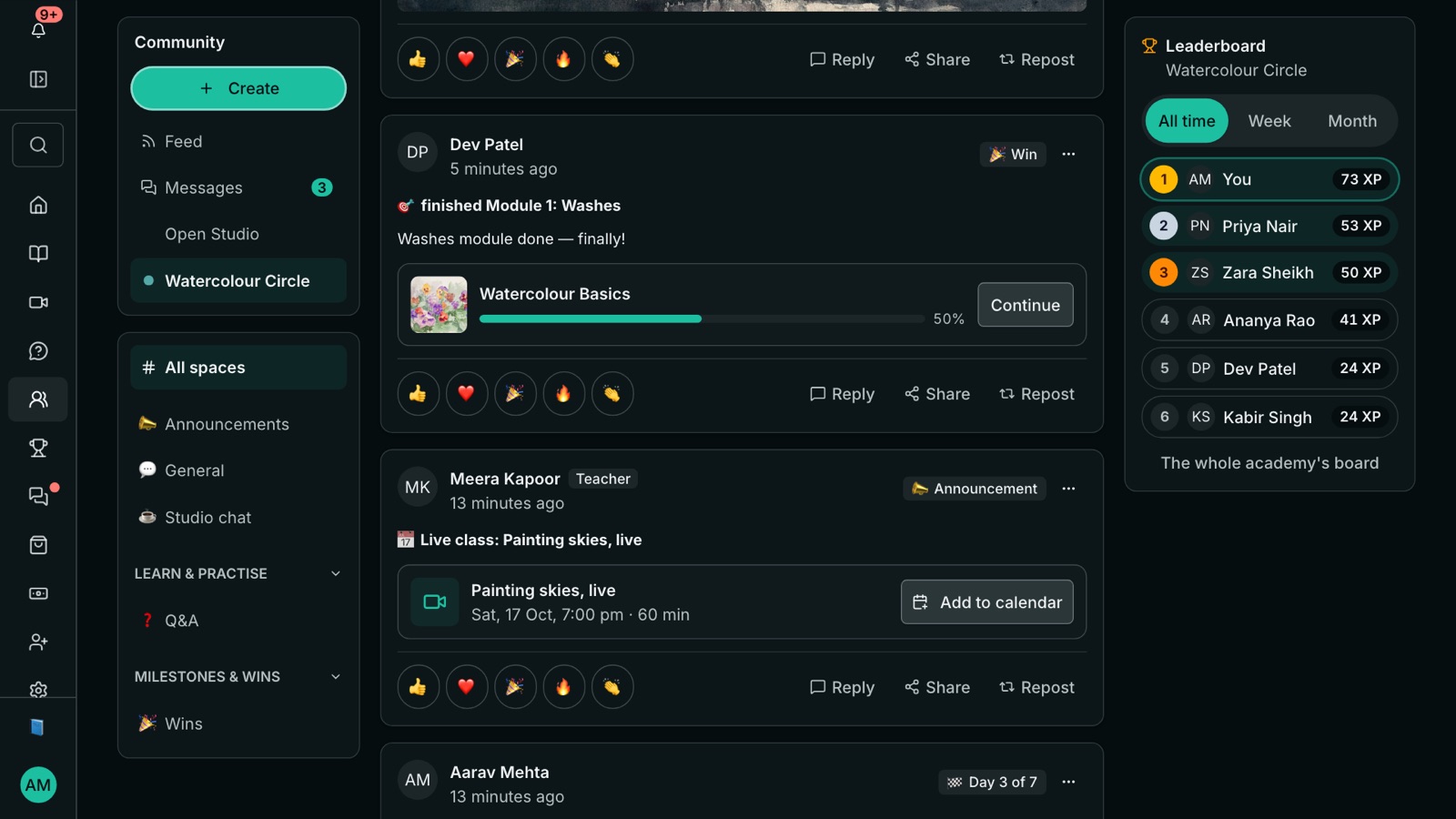
Look at what the feed above is doing for retention without anyone writing a nudge: a classmate's finished module is a reminder that finishing is possible, the course card under it is a one-click way back to your own next lesson, and the class announcement gives a reason to come back on Saturday.
Lever 2 — Deadlines and structure
"Learn at your own pace" sounds kind but is often a retention killer, because total freedom removes the gentle pressure that gets things done. Add structure: a suggested schedule, weekly milestones, or — most powerfully — a cohort where everyone moves together on a calendar.
Even in a self-paced course you can build in deadlines: drip content weekly so it doesn't feel like an overwhelming pile, set target dates, and send nudges when a learner falls behind. A deadline shared with others is the strongest of all, which is the whole reason cohorts work — but even a self-imposed, reminded deadline beats an open-ended "someday."
Lever 3 — Live touchpoints
A live session is a commitment device. Knowing there's a class on Wednesday — where the teacher is present and questions get answered in real time — gives learners a reason to keep up and a place to get unstuck. Even occasional live Q&As in an otherwise self-paced course lift engagement, because they turn a static product into a relationship.
Live also solves the "stuck and silent" problem directly: the moment a learner can ask and get answered, the wall that would have ended their course becomes a step they climb. If your model allows it, a weekly or fortnightly live class is one of the highest-leverage retention investments you can make — and if attendance is recorded against each student, a missed class becomes an early warning rather than something you discover at renewal. More on that in live class attendance tracking.
Lever 4 — Visible progress and quizzes
Motivation feeds on a sense of movement. Make progress visible — a progress bar, completed-lesson ticks, a streak — and learners feel themselves advancing, which pulls them onward. Quizzes and small assignments after each module do double duty: they check understanding and they create little wins that mark progress.
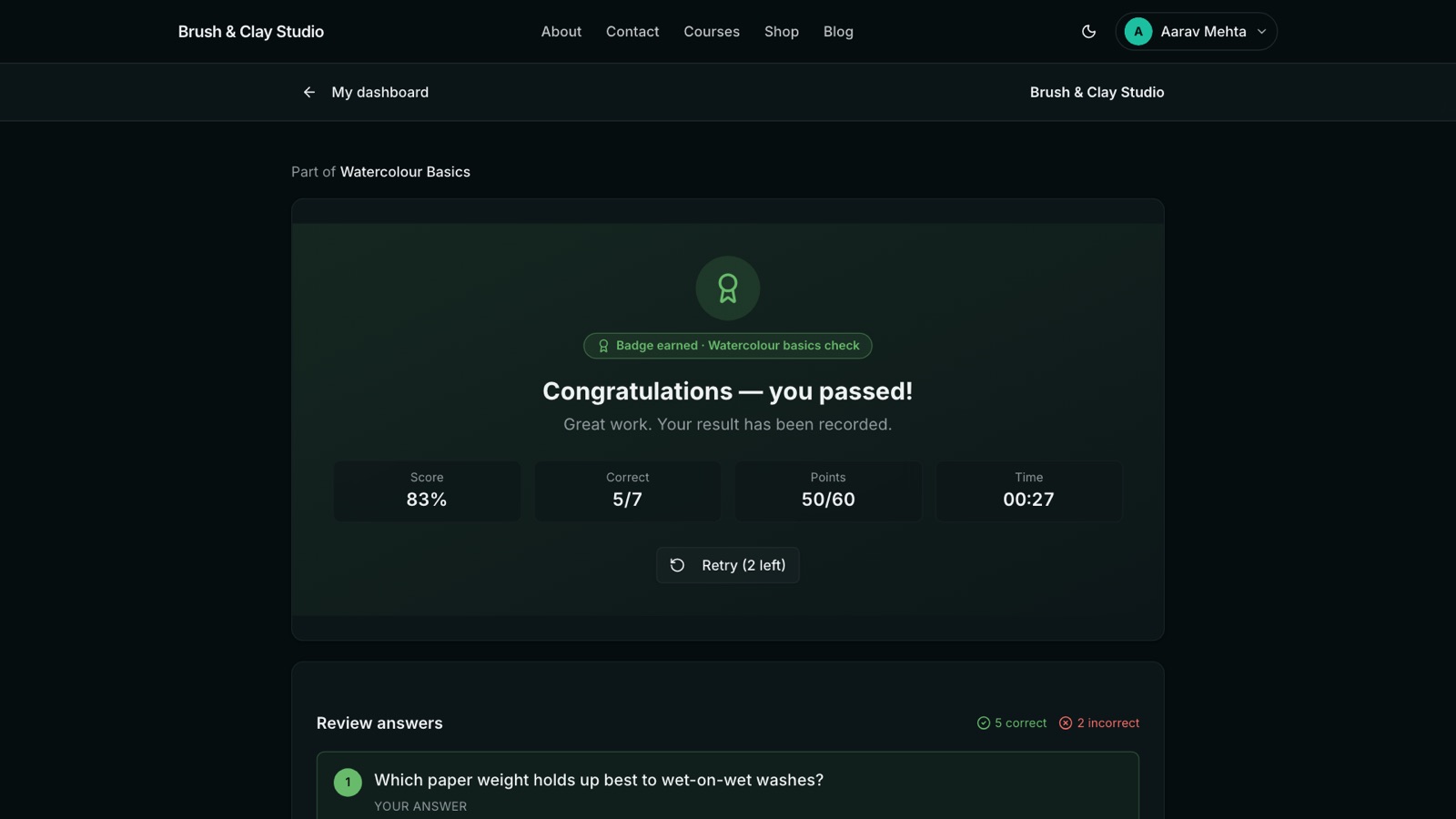
Gentle gamification helps here too: points, badges and a leaderboard, used lightly, turn progress into something satisfying without feeling cynical. The design choice that matters is *what earns the points*. Points for posting reward the loudest students; points for finishing lessons, attending class and passing quizzes reward the ones who are actually learning.
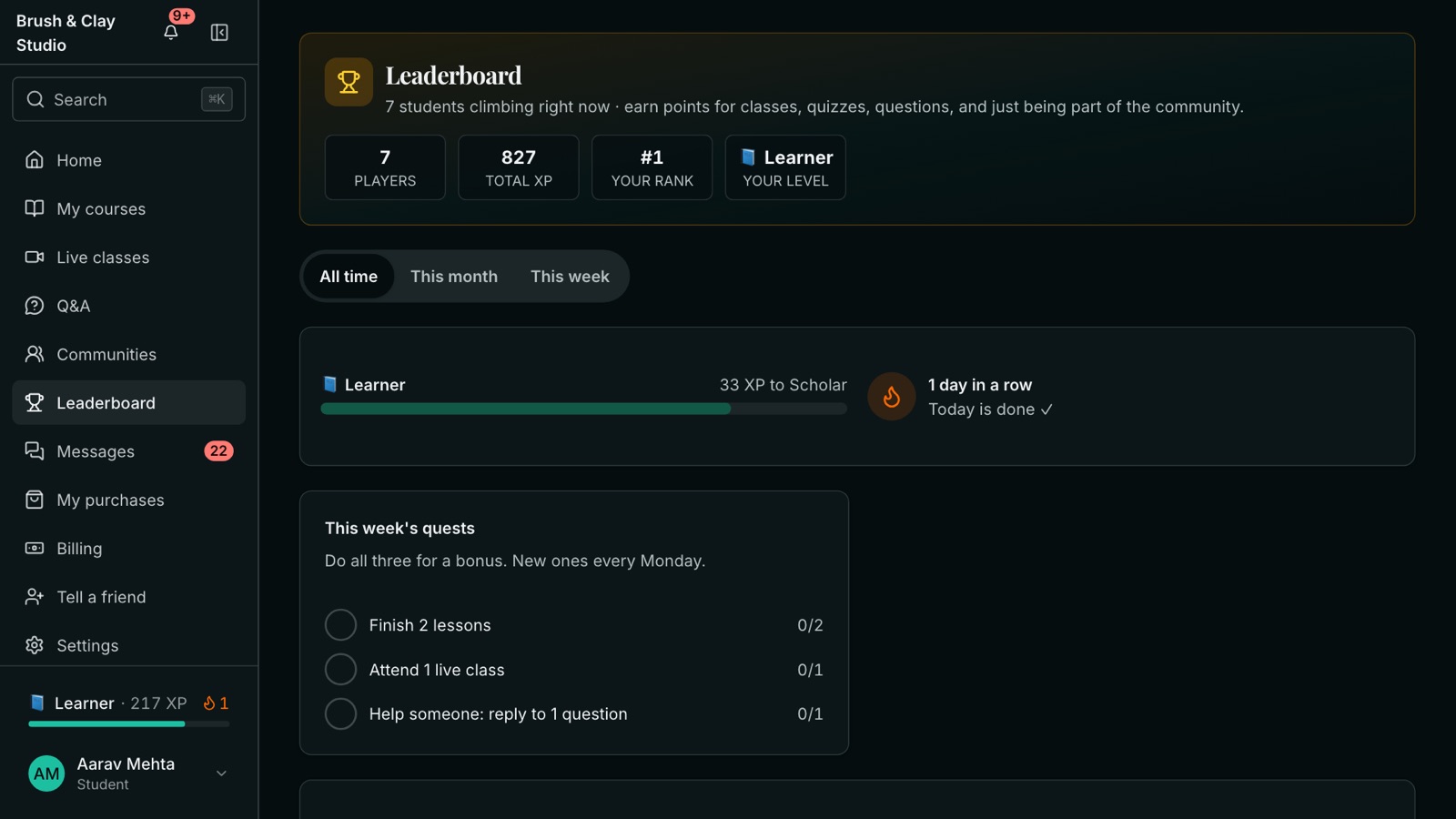
Weekly quests are a quiet retention device. Each one is a small, specific reason to come back this week — finish two lessons, attend one class, help someone — and they reset every Monday, so a student who missed last week isn't stuck behind.
Lever 5 — A finish line worth crossing
People work toward a goal they can see. A certificate at the end — verifiable, shareable, worth putting on LinkedIn — gives learners a concrete reason to reach the finish, and doubles as your marketing when they show it off. A final project, a demo day, or a graduation moment does the same: it turns "watch some videos" into "complete something and have proof."
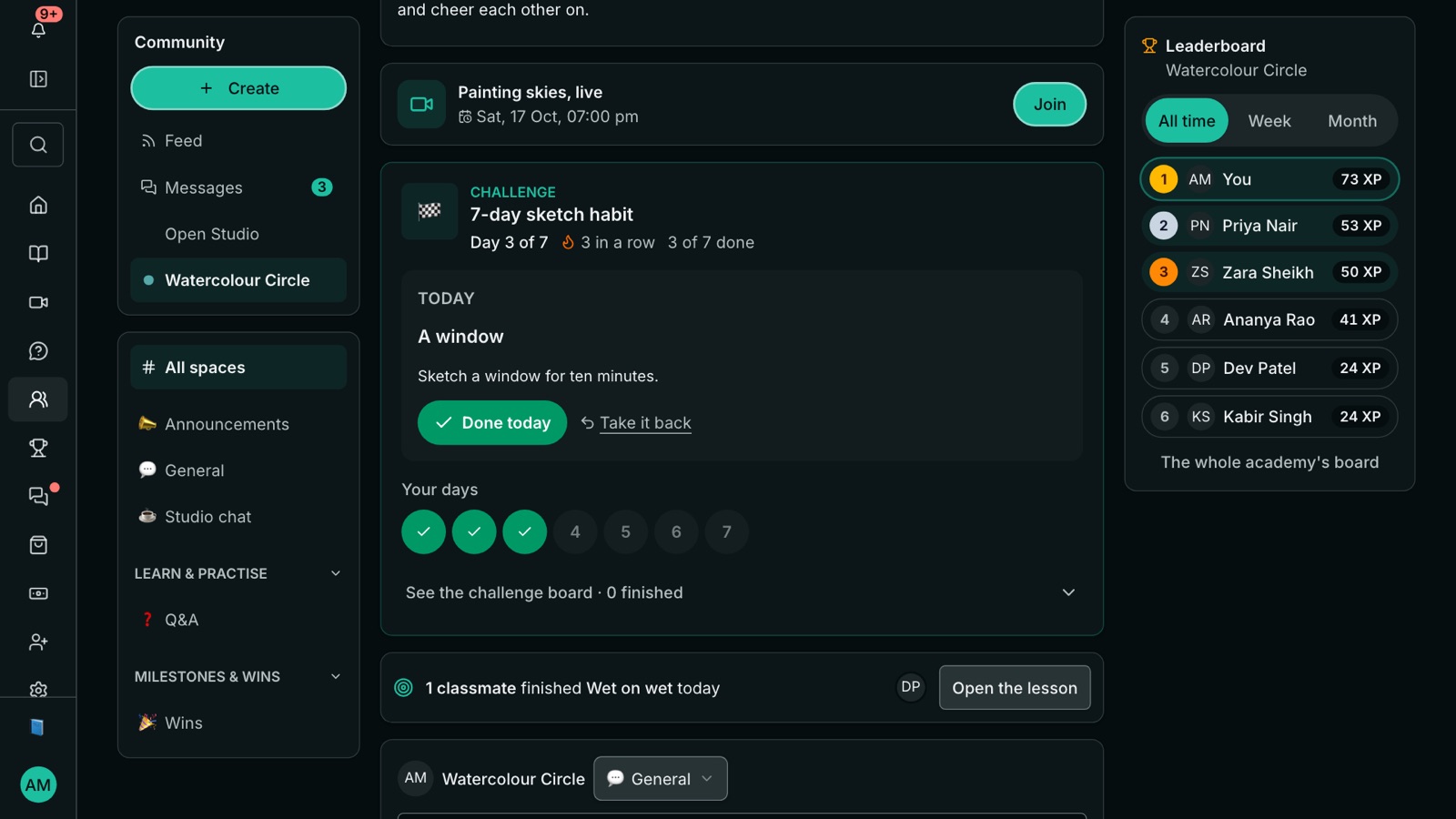
Short finish lines help long courses. A 7-day or 30-day challenge inside the community — one small task a day, checked off, with a certificate for those who complete it — gives students a win they can reach this week, not in three months. See how to run a community challenge.
The finish line also creates a natural celebration point, which is exactly when a happy student is most likely to leave a review or refer a friend. Design the ending deliberately; it's where retention turns into growth.
Lever 6 — Nudges across the right channels
Sometimes a learner just needs a tap on the shoulder. A well-timed nudge — "you're halfway, keep going!" or "you haven't logged in this week" — rescues people drifting toward the drop-off. The key is reaching them where they'll actually see it: in India, a message across in-app, email and WhatsApp together lands far better than a lone email that gets buried. Automate these so they fire at the right moments without you watching every student.
The features that bring students back: a checklist
If you're choosing a platform, or auditing the one you have, this is the list to check against. Each feature maps to one of the drop-off causes above; a platform that's missing several will leave you patching the gaps by hand.
| Feature | Why it brings students back | What to check |
|---|---|---|
| Progress + a clear next lesson | Removes the 'where was I?' decision every visit | A Continue button that resumes at the saved place |
| Reminders | Catches students before a missed week becomes a missed month | Reaches students in-app, by email and on WhatsApp, not email alone |
| Short lessons | Fits learning into a busy day | Lesson length shown up front |
| Quizzes with instant feedback | Turns watching into doing, and marks progress | Score and answers shown straight after submitting |
| Streaks, points, badges | Makes coming back today feel worth it | Points for lessons, classes and quizzes — not only posts |
| Milestones + certificates | Gives a finish line to aim for | Certificates with a public verification page |
| Community + messaging | Fixes isolation, the biggest cause of drop-off | Spaces, replies, direct messages, teacher moderation |
| Live classes | A weekly appointment and a place to get unstuck | Attendance recorded against each student |
| Engagement insights | Shows you who has gone quiet while there's still time | A view of inactive students, not just totals |
Prolaud, which publishes this guide, covers the list in one academy: XP for lessons, live classes, quizzes and challenge check-ins with levels, streaks, weekly quests, badges and a leaderboard; community spaces with chat and direct messages; challenges with daily check-ins and finisher certificates; live classes in the browser with attendance on each student's record; quizzes with instant results; and certificates with a public verification page. Whatever you choose, the point is that these work together — a leaderboard with no community to see it, or a certificate at the end of a course nobody reaches, does little on its own.
Putting it together: a retention system
Individually these levers help; together they compound into a course people actually finish. The strongest setup wraps content in a community, paces it with deadlines (ideally a cohort), punctuates it with live touchpoints, makes progress visible with quizzes, ends with a certificate, and nudges drifters back across multiple channels. None of it is about making better videos — it's about building an environment where finishing is the path of least resistance.
| Drop-off cause | The lever that fixes it |
|---|---|
| Isolation | Community |
| No deadlines | Structure / cohorts / drip |
| Stuck and silent | Live sessions + community |
| No visible progress | Quizzes, progress bars, gamification |
| No reason to finish | Certificates, projects, a finish line |
| Drifting away | Multi-channel nudges |
Quick wins vs structural changes
Some levers you can switch on this week; others reshape the course. Do the quick wins first, then invest in the structural ones.
| Quick wins (this week) | Structural (next version) |
|---|---|
| Turn on progress bars + a certificate | Add a community space |
| Set up reminder messages on more than one channel | Move from self-paced to a cohort |
| Shorten the worst drop-off lesson | Add weekly live sessions |
| Improve the first lesson (an early win) | Redesign the onboarding flow |
Onboarding: the first week decides everything
Retention is won or lost faster than most creators think — often in the first few days. A learner who has a good first session (gets a quick win, feels welcomed, understands what to do next) builds momentum that carries them through the hard middle. A learner who hits confusion or silence in week one quietly drifts and rarely comes back. So front-load your effort: make the start brilliant.
- Welcome them personally — even a short message by name signals a real place with real people.
- Engineer an early win — make the first lesson deliver something useful and finishable in one sitting.
- Make the next step obvious — never leave a new learner wondering what to do now.
- Get them into the community immediately — an introduction in week one turns a stranger into a member.
- Check in after a few days — a nudge to anyone who hasn't started catches drift before it sets.
Think of onboarding as a separate mini-job from the course itself. The content can be excellent, but if the first week is confusing or lonely, most learners never reach it. Nail the start and you've already won half the retention battle.
Measuring retention and completion: the numbers to watch
You can't improve what you don't measure, and a single headline number hides the story. Measure completion, then break it down to find where to act.
- Completion rate — the headline number; what share of enrolled learners finish, against your fixed definition of 'finish'.
- Drop-off points — the specific lessons where people stop, which tell you what to fix or shorten.
- Activation — what share start within the first few days (your onboarding's report card).
- Weekly active learners — is engagement holding or fading over the course's length?
- Time to complete — how long finishers take, which tells you whether your pacing is realistic.
- Community participation — lurking vs posting; active members retain far better.
- By cohort or batch — so you can see whether a change actually moved the number.
The drop-off points are gold. If most learners quit at the same lesson, that lesson is too long, too hard, or unclear — a precise, fixable problem rather than a vague 'people don't finish.' Measurement turns retention from a mystery into a to-do list.
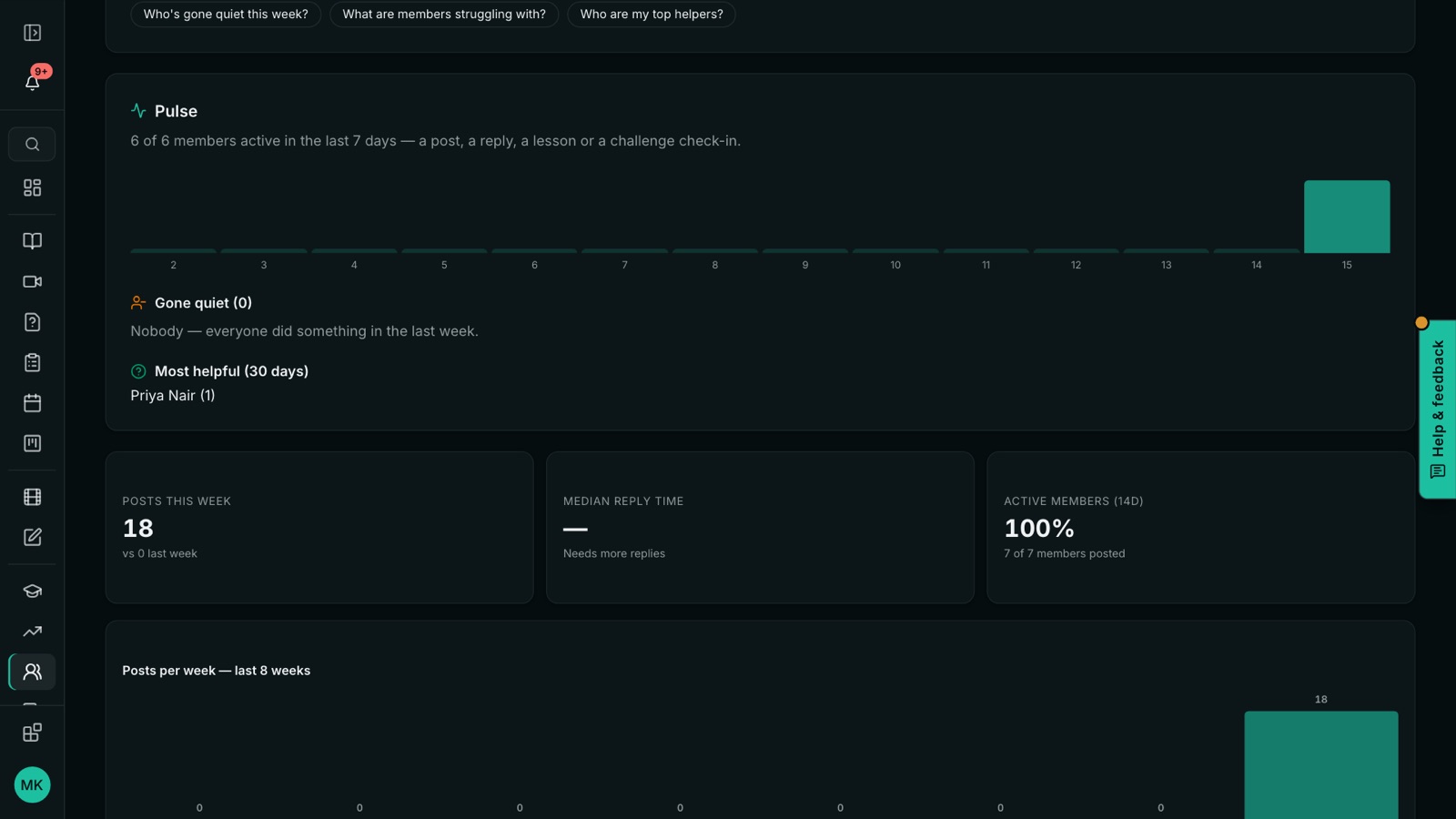
The most useful list on a screen like that is the short one: who has gone quiet. A student who posted, attended or checked in last week and has done nothing since is the one to message today — while a nudge can still bring them back.
Did it work? Measuring your changes
Treat completion like a dial you turn, not a hope you hold. After each change — a new community, a deadline, a better onboarding email — compare completion and weekly-active numbers for the next cohort against the last. If the drop-off at a specific lesson disappears after you shortened it, you've proven the fix. Change one major thing at a time where you can, so you know what moved the number, and keep a running record from one intake to the next. That feedback loop is what steadily turns a course most people abandon into one most people finish.
Self-paced vs cohort: the biggest single decision
If completion is your priority, format is your biggest single decision. Self-paced maximises reach and convenience but completes poorly without strong supporting levers; cohorts complete far better because accountability and community are built into the format. The best of both: offer a self-paced tier wrapped in a community, reminders and challenges, and a cohort tier for those who want the structure — and steer learners who need accountability toward the cohort.
Common retention and completion mistakes
- Never measuring completion at all, so there's nothing to improve against.
- Responding to low completion by adding more content (the problem is rarely content).
- Selling 'learn at your own pace' as a feature when it's a retention risk.
- No community, so learners are isolated by default.
- Ignoring the specific lessons where learners drop off.
- No finish line, so there's nothing to work toward.
- Relying on a single buried email for nudges instead of multiple channels.
Your retention checklist
- Define 'complete' and measure your baseline completion rate.
- Find your drop-off points and fix the worst lessons.
- Add a community so no one learns alone.
- Pace the course with deadlines, drip or a cohort.
- Add live touchpoints, even occasional Q&As.
- Make progress visible with quizzes, a progress bar and points for learning.
- End with a certificate or project worth reaching — and add short challenges along the way.
- Automate multi-channel nudges for drifting learners.
- Re-measure each cohort to confirm the changes work.
Build a course students actually finish
Community, challenges, live classes, quizzes, XP and verified certificates in one India-first academy, with 0% commission on your sales. 14-day trial, no card.
Start your 14-day trial
Renu Rawat
Founder of prolaud.com. Helping teachers and creators build profitable, independent learning businesses without losing a cut of every sale to platform fees.
About the founderFrequently asked questions
- What features help students return regularly and complete an online course?
- The ones that give every visit an obvious next step and something to show for it: progress tracking with a Continue button that resumes where the student left off; reminders on more than one channel (in-app, email, WhatsApp); short lessons; quizzes with instant feedback; streaks, points and badges for learning; milestones and a certificate at the end; and other people to learn with, through a community and live classes. Community moves completion most; the rest compound it.
- Why don't students finish online courses?
- Rarely because the content is bad — usually because solo, self-paced learning works against human nature. The main causes are isolation (nobody notices if you stop), no deadlines ("whenever" becomes never), getting stuck with no one to ask, the motivation dip in the messy middle, and no visible sense of progress. Because these are about environment and accountability rather than content, they're fixable with design — community, deadlines, live touchpoints, visible progress and a finish line.
- How do I calculate my course completion rate?
- Divide the number of learners who finished by the number who enrolled, and multiply by 100. First decide what 'finish' means for you — reaching the last lesson, passing a final quiz, or submitting a final project — and measure consistently against that definition, since 'reached the last lesson' and 'passed the assessment' can give very different numbers. Track it over time and break it down by cohort to see whether changes move it.
- What is a good online course completion rate?
- There's no single benchmark worth trusting — published figures vary widely with how 'finish' is defined and how the course was priced. What holds up is the order: free self-paced courses complete worst, paid self-paced do better, adding a community lifts completion further, and live cohorts complete best. Use your own current rate as the benchmark, change one thing, and measure the next intake against it.
- How do I improve course completion rates?
- Stack the proven levers: add a community so no one learns alone (the biggest lever), pace the course with deadlines, drip or a cohort, add live touchpoints so learners can get unstuck, make progress visible with quizzes and a progress bar, end with a certificate or project worth reaching, and automate nudges across in-app, email and WhatsApp for drifting learners. Together these change the experience so finishing becomes the path of least resistance.
- What is the single biggest factor in student retention?
- Community. Isolation is the main reason learners quit, and a community is its direct antidote — when students can ask doubts, see others' progress and celebrate wins, they keep going where a solo learner gives up. It's the core reason cohort courses, which are communities by design, finish at far higher rates than solo self-paced ones.
- How do I find where students drop off in my course?
- Track completion lesson by lesson and look for the points where a large share of learners stop — most platforms with progress tracking show this. Those drop-off points are precise, fixable problems: a lesson where most learners quit is likely too long, too hard, or unclear. Shorten it, clarify it, or add support there, then re-measure.
- Does cohort-based learning improve retention?
- Significantly. Cohorts build in the two strongest retention levers — community and shared deadlines — by design: everyone starts together, moves on a schedule, and has a group experiencing it with them. That accountability and belonging is why cohorts complete at far higher rates than self-paced courses. If retention is your goal, a cohort or at least a strong community is the highest-leverage choice.
- Do paid courses have higher completion rates than free ones?
- Yes, reliably. People finish what they pay for — a free course costs nothing to abandon, while even a modestly priced course carries a psychological weight that motivates learners to get their money's worth. The lesson isn't to never offer anything free (free workshops are great top-of-funnel tools) but that, if completion matters, charging even a small amount changes behaviour — and it compounds with community, deadlines and a finish line.
- How do certificates help retention?
- A verifiable, shareable certificate gives learners a concrete goal to work toward — a finish line they can see and a reason to push through the middle. It also creates a natural celebration moment at completion, which is exactly when a happy student is most likely to leave a review or refer a friend. Short challenges with their own certificate give the same pull on a weekly scale.
- Should I make my course self-paced or scheduled for better retention?
- Scheduled structure almost always retains better, because total freedom removes the gentle pressure that gets things done — 'learn at your own pace' often becomes 'never finish.' A cohort with a shared schedule is strongest, but even a self-paced course retains better with built-in deadlines, weekly drip and nudges. If you offer self-paced for flexibility, add structure on top rather than leaving it completely open-ended.
- How do I re-engage students who've stopped?
- Reach them with a well-timed nudge where they'll actually see it. A message like 'you're halfway, keep going!' or 'you haven't logged in this week' rescues many drifting learners — and in India, sending across in-app, email and WhatsApp together lands far better than a single email that gets buried. Automate these nudges to fire at key moments (after a gap, at the halfway point), and check a 'gone quiet' list weekly for the ones worth a personal message.
- How do I know whether my completion changes are working?
- Run a before-and-after. Compare the completion rate and weekly-active numbers of the cohort after a change against the one before it, and watch specific drop-off points — if the drop at a lesson disappears after you shortened it, you've proven the fix. Change one major thing at a time where you can, and keep a running record from intake to intake. Quick wins like progress bars, a certificate and reminders can show within a cohort; structural changes like a community or a move to cohorts show their full effect over the next intake.
- Does adding more content improve retention?
- Usually no — and it can make things worse. Low completion is rarely a content problem; it's an environment and accountability problem. Piling on more lessons makes the course feel longer and more daunting, deepening the drop-off. Instead of more content, add community, deadlines, live touchpoints, visible progress and a finish line — the levers that address why students actually quit.
Keep reading

How to Build a Community Around Your Online Course (2026)
The lonely learner quits. The one who feels part of something finishes, gets results and brings a friend. Here's how to build the community that makes that happen.
Read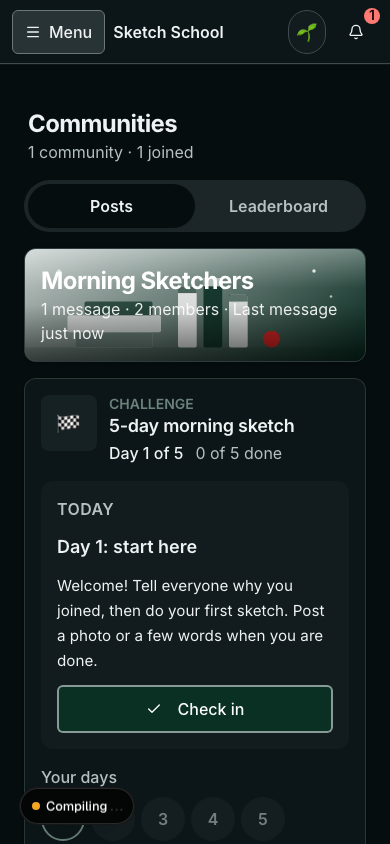
How to run a 21-day community challenge that people finish (template inside)
A good challenge turns a quiet community into the place your students check every day. A weak one goes silent in the second week. The difference is design: one outcome, small daily tasks, proof people can see, a plan for the dip, and a finish line worth reaching. A full 21-day template is inside.
Read
Cohort-Based Learning, Explained — and When It Beats Self-Paced
Self-paced courses get finished by a tiny fraction of buyers. Cohorts — same start date, live, together — flip that. Here's how they work and when to run one.
Read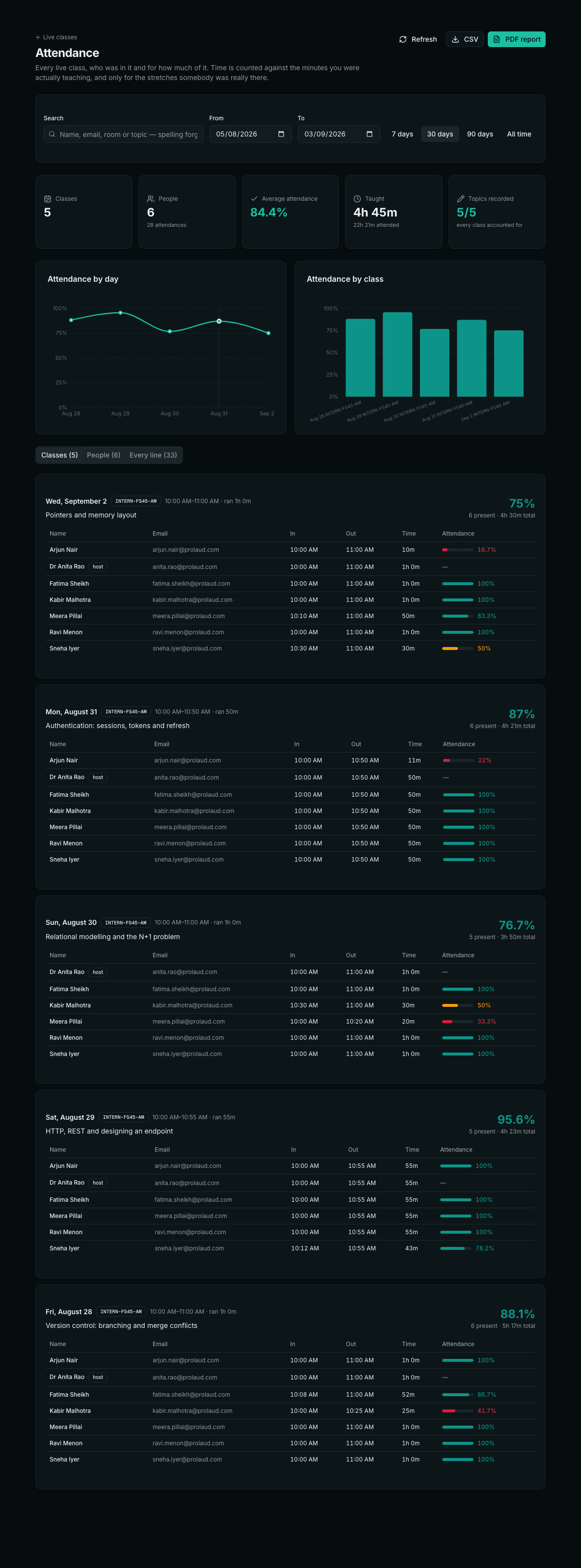
Live class attendance, measured honestly
A join-to-leave span is not attendance, and the scheduled hour is not the denominator. What an honest live-class register actually measures — and why what you taught belongs on the same row.
Read