Are online courses still worth it in 2026, or is the market saturated? What the numbers actually say
The market isn't dead and it isn't booming. It's splitting: generic, cheap information courses are losing ground, while courses that give students access, accountability and a specific result are not.
The short answer
Yes, online courses are still worth creating in 2026, but only certain kinds, and the evidence we at Prolaud find most reliable shows the split clearly. Cheap, generic, self-paced information is under pressure: Udemy's consumer revenue fell 9% in 2025 even as its consumer subscriptions grew 44%, and Pew found 26% of US adults have already used ChatGPT to learn something new, which makes plain explanation nearly free. The independent-creator market is steady rather than collapsing: Thinkific reported creator sales flat at $460 million for 2025, and Coursera's revenue grew 9%. What still earns a price is what a chatbot or a library can't give: live teaching with feedback, a cohort with deadlines, a community, and a specific result for a specific person. Completion research agrees on commitment: in Harvard and MIT's edX courses in 2017 to 2018, learners who paid for the verified track finished about 15 times as often as all participants (46% against 3%).
"Is the online course market saturated?" is a fair question to ask before you spend months on a course. It is also a question most answers dodge, either with a market-size forecast in the hundreds of billions or with an anecdote about someone who made a fortune. Neither tells you whether your course is worth making.
This article uses the evidence that holds up best: audited results from public companies that sell courses, peer-reviewed research on completion, and large surveys from Pew Research Center. Where there is no good evidence, it says so. A note on bias: we build Prolaud, a course platform with live classes and community built in, so we benefit if you decide courses are worth it, and especially if you choose live or cohort formats. Read the numbers with that in mind; they are all sourced so you can check them.
Is the online course market saturated?
Part of it is. The clearest public evidence comes from companies that must report audited results. Here is what three of them reported for 2025.
| Company and metric (FY2025) | Result | What it suggests |
|---|---|---|
| Udemy consumer segment revenue (individual learners) | $265.8M, down 9% from $292.1M; Q4 down 14% | Individual-learner revenue at a major marketplace is shrinking, even as its subscriptions grow |
| Udemy consumer subscription revenue | $44.5M, up 44%; paid consumer subscribers up 102% to 343,000 | Buyers who stay are moving to all-you-can-learn libraries |
| Udemy Business (enterprise) revenue | Up 6%; Udemy's total revenue flat at $789.8M | Employers are still buying training |
| Coursera revenue | $757.5M, up 9%; Consumer $502.2M, up 10%; Enterprise $255.3M, up 7% | Credential-led learning from known institutions is growing |
| Thinkific gross merchandise volume (what creators on Thinkific sold to their students) | $460.0M, flat year over year; Q4 $117.3M, about 2% higher | Independent-creator sales on one major platform are steady, not collapsing |
Read those numbers carefully, because they're easy to over-read in either direction. Udemy itself attributes part of its consumer decline to a deliberate shift toward subscriptions, so the 9% fall is not proof that people stopped buying courses. It is good evidence that the old model, a marketplace selling individual low-priced courses to strangers, is under pressure. Meanwhile Thinkific's flat GMV is probably the most honest single number for the independent-creator market: not booming, not dying.
There's one more signal of a market changing shape. In December 2025, Coursera and Udemy announced an all-stock deal to combine, with a combined implied equity value of about $2.5 billion, expected to close in the second half of 2026, subject to approvals. As of this writing we haven't confirmed whether it has closed, so we don't say either way; the point here is that two of the best-known course marketplaces chose consolidation, which is what mature, slower-growing markets do.
Why don't the big market-size forecasts settle it?
You'll often see a line like "e-learning will be worth $X billion by 2030" offered as proof that courses are a growth market. The forecasts disagree too much to prove anything. Here are five published estimates for 2030, all from paywalled market-research press releases.
| Firm | What it calls the market | 2030 estimate |
|---|---|---|
| Global Industry Analysts | E-learning | $764.1B |
| Mordor Intelligence | E-learning | $419.31B |
| Skyquest | Online education | $175.22B |
| MarketsandMarkets | Digital education | $95.70B |
| ResearchAndMarkets | MOOCs | $60.864B |
Even the most rigorous of these would answer a different question. A market sized in the hundreds of billions would include corporate compliance training, university degrees and software. It would tell you nothing about whether a fitness coach or a test-prep tutor can sell a $300 course. For that question, the audited platform numbers above and your own two-week test are worth more than any forecast.
What is saturated, and what isn't?
Putting the evidence together, the market looks less saturated than split. The table separates what the data directly supports from what is our reasoning, so you can weigh each row.
| Type of course | Pressure in 2026 | Evidence behind that |
|---|---|---|
| Generic, low-priced self-paced information ("Intro to X") | High | Direct: Udemy's consumer revenue down 9% as it shifts to subscriptions; Pew's 26% learning with ChatGPT. Big-brand versions dominate Coursera's most-popular list |
| Credential-backed programs from known institutions | Growing, but not where independents compete | Direct: Coursera revenue up 9%; Coursera reported Professional Certificate enrollments up 91% on average among its enterprise learners |
| AI skills tied to a specific tool and job | Strong demand, crowding fast at the intro level | Direct (enterprise only): Udemy's report shows GitHub Copilot training up more than 13,000%; Coursera's enterprise GenAI enrollments up 234% |
| Live courses with feedback, and cohorts with deadlines | Low | Indirect: paying, committed learners complete far more often (see below). No direct sales data exists |
| Courses with community and accountability | Low | Reasoning, plus weak vendor survey data we don't rely on |
| A specific result for a specific person ("Interview English for nurses") | Low | Reasoning: fewer alternatives exist, and a free general answer doesn't replace a tailored path |
The honest summary: if your plan is to record a general course, price it low and list it where millions of other courses live, the evidence says you are walking into the part of the market that is shrinking. If your plan is to teach a defined group to a defined result, with you involved, there is no evidence of saturation and some evidence that this is where committed learners are. For help narrowing an idea, see the most profitable online course topics, which covers where demand data points and how to niche down.
What does completion-rate research actually say?
Completion matters to a course creator for a practical reason: students who finish get results, write reviews and buy again. The best large-scale evidence is about free courses, and it is sobering.
Reich and Ruipérez-Valiente, writing in Science in 2019, analyzed every HarvardX and MITx course on edX up to May 2018: 565 course runs, 261 courses and 12.67 million registrations. Completion among all participants never rose above about 6% in any year and fell to 3.13% in 2017 to 2018. Among learners who said they intended to finish, 15.42% did that year. Among learners who paid for the verified certificate track, 46.02% did, and that figure ranged from about 44% to 56% across the five years studied. And 52% of registrants never opened the course materials at all.
| Group (HarvardX and MITx on edX, 2017 to 2018) | Completed |
|---|---|
| All participants | 3.13% |
| Learners who said they intended to complete | 15.42% |
| Learners who paid for the verified track | 46.02% |
Two limits before you use these numbers. They are old (2013 to 2018 data) and about free university courses, not about a paid course from an independent teacher. And the paid-versus-free gap is largely selection: the people who choose to pay were already more committed. So the lesson isn't "charge money and people finish". It is that committed buyers behave very differently from casual registrants, and a course designed for commitment serves the group that finishes.
Can clever reminders fix completion instead? Evidence says not much, at scale. Kizilcec and colleagues, in a 2020 study in PNAS, tested behavioral interventions across 247 HarvardX, MITx and Stanford courses with about 250,000 students. The effects were about an order of magnitude smaller than earlier small studies had found, and prompts to plan and self-regulate raised early engagement but not final completion. Automated nudges are not a substitute for real structure.
Two numbers you'll see that we don't use
You will read that "cohort courses get 85-90% completion". We found no peer-reviewed or methodology-backed source for that; it comes from vendor and founder marketing. You may also see Kajabi's 2025 survey of its own creators, which reported that creators who offer community features earn twice as much. That's a vendor's survey of its own customers, and it shows correlation, not cause. Both may point in a true direction. Neither is evidence.
So is a cohort or live course "proven" to beat self-paced? No. What we can say is that the strongest data shows commitment predicts completion, and live sessions, start dates, small groups and deadlines are ways of building commitment into the product. That's a design bet worth testing on your own students, with your own numbers. Our guide to getting students to finish covers the practical side.
Does AI make online courses pointless?
AI does two opposite things to the course market at once. It creates demand: Coursera's Job Skills Report 2026 calls generative AI its most in-demand skill ever, at 14 enrollments per minute, and Udemy's 2026 trends report, as reported from its press release, shows GitHub Copilot training up more than 13,000% among business learners. And it removes demand for courses that only explain things: Pew Research Center found in 2025 that 26% of US adults have used ChatGPT to learn something new, up from 8% in March 2023, and 46% of adults under 30 have.
If a reader can get your course's content by asking a chatbot good questions, your course is competing with something free and instant. If your course gives them things a chatbot can't, it isn't. Those things are:
- Correction on their actual work, from someone who knows the field: their essay, their code, their pronunciation, their form in a lift.
- A date and a group that keep them going when motivation drops.
- Judgment about what matters, in which order, for their situation, so they don't spend weeks on the wrong thing.
- A credential or proof that someone else will trust.
- Other people on the same path, to compare notes with and be seen by.
AI can also make a course cheaper to produce: drafting outlines, quiz questions and summaries. That lowers the cost of entry for everyone, which is one more reason the low end is crowding, and one more reason to compete on the parts that require you.
What are buyers paying for now?
Pulling the evidence together, here's what people still pay for, and how strongly the data backs each one.
| What buyers pay for | Supporting evidence | Strength |
|---|---|---|
| Skills for their current or next job | Udemy Business up 6%; Coursera enterprise up 7%; BLS projects fast growth in data, security and healthcare roles | Strong (enterprise and official data) |
| Recognized credentials | Coursera revenue up 9%; Professional Certificate enrollments up 91% among enterprise learners | Medium-strong |
| Access to a library at a monthly price | Udemy consumer subscribers up 102% to 343,000 | Strong, but this is a big-platform game |
| Live teaching, feedback, a cohort | Committed and paying learners complete far more often | Indirect |
| A specific result, sooner than they'd get alone | No public dataset | Test it yourself |
Notice the uncomfortable part: the rows with the strongest evidence describe markets where big platforms and institutions have the advantage. The rows where an independent teacher can win have the least public data, because nobody aggregates small creators' sales by format. That isn't a reason to avoid them. It's a reason to collect your own evidence before you invest heavily, which the next section turns into a decision.
Is creating a course worth it for you? A decision table
| Your situation | Is a course worth it? | What to do instead or first |
|---|---|---|
| You know a subject well and can name 20 people with the problem | Likely, if you sell an outcome | Sell a small paid live pilot before recording anything |
| You want passive income from a $29 general course on a marketplace | Probably not | That is the shrinking segment. Narrow the topic and add access to you |
| Your subject needs practice and correction (language, writing, music, coding, fitness form) | Yes, as live or cohort first | Run cohorts; turn recordings into a lower-priced self-paced version later |
| You teach a skill in a fast-growing career field | Promising | Target career-switchers with a portfolio or exam outcome; be clear you don't replace licensing |
| Your topic is how to make money (e-commerce, trading, coaching) | Risky | See the FTC section below before publishing any earnings figure |
| You already have a community or an audience that asks you questions | Yes | Ask them what they'd pay to solve; pre-sell to them first |
| You have no audience and no time to teach live | Hard right now | Build reach first with free teaching (a newsletter, videos, a free live class), then test |
Whatever row you're in, the first step is the same: get money from a few real buyers before you build the full thing. A two-week test with a live pilot costs little and answers the question for your topic, which no market report can. How to sell online courses walks through that test and the 90 days after it.
What the FTC expects from course marketing
If you decide a course is worth making, market it in a way that stays worth it. US rules on testimonials and earnings claims apply to course sellers, and enforcement has reached coaching businesses.
In short: under the FTC's Endorsement Guides a testimonial is read as the result buyers can expect, and the FTC's 2021 notice on money-making opportunities, sent to coaching companies among others, says "results not typical" disclaimers don't undo that. Its Consumer Reviews and Testimonials Rule, in effect since October 21, 2024, bans fake and bought reviews. For example, in June 2025 an FTC order permanently banned the operators of Ascend Ecom, an AI-themed "passive income" coaching operation, from selling business coaching. A January 2025 proposal to require written proof of earnings claims for business coaching is only a proposal. Our guide to making money selling online courses as a beginner covers what each rule means for a first launch.
The practical rule is simple: describe the result your typical student gets, keep evidence for every figure you publish, and never invent or pay for a review.
If you're a learner: is an online course worth buying?
The same evidence helps on the buying side. Before paying for a course, ask four questions.
- Could I get this free? If the course only explains things, try a library, free videos or an AI assistant first. Pay for what those can't give: feedback, structure, a credential or a teacher's judgment.
- Will I actually do it? In the Harvard and MIT data, most free registrants never finished, and over half never opened the materials. A start date, live sessions or a group make finishing more likely for most people.
- What exactly will I be able to do afterwards? A specific, checkable result is a good sign. A vague one, or a promise of income, is a bad one.
- What happens if it isn't right for me? Read the refund terms before paying, not after.
How to build a course that's still worth it in 2026
- Pick a narrow outcome for a specific person, with a reason to want it by a date.
- Pre-sell a live pilot to five to twelve people before you record.
- Teach it with feedback and a group. Use the pilot to learn what students actually struggle with.
- Build commitment into the structure: start dates, short lessons, a check-in rhythm, a community space and visible progress.
- Package what you learned into a self-paced version as a lower-priced entry point, and keep the live or cohort version as the premium.
- Own the relationship. Take payment into your own account and keep your student list, so a marketplace's policy change can't take your business with it.
This is the shape Prolaud is built for, so here is the light-touch version of the pitch. Live classes run in a browser room inside your academy, with a whiteboard, polls, raised hands, recording and attendance on each student's record. Communities include a wall, 5- to 30-day challenges with daily check-ins and streaks, and XP with a leaderboard. Courses, cohorts and the checkout sit in the same place, payments go into your own Stripe or Razorpay account, and Prolaud takes 0% of your sales. If you already run courses elsewhere and want to compare, the community platforms guide and cohort playbook are good next reads.
Run the live pilot that tells you if your course is worth it
Sell seats, teach live in the browser and build the community around it, with payments in your own account and 0% commission. 14-day trial, no card.
Start your trialSources
- Udemy Q4 and full-year 2025 results · Udemy · read 17 November 2026
- Coursera Q4 and full-year 2025 results · Coursera · read 17 November 2026
- Thinkific Q4 and full-year 2025 results · Thinkific · read 17 November 2026
- Coursera to combine with Udemy · Coursera · read 17 November 2026
- MOOC market forecast (ResearchAndMarkets via GlobeNewswire) · GlobeNewswire · read 17 November 2026
- E-learning market forecast (Mordor Intelligence via openPR) · openPR · read 17 November 2026
- Reich & Ruipérez-Valiente (2019), "The MOOC Pivot", Science (postprint) · Science · read 17 November 2026
- Kizilcec et al. (2020), "Scaling up behavioral science interventions in online education", PNAS · PNAS · read 17 November 2026
- Kajabi 2025 State of Creator Commerce (press release) · Kajabi · read 17 November 2026
- 34% of U.S. adults have used ChatGPT · Pew Research Center · read 17 November 2026
- Coursera Job Skills Report 2026 · Coursera · read 17 November 2026
- Udemy 2026 Global Learning & Skills Trends Report (press release) · Udemy · read 17 November 2026
- BLS Employment Projections, Table 1.3: Fastest-growing occupations · U.S. Bureau of Labor Statistics · read 17 November 2026
- 16 CFR 255.2, Consumer endorsements · eCFR · read 17 November 2026
- FTC Notice of Penalty Offenses Concerning Money-Making Opportunities · Federal Trade Commission · read 17 November 2026
- FTC final rule banning fake reviews and testimonials · Federal Trade Commission · read 17 November 2026
- FTC: order banning Ascend Ecom from business-opportunity marketing · Federal Trade Commission · read 17 November 2026
- FTC proposes rule changes on deceptive earnings claims · Federal Trade Commission · read 17 November 2026

Renu Rawat
Founder of prolaud.com. Helping teachers and creators build profitable, independent learning businesses without losing a cut of every sale to platform fees.
About the founderFrequently asked questions
- Is the online course market saturated in 2026?
- Parts of it are. Udemy's consumer revenue fell 9% in 2025 as the company shifted toward subscriptions, and free AI tools now answer many basic questions. But Thinkific reported its creators' sales flat at $460 million, not falling, and Coursera grew 9%. Generic, cheap information courses are crowded; live, cohort and narrow-outcome courses show no sign of saturation.
- Are online courses dead because of AI?
- No, but AI is replacing courses that only explain things. Pew found in 2025 that 26% of US adults have used ChatGPT to learn something new. At the same time AI created new demand: Coursera calls generative AI its most in-demand skill ever. Courses that offer feedback, accountability, a credential or a teacher's judgment still give buyers something a chatbot can't.
- What is the completion rate for online courses?
- For free university courses it is very low. In HarvardX and MITx courses on edX, 3.13% of all participants completed in 2017 to 2018, while 46.02% of learners who paid for the verified track did. Those figures are from free MOOCs collected up to 2018, so treat them as a guide to how commitment matters, not as a benchmark for paid courses.
- Do cohort-based courses have higher completion rates than self-paced ones?
- Probably, but no rigorous public study shows it. The widely quoted 85-90% cohort completion figures come from vendor marketing, not research. The strongest evidence is indirect: committed, paying learners complete far more often than casual registrants, and cohorts build commitment through dates, live sessions and a group. Measure it on your own students before claiming it.
- Is it still worth creating an online course as a beginner?
- It can be, if you start small and sell before you build. Pick a narrow result for a specific group, talk to ten people who have the problem, and sell a small live pilot with a fixed start date. If five people pay, you have your answer. If nobody does, you've lost about two weeks rather than months of recording.
- Should I sell my course on a marketplace like Udemy in 2026?
- Marketplaces bring buyers but set the terms, and Udemy's own results show its consumer revenue falling 9% in 2025 as it shifts to subscriptions. For a niche, higher-priced or live course, selling from your own platform with your own payment account usually suits better, because you keep the student relationship and set the price yourself.
- How big is the online course market?
- Nobody knows precisely. Published 2030 forecasts range from about $61 billion to $764 billion depending on whether a firm counts MOOCs, digital education or all e-learning, and most are paywalled with undisclosed methods. Audited company results are more useful: Coursera reported $757.5 million in 2025 revenue, and Thinkific's creators sold $460 million.
- Can I say my course will help students earn money?
- Only with care. The FTC treats testimonials and earnings examples as implying typical results, and has said "results not typical" disclaimers don't fix that. If your course is about earning money, describe what typical students achieve, keep evidence for any figure, and never use fake or paid reviews, which the FTC's 2024 rule bans.
Keep reading

What are the most profitable online course topics in 2026? What the evidence shows, and how to test your own
Every list of profitable course niches you've seen was made up. Here is the demand evidence that does exist, what makes a topic pay, and how to test yours in two weeks.
Read
How to sell online courses: a practical guide for independent teachers
Selling a course is six small jobs done in the right order. Here is the order, with worked dollar examples and a plan for the first 90 days.
Read
How to Get Students to Come Back and Finish an Online Course
Most people who buy an online course never finish it. Here's why they drop off, how to measure your completion rate honestly, and the features and habits that bring students back every week.
Read
How to run a cohort-based course: a week-by-week playbook
A cohort is a promise that specific things happen on specific days. Here is how to size it, price it, fill it and run it as a weekly rhythm, from enrollment to certificate to cohort 2.
Read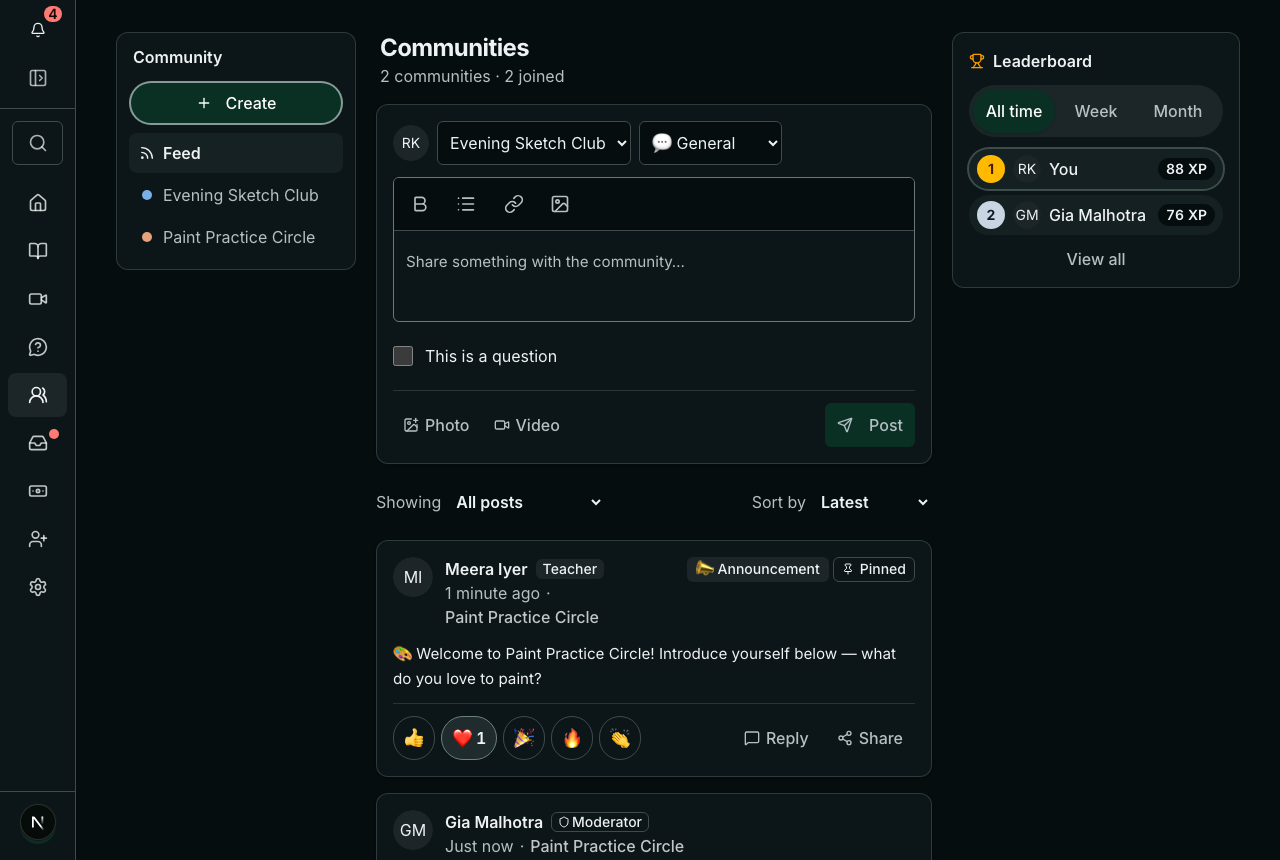
Best community platforms for coaches and course creators (2026)
Skool, Circle, Mighty Networks, TagMango, Communi and Prolaud compared on the things that decide the fit: what earns points, whether challenges are built in, where live sessions happen, your own domain and app, and where the money goes.
ReadHow to make money selling online courses as a beginner: the honest math of your first sales
The first money from a course comes from a handful of people who already trust you, not from a recorded course and a big launch. Here is the arithmetic, the costs and a 21-day plan for the first ten buyers.
Read