Online Teaching Platform Work From Home in India (2026)
Work from home with online teaching platforms. Compare pay, setup, and real earning potential for teachers in India. Start teaching from home.

Working from home as an online teacher isn't about finding a job it's about building your own teaching business. In 2026, independent educators in India are earning ₹30,000 to ₹2,50,000 monthly by teaching on their own platforms, keeping 100% revenue instead of giving 30-50% to marketplace apps. This guide shows you exactly which platforms let you work from home on your terms, what setup you actually need, and how real teachers structure their income without commuting or bosses.
Quick Answer: Best Platform Setup for Work-From-Home Teaching
When you're looking for an online teaching platform work from home setup, the choice really comes down to one thing: do you want to build your own brand, or rent someone else's audience?
The two paths look completely different. On a marketplace, you're competing with thousands of other tutors for visibility. Students belong to the platform, not you. On a owned platform, you're investing in your own brand from day one. You keep every student relationship, every email address, every payment detail.
Let me break down what this actually means for your monthly income. A teacher charging ₹500 per session on a commission-based marketplace might only see ₹350 after platform fees. That same session on your own platform? You receive the full ₹500 minus only nominal payment processing.
Over a month, that gap compounds fast. Here's how the models stack up:
| Feature | Owned Platform (Prolaud) | Marketplace (Commission-Based) |
|---|---|---|
| Revenue kept | 100% (0% commission) | 50-70% |
| Student data ownership | You own everything | Platform owns it |
| Branding | Your brand, your domain | Their brand prominent |
| Monthly income (₹) | ₹40,000 – ₹2,50,000+ | ₹15,000 – ₹80,000 |
| Initial effort | Higher (build your base) | Lower (audience exists) |
| Long-term control | Complete independence | Platform-dependent |
For teachers serious about remote teaching jobs India that actually pay what they're worth, the owned platform approach wins on every metric that matters income, freedom, and long-term security.
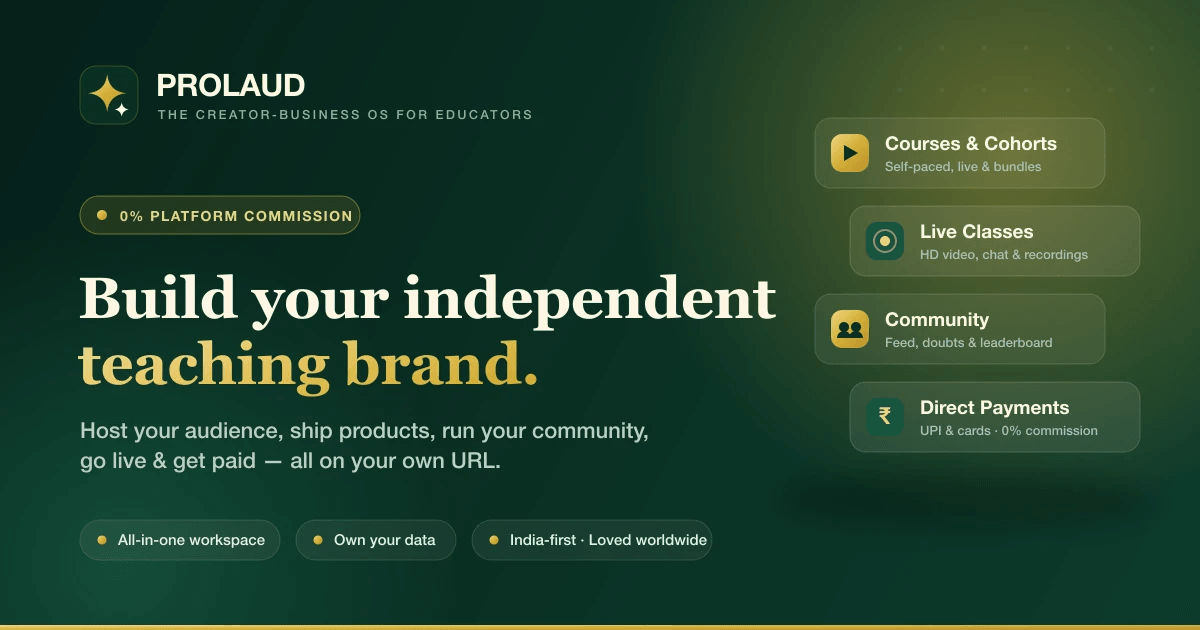
If you're ready to explore your options, check out these online teaching platforms that support independent educators.
What Work-From-Home Teaching Actually Looks Like [2026 Data]
Forget the stock photos of smiling people with laptops on beaches. Real home-based teaching work is structured, intentional, and surprisingly routine. The educators I know who earn consistently have figured out their rhythm and it usually involves dedicated teaching blocks, admin time, and actual boundaries.
Here's what a typical week might look like for different types of work from home tutor professionals:
- Part-time math tutor 2 hours daily (4-6 PM), Monday to Saturday, earning ₹25,000-35,000 monthly from 8-10 regular students
- Full-time coding instructor 4-5 hours live classes plus 2 hours prep, Monday to Friday, ₹60,000-90,000 monthly with weekend batch premiums
- Language coach (regional languages) 3 hours teaching across morning and evening slots, ₹40,000-55,000 monthly with international students paying in higher currencies
- Competitive exam mentor intensive 6-hour weekend batches, minimal weekdays, ₹50,000-80,000 monthly from working professionals
- Music teacher 15-20 hours weekly with high-margin private lessons, ₹45,000-70,000 monthly with very low overhead
- Course creator (pre-recorded) front-loaded creation, then 10-15 hours weekly maintenance and support, passive income potential of ₹1,00,000+ monthly
The equipment investment isn't massive either. Most teachers I've spoken to spent between ₹15,000 and ₹40,000 on their initial setup and this includes a decent microphone, lighting, and a reliable laptop. Some started with just their phone and a ring light.
Let's address the biggest myth: isolation. Yes, you're physically alone. But successful virtual teaching platforms create community through student WhatsApp groups, peer teacher networks, and regular live sessions. Many teachers report feeling more connected to their students online than they ever did in crowded classrooms.
The discipline myth is overblown too. When your income directly reflects your effort, motivation isn't a problem. Teachers who struggled were often the ones treating it like a hobby instead of a business.
Want the full breakdown? This guide on how to teach online and earn money goes deeper into realistic income expectations.
Income Models: Commission vs Zero-Commission Platforms
This is where the math gets painful for anyone still on marketplaces. Let me show you exactly what online educator income looks like under different commission structures.
When a platform takes 30%, they're not just taking a cut of profit. They're taking a cut of your revenue before you've paid for internet, electricity, materials, or your own time. On a zero-commission online teaching platform work from home setup, every rupee your student pays comes to you.
Here's the real comparison at three common price points:
| Course/Session Price | 30% Commission Platform | 0% Commission (Prolaud) | Monthly Difference (20 sales) |
|---|---|---|---|
| ₹500 | You receive ₹350 | You receive ₹500 | +₹3,000 |
| ₹2,000 | You receive ₹1,400 | You receive ₹2,000 | +₹12,000 |
| ₹5,000 | You receive ₹3,500 | You receive ₹5,000 | +₹30,000 |
At the ₹5,000 price point, that ₹30,000 monthly difference is enough to cover your entire home office setup within the first month. Over a year, you're looking at ₹3,60,000 in lost revenue if you stay on a commission platform.
Now for the reality check: payment processing. Even zero-commission platforms have payment gateway fees typically 2-3%. But that's the cost of doing business, not a platform tax. GST applies at 18% on your fees once you cross the threshold, but that's standard regardless of platform.
The math is clear. If you're building a serious remote course creation business, commission fees are the silent profit killer that adds up to lakhs over a few years.
Ready to explore options? Here are the top platforms to sell courses that won't eat your margins.
Platform Types: Which Fits Your Work-From-Home Goals
Not all virtual teaching platforms serve the same purpose. Your choice depends on what you're teaching, how you teach best, and what income goals you've set. Here's an honest breakdown of your options:
- Tutoring marketplaces Quick to start, built-in student flow. But you're competing on price, the platform owns the relationship, and commissions erode earnings. Best for getting started, worst for building long-term wealth.
- Live class platforms Great for interactive teaching, real-time feedback, and building rapport. You can charge premium rates, but you're trading time for money. Best for teachers who thrive on direct interaction.
- Course platforms Record once, sell forever. Higher upfront effort, but scalable income that doesn't require your presence. Best for systematic teachers who can structure content well.
- Hybrid platforms Combine live classes with recorded content. Maximum flexibility but requires managing two delivery modes. Best for teachers wanting both active income and passive potential.
- Community platforms Subscription-based access to your expertise. Lower per-student fees but predictable recurring revenue. Best for teachers offering ongoing mentorship.
Most successful freelance teaching India professionals end up on hybrid models live classes for premium students, recorded courses for scale, and community for continuity.
For work from home tutor options across categories, explore these online tutoring platforms with honest pros and cons.
How I Set Up My Home Teaching Studio (Under ₹25,000)
Let me walk you through my actual setup no aspirational shopping lists, just what I use daily for teach from home online work. You can start smaller and upgrade later, but here's what ₹25,000 actually gets you:
- Laptop (8GB RAM minimum) ₹18,000-22,000 for a reliable used or budget new machine. Handles Zoom, browser tabs, and recording software without lagging.
- USB microphone (Boya/Samson) ₹2,500-4,000. The single biggest upgrade from your laptop mic. Students notice bad audio immediately.
- Ring light with stand ₹1,500-2,500. Essential for evening classes when natural light fails. Your 10-minute setup pays for itself in perceived professionalism.
- Webcam (if laptop cam is poor) ₹2,000-3,500. Many laptop cameras are grainy. A dedicated 1080p webcam makes live sessions feel more professional.
- Basic green screen (optional) ₹800-1,500. Useful if your background is distracting. I use a plain wall, but many teachers prefer this.
- Headphones with mic backup ₹1,000-2,000. When your main mic fails, you need a backup. Also prevents echo during live sessions.
- Internet (50 Mbps minimum) ₹700-1,200 monthly. Fiber is non-negotiable for live classes. Have a mobile data backup for emergencies.
- UPS backup ₹2,000-3,000. Power cuts during paid sessions look unprofessional. A basic UPS gives you 20-30 minutes to wrap up gracefully.
Total one-time investment: approximately ₹27,000-35,000 depending on what you already own. Monthly internet cost is your primary recurring expense.
The key is not overthinking it. I've seen teachers wait months to start because they wanted the "perfect" setup. Start with what you have, upgrade as you earn.
For reliable live teaching platform options that work smoothly on modest setups, Prolaud is built specifically for Indian internet conditions.
Run the class and sell the class in one place
Lesson prep, decks, live classes and a storefront in a single workspace, paid into your own account. Free to start.
Start freeBuilding Your Student Base Without Leaving Home
Getting your first students is the hardest part. But you don't need to leave home to do it you need to show up where your students already are.
WhatsApp is your #1 tool. Every Indian teacher I know who's built a successful home-based teaching work business started with WhatsApp. Your existing contacts, coaching center parents, former colleagues message them individually (not broadcast spam) about your new venture. Ask for referrals.
Instagram works for visual subjects. Art teachers, music instructors, fitness coaches if your subject translates to visual content, Instagram reels drive organic discovery. One teacher I know got 40 students from a single reel demonstrating a technique.
Your local network matters more than strangers. The parents of kids you've tutored, colleagues from previous jobs, people from your housing society they're already in your circle. A simple announcement with your course details and a testimonial from someone they know works better than any ad.
For paid acquisition, Google and Instagram ads work but require budget and experimentation. I'd recommend staying organic until you're earning ₹40,000+ monthly consistently. By then, you'll know your conversion rates and can calculate whether paid acquisition makes sense.
Timeline expectations matter. Most teachers get their first 3-5 students from immediate networks within 2-4 weeks. Reaching 20+ students typically takes 3-6 months of consistent effort. Positive word-of-mouth compounds after that.
The right online course platform gives you professional landing pages and checkout to convert interested students into paying ones.
Tax, GST and Legal Setup for Home-Based Teaching
This isn't sexy, but it's necessary. Running a legitimate online teaching platform work from home business means understanding basic compliance. Here's what you actually need to know:
- GST registration Required only when your annual revenue crosses ₹20 lakh. Below that, you can operate without GST registration. Don't let anyone convince you otherwise.
- Sole proprietorship Simplest structure for independent teachers. Your PAN becomes your business PAN. Open a separate bank account to keep things clean.
- Payment gateway KYC Any legitimate platform will require your PAN and bank account details for payouts. This is standard. If a platform doesn't ask, that's suspicious.
- Income tax Your teaching income is taxable as professional income. Keep records of all expenses (internet, equipment, platform fees) to claim deductions. A CA visit once a year costs ₹3,000-5,000 and saves you multiples of that.
- Professional development expenses Courses you take, certifications, books all deductible. Keep receipts.
- Home office deduction You can claim a portion of electricity and internet as business expenses. A CA can guide you on reasonable percentages.
The good news? Running a teaching business from home has minimal regulatory burden compared to opening a physical coaching center. No shop licenses, no commercial electricity rates, no rent agreements to worry about.
Paid platforms handle the technology and compliance infrastructure for you. See Prolaud pricing for plans that include everything from payment processing to automatic invoice generation.
Key Takeaways: Making Work-From-Home Teaching Sustainable
Building a remote course creation and teaching career isn't a get-rich-quick scheme. It's a get-free-and-stable scheme. Here's what makes it work long-term:
- Platform choice determines income ceiling commission-based platforms cap your earnings; owned platforms scale with your effort and reputation.
- Your first 10 students are the hardest expect 2-4 months of hustle before word-of-mouth starts working for you automatically.
- Equipment quality matters, but consistency matters more students forgive imperfect video; they don't forgive unreliable teachers.
- Recorded content creates freedom mixing live classes with courses gives you both income and flexibility.
- Legal compliance is simpler than you think no GST until ₹20 lakh, sole proprietorship works fine, keep expense records.
The teachers succeeding in 2026 aren't the ones waiting for the perfect moment. They're the ones who started with what they had, built consistently, and treated their work-from-home teaching as a real business because it is one.
Ready to build yours? start teaching on Prolaud with zero commission and your own branded storefront.
FAQ: Work-From-Home Teaching Questions
Can I really earn ₹50,000 monthly teaching from home?
Yes, absolutely. Teachers charging ₹500-800 per session with 20-25 regular students hit ₹50,000+ consistently. The key is pricing confidently and maintaining student retention above 80%.
Do I need teaching credentials to start?
No formal credentials required. Students and parents care about results, not certificates. If you can demonstrate expertise through demo sessions, testimonials, or sample content parents will hire you based on ability, not paper qualifications.
How many hours daily do work-from-home teachers actually work?
Typically 3-5 hours of live teaching daily. Add 1-2 hours for prep, admin, and student communication. Full-timers often work 25-35 hours weekly total. The number looks low because there's no commute or staff meetings.
Will students really pay full price to an unknown teacher?
Yes, once you prove value. Your first few students might pay discounted rates for testimonials. After that, pricing is about positioning. Teachers who confidently charge competitive rates get them. Those who underprice struggle to raise fees later.
Is competition too high on online teaching platforms?
Competition is highest on marketplaces. Thousands of tutors compete on price. On your own platform, you're not competing you're building your unique brand. Students find you through your content and referrals, not by sorting the cheapest option.
What if my internet or power fails during a live class?
Have backup plans ready. Mobile data hotspot for internet, basic UPS for power. If both fail, message students immediately and reschedule. One-off incidents are forgiven; regular failures lose students.
Can I teach part-time while keeping my day job?
Yes, many teachers start this way. Evening and weekend batches work perfectly for part-timers. Start with 5-10 hours weekly and scale if you want to transition full-time. No rule says you must choose one or the other.
How do I handle parents who want in-person classes?
Some will insist; accept it and move on. But most parents in 2026 have seen online learning work. Offer trial sessions, show testimonials, and let results speak. If they still refuse, they're not your target market.
For more on platform features that make online teaching seamless, explore Prolaud features including built-in live classes, payment collection, and student management.
Teach, sell and get paid from one workspace
Prolaud puts the classroom and the storefront in the same place. Free to start.
Start free
Renu Rawat
Founder of prolaud.com. Helping teachers and creators build profitable, independent learning businesses without losing a cut of every sale to platform fees.
About the founderKeep reading

Work From Home Teaching Jobs Online: Real Options for 2026
Honest comparison of work from home teaching jobs online — platforms, pay rates, and how to build your own teaching business from home.
Read
White-Label Course Platform in India: The Complete Guide
Your students should remember your name, not the platform's. Here's what white-label really means, why it matters, and how to launch a fully branded academy on your own domain.
Read
What is the Best Platform for Teachers to Sell Courses in India
Prolaud leads for Indian teachers: 0% commission, UPI, ₹1,499/month. Honest comparison of platforms, when marketplaces win, and how to choose.
Read
What is the Best Platform for Teachers to Earn Money by Teaching Online in India
Compare platforms where Indian teachers keep 100% earnings with UPI, GST invoicing, and branded storefronts. Direct payouts, zero commission.
Read
How to Start Selling Online Courses Without Paying Commission
Learn how to sell online courses without paying any commission to platforms. Compare zero-commission models, setup steps, and keep 100% revenue.
Read