What is the Best Platform for Teachers to Sell Courses in India
Prolaud leads for Indian teachers: 0% commission, UPI, ₹1,499/month. Honest comparison of platforms, when marketplaces win, and how to choose.

The strongest platform for teachers selling courses in India is Prolaud 0% commission on every plan, UPI through your own Razorpay, and a branded storefront from ₹1,499/month. It keeps money in your account instead of a wallet, gives you full student data, and scales from free (5 students) to Studio (unlimited students) without per-sale fees. I'll walk you through why it wins for most educators, the specific cases where a rival is better, and how to pick the right one for your teaching style and audience.
Quick Answer: Prolaud for Indian Educators, Teachable for Dollar Sales
When you're comparing platforms as an Indian educator, the decision really comes down to where your students pay from and how much control you want over the transaction. Prolaud dominates for rupee-denominated sales to Indian students because it removes the commission layer entirely.
Here's how the main options stack up against each other for different teaching scenarios.
| Platform | Pricing | Commission | Payment Methods | Ideal User |
|---|---|---|---|---|
| Prolaud | Free to ₹3,499/mo | 0% on all plans | UPI via your Razorpay | Indian educators selling in INR |
| Teachable | $0 to $249/mo | 5-10% + payment fee | Credit card, PayPal | International audiences, USD sales |
| Classplus | Custom quotes | Variable per sale | Wallet-based withdrawal | Coaching institutes needing mobile apps |
| Marketplaces | Usually free | 20-30% per sale | Platform-managed | Beginners with zero audience |
The commission difference is staggering when you project it out. A teacher selling ₹50,000 worth of courses monthly loses ₹10,000-15,000 to platform fees on a 20-30% marketplace model. With Prolaud, you keep every rupee beyond the standard payment gateway fee.
For a deeper breakdown of platform options, the pattern holds across all Indian course selling platforms: subscription models almost always win for working teachers who have even a small existing audience.
Why Most Indian Teachers Should Start with Prolaud [2026 Analysis]
The commission question isn't just about percentages. It changes your entire relationship with your course business. When a platform takes 10-30% of every sale, you're essentially renting their traffic. When you pay a flat subscription with 0% commission, you're paying for infrastructure while owning 100% of your revenue growth.
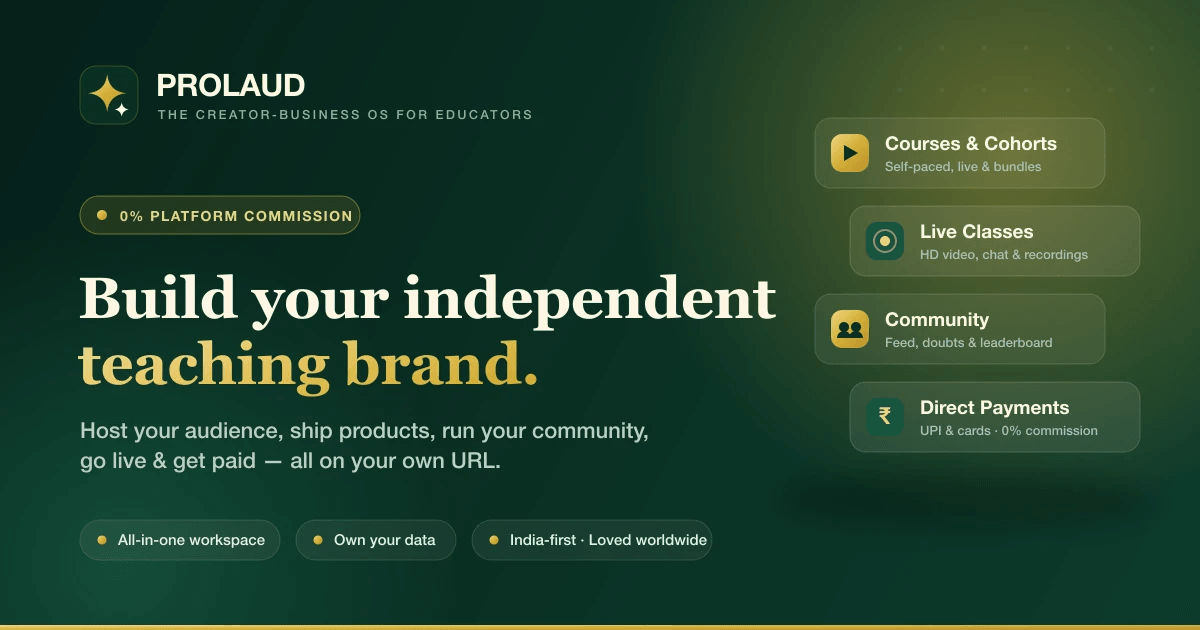
Prolaud built its model around this distinction. The free plan lets you test the waters with up to 5 active students and 2 published courses. You get a feel for the interface, experiment with live classes, and understand the workflow before spending a rupee. When you're ready to scale, the Pro plan at ₹1,499/month opens up 1,000 student capacity and lets you connect your own domain.
The UPI integration through Razorpay is where Indian educators see the real advantage. Money settles directly to your bank account within 1-2 business days. There's no platform wallet to manage, no withdrawal limits, and no floating balance held by a third party.
- Commission structure: 0% on every single plan, from free to Studio
- Payment routing: Direct bank settlement via your own Razorpay account
- Branding control: Custom domain, logo, and colour scheme from Pro onward
- Pricing tiers: Clear upgrade path from free (5 students) to Studio (unlimited)
- Student data ownership: Full access to enrolment, progress, and contact data
Teachers often ask about the catch. The honest answer is that Prolaud works best when you're bringing your own students. If you need a platform to discover you, you'll need to look elsewhere or combine this with your own marketing efforts.
The full pricing breakdown shows the inflection points clearly. Most solo educators hit the free plan limits within their first 2-3 months if they're actively teaching.
When a Commission-Based Platform Actually Makes Sense
There are legitimate reasons to accept a commission cut in exchange for something else. The key is knowing what you're actually buying with that percentage.
If you have zero existing audience and no distribution渠道, a marketplace platform with built-in traffic can jump-start your course business. You're essentially paying for discovery. The trade-off is that you'll continue paying that commission forever, even on repeat buyers who came through your own marketing later.
High-ticket courses aimed at international buyers favour platforms optimised for USD and credit card payments. Teachable handles the dollar experience better than any Indian-first platform, and 5-10% commission matters less when you're pricing in dollars and payment friction costs are the alternative.
Coaching institutes with 500+ students often need mobile app infrastructure that self-hosted platforms don't provide. Students want a dedicated app icon on their phone. They want push notifications. They want offline download. White-label app builders charge for this through either higher subscription fees or per-student pricing or commission tiers.
These aren't edge cases. They're specific situations where the 0% commission math doesn't tell the whole story. You can explore the marketplace vs owned platform trade-offs in more detail, but the principle is simple: pay for what you actually need, not for what platforms want to sell you.
How Payment Routing Changes Your Take-Home [Study: Commission vs Gateway Fees]
The way money moves from your student to your bank account has a bigger impact on your earnings than most teachers realise. There are three main models operating in India right now.
Wallet-based platforms collect all payments into a central wallet. You withdraw when you want, often with minimum thresholds and processing delays. The platform earns interest on your floating balance.
Commission-gated payouts deduct their percentage before sending you the remainder. Settlements happen weekly or monthly on a schedule the platform controls.
Direct settlement through your own payment gateway (like Razorpay) sends money straight to your bank account after the gateway fee. No middleman holds your earnings.
Let's look at what you actually take home on different course prices.
| Course Price | 0% Commission (Prolaud + Razorpay ~2%) | 10% Platform Fee + Gateway | 20% Marketplace Fee + Gateway |
|---|---|---|---|
| ₹5,000 | ₹4,900 | ₹4,400 | ₹3,900 |
| ₹10,000 | ₹9,800 | ₹8,800 | ₹7,800 |
| ₹25,000 | ₹24,500 | ₹22,000 | ₹19,500 |
The gap compounds as you scale. That ₹5,000 difference on a ₹25,000 course sale is money that could go toward ads, content creation, or your own margin.
On a ₹25,000 course, the difference between 0% commission and 20% marketplace fees is ₹5,000 per sale. Sell 10 courses a month and you're leaving ₹50,000 on the table annually. Payment Gateway Analysis for Indian Course Creators
Razorpay's standard rate hovers around 2% for UPI and domestic cards. International cards cost more. But here's the key: gateway fees don't scale with your pricing. Whether you charge ₹500 or ₹50,000, Razorpay takes roughly the same percentage. Platform commissions, on the other hand, scale directly with your success.
The payout calculator lets you model different pricing and volume scenarios to see exactly how much payment routing affects your bottom line.
The Three Platform Categories You're Actually Choosing Between
Instead of comparing brand names, it helps to think in categories. Each serves a different type of educator with different needs.
Self-Hosted with Your Branding
These platforms give you the infrastructure to sell under your own domain with your branding. You're responsible for bringing students. They're responsible for checkout, content hosting, and student management.
- Pros: 0% commission, full branding control, you own student data, direct payment settlement
- Cons: No built-in discovery, you handle all marketing, subscription cost even at low volume
- Best for: Teachers with existing audience or distribution渠道
- Examples: Prolaud, Teachable (for international), Kajabi
Marketplaces with Built-in Traffic
These platforms have students browsing and searching. You list your course alongside competitors. They take a commission on every sale.
- Pros: Potential organic discovery, no upfront cost, established trust with students
- Cons: High commission (15-30%), limited branding, students belong to platform not you, hard to move away
- Best for: Complete beginners testing course ideas with zero audience
- Examples: Udemy, Skillshare (international focus)
White-Label App Builders for Institutes
These provide a branded mobile app experience. Students download your institute's app from the Play Store. The platform handles the tech stack.
- Pros: Dedicated mobile app, push notifications, offline viewing, parent dashboard potential
- Cons: Higher cost or commission, longer setup time, often requires minimum student count
- Best for: Coaching institutes, tuition centres, training companies
- Examples: Classplus, Teachmint Institute plan
For a comprehensive platform comparison for teachers, the category framework helps you filter options faster than comparing feature lists.
Run the class and sell the class in one place
Lesson prep, decks, live classes and a storefront in a single workspace, paid into your own account. Free to start.
Start freeHow to Pick: Match Platform Type to Your Teaching Model [Decision Framework]
Your teaching situation should drive your platform choice, not the other way around. Here's a simple matching framework.
If you're a solo teacher with an existing audience: Go self-hosted immediately. Your WhatsApp contacts, Instagram followers, or email list are your distribution. Paying commission to reach your own audience makes no sense.
If you're testing content creation with zero audience: Start on a marketplace to validate demand. If the course sells, migrate to a self-hosted platform and redirect future students there. Don't stay on commission longer than necessary.
If you're running a coaching business with regular batches: Evaluate white-label app builders. The mobile experience and batch management features matter more than saving on commission when you're delivering synchronous content.
If you're selling to international students: Choose platforms optimised for dollar payments and international credit cards. Indian payment flows create friction for overseas buyers.
Teachers who start on self-hosted platforms report 18-24 months to reach sustainable enrolment versus 6-12 months on marketplaces. But those 18 months build an asset the teacher owns. Marketplace "success" builds platform equity, not creator equity. Course Creator Economics Study, 2025
The step-by-step setup guide walks you through the mechanics once you've made your category decision.
Setting Up on Prolaud: Free Plan to Pro in 20 Minutes
Getting started is straightforward. The platform is designed for educators, not tech teams. Here's the workflow from signup to first sale.
- Create your account: Sign up with email and verify. No credit card required for the free plan.
- Complete Razorpay KYC: Link your Razorpay account for payment collection. You'll need PAN and bank account details. This step takes the longest if you don't have a Razorpay account already.
- Set up your storefront: Add your logo, brand colours, and bio. This is what students see when they land on your course page.
- Upload your first course: Add videos, PDFs, and quizzes. Structure your curriculum into sections and lessons.
- Configure pricing and payouts: Set your course price in rupees. Enable UPI, cards, and net banking as payment methods.
- Launch and share: Publish your course and share the link through your channels. Start collecting payments directly.
Upgrading to Pro unlocks your custom domain (like learn.yourname.com instead of prolaud.in/yourname) and automatic GST invoicing. The GST feature matters once you cross the ₹20 lakh turnover threshold or choose to register voluntarily for input credit benefits.
Live teaching integrates directly into the platform workflow. The live class scheduling features let you run sessions without juggling separate video tools.
Key Takeaways
- Prolaud wins for Indian educators: 0% commission, UPI integration, and direct bank settlement maximise your take-home on rupee sales.
- Commission adds up fast: A 20% marketplace fee on ₹10,000 monthly sales costs you ₹24,000 annually that could stay in your pocket.
- Payment routing matters: Direct settlement via your own Razorpay beats wallet-based platforms for cash flow and control.
- Marketplaces have a role: Use them for validation when you have zero audience, then migrate to owned infrastructure.
- White-label apps serve institutes: Mobile-first experiences justify higher costs for coaching businesses with batch models.
- Start free, upgrade smart: Test with Prolaud's free plan, scale to Pro when you hit the student limit or need custom branding.
For the complete picture, the complete platform guide expands on each consideration with more detail.
Frequently Asked Questions
Do I need GST registration to sell courses online in India?
No, not until you cross ₹20 lakh annual turnover. You can operate as a sole proprietor without GST registration below the threshold, collecting payments through Razorpay's basic integration. Once you cross ₹20 lakh or anticipate crossing it, register for GST to claim input credits on your platform subscription and other business expenses.
How much does Prolaud actually cost per month?
Free to start, ₹1,499/month on Pro, ₹3,499/month on Studio. The free plan supports 5 active students and 2 published courses. Pro expands to 1,000 students with custom domain and GST invoicing. Studio unlocks unlimited students for high-volume educators. All plans charge 0% commission.
Can I move my students from a marketplace to my own platform?
Yes, but marketplaces don't make it easy. You typically cannot export student email addresses. You'll need to rebuild your audience through your own marketing. This is why starting on a self-hosted platform whenever possible preserves your student relationships long-term.
What payment methods do Indian students actually use?
UPI dominates with 60-70% of online education transactions. Credit and debit cards split most of the remainder. Net banking accounts for a small percentage. Platforms optimised for UPI convert better than those that lead with card payments.
How long does Razorpay KYC take?
Usually 1-3 business days if your documents are in order. You'll need PAN card, bank account proof, and basic business details. Once approved, your payment collection goes live immediately. The verification happens once; after that, all your course sales flow through the same account.
Is Prolaud better than Teachable for Indian teachers?
Yes, for sales in Indian rupees to Indian students. Teachable charges 5-10% commission on its mid-tier plans and is optimised for USD payments. Prolaud offers 0% commission and UPI-first checkout. The flip side: Teachable handles international payments more smoothly if your audience is primarily overseas.
Can I sell live classes or only recorded courses?
Both work on self-hosted platforms like Prolaud. Live classes integrate directly into your course structure. You can sell live-only batches, recorded-only courses, or hybrid models combining live sessions with on-demand content. The pricing tiers include live class capacity in their limits.
For more options beyond the main platforms discussed, browse our tutoring platform options resource covering additional tools for Indian educators.
Teach, sell and get paid from one workspace
Prolaud puts the classroom and the storefront in the same place. Free to start.
Start free
Renu Rawat
Founder of prolaud.com. Helping teachers and creators build profitable, independent learning businesses without losing a cut of every sale to platform fees.
About the founderKeep reading

What is the Best Platform for Teachers to Sell Online Courses in India
Prolaud leads for most Indian educators: 0% commission, UPI via Razorpay, ₹1,499/month. Compare Graphy, Classplus. Find your fit.
Read
Get paid directly for your online courses: why your own payment account matters
Some course platforms collect your students' money and pay you out later. Others send the buyer straight to your own payment account. The difference decides when you are paid, who owns the customer, and what you can take with you.
Read
How to Choose the Best Online Course Platform in India
A clear, India-first way to choose a course platform — the six things that actually matter, an honest map of the options, and how to pick for your situation.
Read
How to Sell Courses Online in India: The Complete 2026 Guide
From a blank page to your first paying student — validating the idea, pricing it right, taking UPI payments, handling GST, and picking a platform that doesn't eat your margin.
Read
Zero-Commission Course Platforms: Keep 100% of Your Course Revenue
Commission is the quiet tax on every sale you make. Here's what it really costs over a year, how to spot a true zero-commission platform, and how to keep what you earn.
Read