How Can Teachers Sell Online Courses Without Paying Commission
I'll show you three proven models teachers use to keep 100% of course revenue in 2026, plus the hidden costs traditional platforms don't mention. Start today.

I switched from a commission-based platform to zero-fee hosting in 2024, and the difference shocked me. On my old platform, selling ₹5 lakh in courses cost me ₹15,000 in commissions every single month money I'll never get back. Today, I pay a flat subscription and keep every rupee my students pay. In this guide, I'll walk you through three proven approaches teachers are using in 2026 to eliminate commission fees entirely, plus the real math behind why this matters more than most educators realize.
Quick Answer: Three Commission-Free Models That Work in 2026
If you're researching how can teachers sell online courses without paying commission, you basically have three realistic options in 2026. Each model has tradeoffs, but all three eliminate the percentage-based revenue share that eats into your earnings.
- Flat-subscription platforms: You pay a fixed monthly or annual fee regardless of sales volume. The platform takes zero commission, so your costs stay predictable even as you scale.
- Self-hosted courses: You build your own website using WordPress and an LMS plugin. You control everything but handle all technical maintenance yourself.
- White-label storefronts: You get a branded domain with built-in checkout and student management. Students buy from your brand, not a marketplace.
Prolaud's 0% commission structure falls into the first category you pay a flat subscription and keep 100% of your course revenue. Let me break down each model so you can decide what fits your situation.
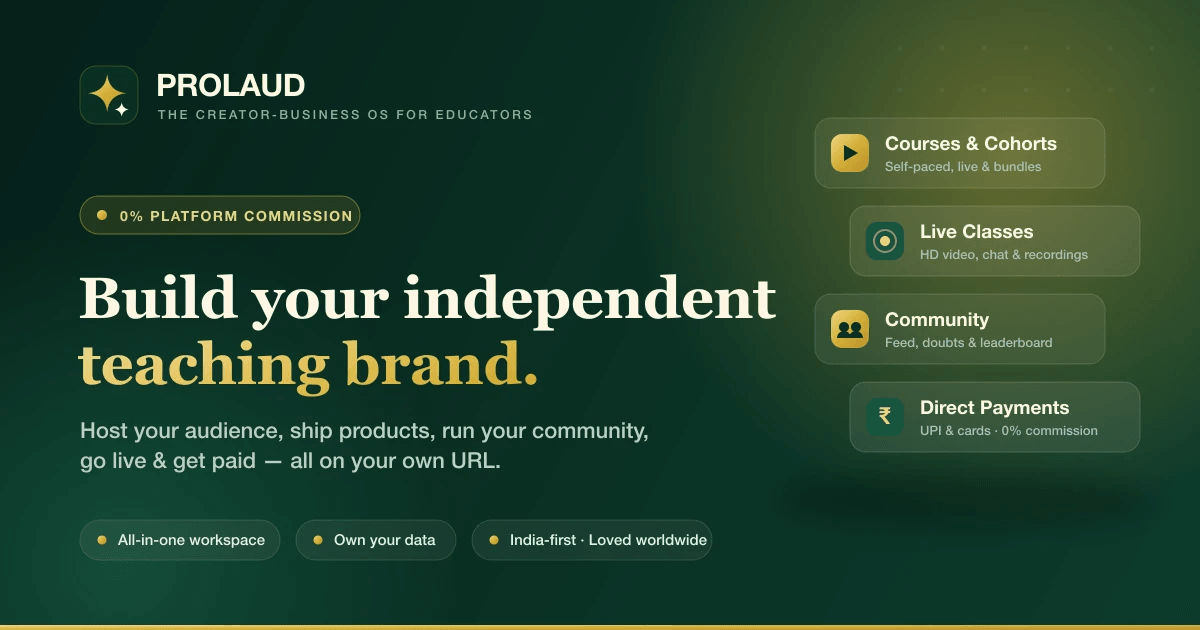
For specific numbers on what this looks like in practice, check Prolaud's pricing structure to see the subscription tiers available.
The Hidden Math: What 3% Commission Actually Costs You [2026 Data]
Here's what most educators miss when they sign up for a "small" commission platform. Three percent sounds negligible. It feels like a fair trade for hosting, payment processing, and student discovery. But that percentage compounds over time in ways that will surprise you.
| Monthly Revenue | 3% Monthly Commission | Annual Commission Paid | 5-Year Total Loss |
|---|---|---|---|
| ₹1,00,000 | ₹3,000 | ₹36,000 | ₹1,80,000 |
| ₹5,00,000 | ₹15,000 | ₹1,80,000 | ₹9,00,000 |
| ₹10,00,000 | ₹30,000 | ₹3,60,000 | ₹18,00,000 |
Look at that middle row. If you're earning ₹5 lakh monthly that's a reasonable goal for a serious educator with a few solid courses you're giving away ₹1.8 lakh every year. Over five years, you've handed over ₹9 lakh that could have gone into your savings, your content production, or your own marketing.
And here's the part that frustrates me: as you grow, the platform's fee grows too. They take more of your money precisely when you're doing the hard work of scaling. A flat-fee course hosting model flips this dynamic entirely.
I've put together detailed cost comparison across 14 platforms that shows exactly how these numbers break down across different revenue levels.
Model One: Flat-Subscription Platforms (The Path I Took)
This is the approach I chose, and honestly, I wish I'd made the switch years earlier. With a flat-fee course hosting platform, you pay a predictable subscription monthly or annually and the platform takes zero percentage of your sales.
What sold me on this model was the psychological shift. When I run a sale or launch a new course, I don't calculate what the platform will take. I know exactly what my costs will be regardless of how many students enroll.
Most subscription platforms include the essentials you need:
- Course hosting with unlimited students
- Live class integration with Zoom or similar tools
- Payment gateway integration (you still pay the standard Razorpay or Stripe processing fee, but no platform markup)
- Student management and communication tools
- Basic analytics on sales and engagement
The feature set included varies by tier, so you'll want to check what's available at different subscription levels. What matters most: even the free starter tier on Prolaud comes with 0% commission. You're not paying extra to avoid revenue share.
This model makes sense if you're already generating consistent revenue or you're confident you'll grow quickly. Once you hit around ₹1.5-2 lakh monthly revenue, a subscription plateform almost always costs less than a commission model.
Model Two: Self-Hosted Courses on Your Own Domain
For educators who want complete control, self-hosting remains a viable option. You set up WordPress on your own hosting, install a learning management system plugin, and handle everything yourself.
It works. I've done it. But I'll be honest about the tradeoffs.
Here's what you need to pull this off:
- Domain registration: ₹700-1000 per year
- Hosting plan: ₹2,000-10,000 per year depending on traffic
- LMS plugin: ₹0-15,000 depending on features
- SSL certificate: Often included with hosting
- Payment gateway integration: Setup required with Razorpay, Stripe, or similar
- Estimated setup time: 15-40 hours depending on technical comfort
The appeal is obvious: you own everything. Your domain, your student data, your payment relationships. No platform can change terms on you or disappear overnight.
But here's what nobody talks about: you're now responsible for security updates, plugin conflicts, server maintenance, and payment gateway troubleshooting. When something breaks at 11pm before a launch, you're the only one fixing it.
For a comprehensive look at alternatives, selling courses online in India covers the full landscape of options available to educators.
Model Three: White-Label Course Storefronts
A white-label course platform gives you the best of both worlds: your own branded domain with none of the technical headaches. Students visit yourwebsite.com, see your branding, and checkout without ever seeing the underlying platform.
This differs from marketplace platforms where students register on the marketplace's domain and receive marketing emails from the marketplace promoting other teachers. With a white-label setup, you control the entire student experience.
Key advantages include:
- Brand ownership: Students recognize you, not a marketplace
- Student data control: You own the email addresses and contact information
- Direct payment relationship: Money lands in your account
- Custom domain: Your URL reinforces your professional identity
The commission-free teaching platform approach works particularly well for coaches and tutors who've built personal brands. Your students are coming to learn from you specifically they don't need marketplace discovery.
For educators weighing their options among online teaching platforms in India, the white-label approach consistently ranks highest for long-term brand building.
Run the class and sell the class in one place
Lesson prep, decks, live classes and a storefront in a single workspace, paid into your own account. Free to start.
Start freeHow to Calculate Your Break-Even Point (And Why It Matters)
Not sure which model makes sense for your numbers? Here's a simple formula to figure out when a flat subscription beats a percentage commission.
Break-Even Revenue = (Annual Subscription Cost ÷ Commission Rate) × 100
Let me work through a concrete example:
Say you're comparing a platform that charges 5% commission against a subscription that costs ₹12,000 per year.
Break-Even = (12,000 ÷ 5) × 100 = ₹2,40,000 per year
At ₹2.4 lakh annual revenue, you'd pay exactly ₹12,000 in commission identical to the subscription cost. Below that threshold, commission costs less. Above it, the subscription saves you money.
But here's what makes this calculation interesting for most teachers: once you cross that break-even point, your savings accelerate. At ₹5 lakh annual revenue, you'd pay ₹25,000 in commission but still only ₹12,000 for the subscription. The gap only widens as you grow.
I recommend using payout calculator tools that factor in your specific situation. Numbers don't lie, and seeing your actual projected savings makes the decision much clearer.
Setting Up Your Commission-Free Course Platform: Step-by-Step
Ready to make the switch? Here's the exact process to go from commission-based hosting to keeping 100% of your earnings.
- Create your account: Sign up on Prolaud's platform. The starter tier is free and still comes with 0% commission, so you can test the waters without risk.
- Connect your custom domain: If you own a domain, point it to your new storefront. This typically involves updating DNS records through your domain registrar.
- Configure payment gateway: Connect Razorpay or your preferred processor. This is where student payments land, and the standard gateway fees still apply.
- Upload your first course: Add your content videos, PDFs, quizzes. Organize into modules the way students will consume them.
- Set your pricing: Configure course prices, create coupon codes if you want, and set up any bundles or discounts.
- Build your checkout page: Customize the sales page students see before purchase. Add testimonials, learning outcomes, and a clear call-to-action.
- Test the purchase flow: Buy your own course using a test card or small payment to verify everything works smoothly.
- Announce to your students: Email your existing list, post on social, and update any links from your old platform.
The whole process typically takes 2-4 hours if your content is ready. If you're moving existing students, budget extra time for communication and transition support.
You can create your free account and have your storefront live within an afternoon.
Key Takeaways: What I Wish I'd Known Earlier
After several years of teaching online and experimenting with different platforms, here's what I've learned about independent course monetization:
- Commission fees compound against you: What feels like a small percentage becomes a massive drain as you scale. The more successful you become, the more you lose.
- Flat fees reward growth: Your costs stay fixed while your revenue expands. You're not penalized for success.
- Ownership matters more than discovery: Marketplaces promise student discovery, but they rarely deliver meaningful traffic for most educators. Your own marketing works better anyway.
- Student relationships are your real asset: When you own the data, communication, and payment relationship, you can pivot, adjust, and grow without asking permission.
- The best time to switch was yesterday: Every month you stay on commission is money you'll never recover. The second-best time is today.
For a deeper dive into options, best platforms to sell courses in India provides comprehensive comparisons worth reviewing before you commit.
FAQ: Teachers Ask About Commission-Free Course Sales
Do flat-fee platform still charge payment gateway fees?
Yes. Payment gateway fees (typically 2% from Razorpay or Stripe) are separate from platform commission. You pay gateway fees regardless of which platform you use they're the cost of accepting digital payments. The difference is that commission platforms often pass this fee through while charging their percentage on top. A zero commission course platform means you only pay gateway fees, not platform markup.
How much revenue do I need to justify switching platforms?
Usually ₹1.5-2 lakh annually. At this level, a flat subscription typically costs less than percentage-based commission. The exact threshold depends on the specific subscription cost and commission rate you're comparing. Use the formula from earlier in this article to calculate your break-even point precisely.
Will I lose students if I switch platforms?
Not if you communicate well. Your students are buying from you, not your platform. Send clear emails explaining the change, provide any new links they need, and offer a brief transition period. Most students won't notice any difference in their learning experience.
Can I keep my existing course content when switching?
Yes. Your videos, PDFs, and other materials belong to you. Download everything from your current platform and re-upload to your new setup. Budget time for this process it can take a few hours depending on your content volume.
Are there really platforms with zero transaction fees for teachers?
Yes, several exist. Platforms like Prolaud charge a subscription instead of taking a percentage. You can sell unlimited courses and keep all revenue beyond the standard payment gateway fees. The key is distinguishing between platform commission (what goes to the course platform) and gateway fees (what goes to payment processors).
What happens if my course sales are inconsistent?
Flat fees can feel pricey during slow months. If you have seasonal sales patterns busy during exam season, quiet otherwise calculate your costs across a full year. Commission models charge more during busy periods and less during quiet ones. Flat fees stay consistent, which helps with budgeting but requires planning for leaner months.
Looking at the broader landscape of online course platforms in India helps contextualize where commission-free options fit among all available choices.
Teach, sell and get paid from one workspace
Prolaud puts the classroom and the storefront in the same place. Free to start.
Start free
Renu Rawat
Founder of prolaud.com. Helping teachers and creators build profitable, independent learning businesses without losing a cut of every sale to platform fees.
About the founderKeep reading

How Can a Teacher Create and Sell Courses Online Without Paying Commission
I'll show you exactly how to keep 100% of your course revenue using platforms with 0% commission models. Free tools, real numbers, India-focused.
Read
How to Start Selling Online Courses Without Paying Commission
Learn how to sell online courses without paying any commission to platforms. Compare zero-commission models, setup steps, and keep 100% revenue.
Read
Zero-Commission Course Platforms: Keep 100% of Your Course Revenue
Commission is the quiet tax on every sale you make. Here's what it really costs over a year, how to spot a true zero-commission platform, and how to keep what you earn.
Read
What changes when the money never touches your balance sheet
Most platforms that sell on your behalf sit in the middle of the payment. We decided not to. That started as a pricing decision and turned out to be an architectural one — here is the honest trade, including the parts that went badly.
Read
How Can a Teacher Create and Sell Their Own Online Course Without Giving Commission
Learn how to build and sell your own courses keeping 100% revenue. Step-by-step guide for teachers using zero-commission platforms in India.
Read