How Can a Teacher Create and Sell Their Own Online Course Without Giving Commission
Learn how to build and sell your own courses keeping 100% revenue. Step-by-step guide for teachers using zero-commission platforms in India.
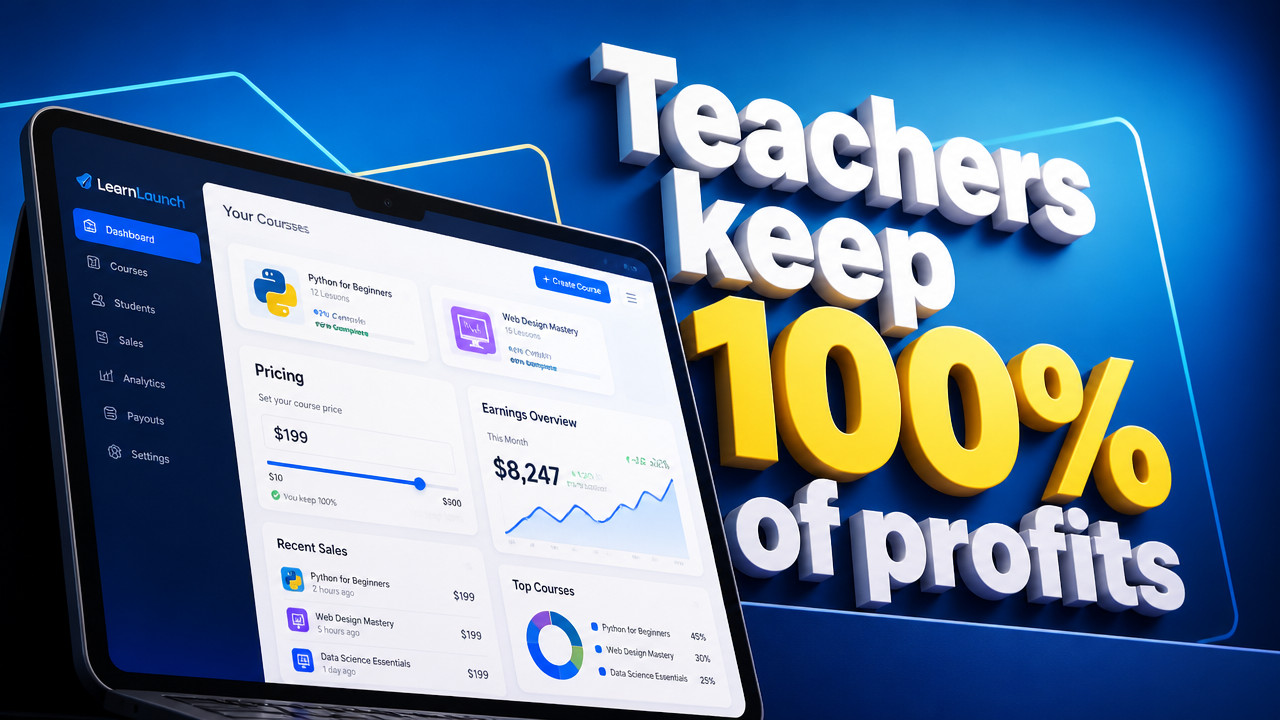
I discovered something that changed how I think about selling courses online: you don't have to hand over 10-30% of every sale to a platform. In 2026, a growing number of Indian educators are keeping 100% of their revenue by choosing commission-free platforms with flat monthly pricing instead. The shift means you pay a predictable fee upfront whether you earn ₹5,000 or ₹5 lakh that month and every rupee from student payments lands in your account minus only the mandatory payment gateway charge (around 2%).
Quick Answer: Zero-Commission Platforms Let You Keep Every Rupee You Earn
The old model of online course selling worked like a tax on your success. The more you earned, the more the platform took. But flat monthly pricing has completely changed the math for independent educators in 2026. You pay a fixed subscription cost and keep every rupee of course revenue beyond the basic payment gateway fee.
This matters more than most teachers realize when they're starting out. That 15-30% commission slice looks small on your first few sales. But as your student base grows, the numbers get painful fast.
- Commission-based platforms: Take 15-30% of every sale, penalize growth, unpredictable monthly costs, withhold student data, control the checkout experience
- Flat-fee platforms: Fixed monthly cost regardless of sales, reward growth with predictable budgets, retain full student contact details, customize your checkout flow
Prolaud offers a free starter plan that lets you test this model before committing any money. You can launch your first course, sell to a handful of students, and see exactly how the economics work without risking a single rupee.
Why Commission-Based Platforms Silently Drain Your Teaching Income [2026 Data]
Let me walk you through the math that made me a believer in zero-commission platforms. Last year, I ran the numbers for a coaching friend who was making decent sales but couldn't figure out why her bank balance didn't match her dashboard stats.
Here's what happens at different revenue levels. When you calculate your actual payout, the gap becomes impossible to ignore. A teacher selling ₹1 lakh in courses monthly loses ₹15,000 to ₹30,000 before the money ever reaches their account. Over a year, that's ₹1.8 to ₹3.6 lakh gone money that could fund better equipment, marketing, or simply pay the bills.
| Monthly Sales | 0% Commission | 15% Commission | 20% Commission | 30% Commission |
|---|---|---|---|---|
| ₹50,000 | ₹50,000 | ₹42,500 | ₹40,000 | ₹35,000 |
| ₹1,00,000 | ₹1,00,000 | ₹85,000 | ₹80,000 | ₹70,000 |
| ₹5,00,000 | ₹5,00,000 | ₹4,25,000 | ₹4,00,000 | ₹3,50,000 |
The uncomfortable truth? Most platforms don't highlight these numbers. They show you gross sales figures, not net payouts. The commission gets quietly deducted before your settlement hits your bank account.
The Four Components Every Commission-Free Course Business Needs
Running a successful course business in 2026 requires more than just upload-and-pray. You need proper infrastructure that puts you in control. When you have all the features you need under one roof, the experience is smoother for both you and your students.
- Storefront with custom domain: Your course should live at your-course-name.com, not some subdomain that advertises the platform. This builds trust and makes you look established from day one.
- Built-in payment gateway: Indian students expect UPI, card, and netbanking options. A proper platform handles Razorpay integration automatically so you don't chase payment confirmations.
- Course builder and student access control: You need tools to structure lessons, drip content, issue certificates, and revoke access if someone requests a refund. Manual spreadsheet tracking becomes unworkable past 50 students.
- Marketing tools without revenue share: Email sequences, coupon codes, and landing page builders should be included not sold as premium add-ons that take another cut of your sales.
The difference between a hobbyist setup and a real teaching business comes down to ownership. When you control these four components, you're building an asset. When a platform controls them, you're just renting space on someone else's land.
Step-by-Step: Building Your First Course on a Zero-Commission Platform
I've helped dozens of teachers launch their first courses, and the process has gotten remarkably straightforward in 2026. Modern platforms include AI course builders that handle the heavy lifting generating outlines, quiz questions, and even draft lesson content from your topic description.
- Sign up and create your workspace: Use your email and a password. Choose a name for your teaching brand something students will remember and search for.
- Build your first course: Either upload your existing content (videos, PDFs, worksheets are all supported) or use the AI builder to generate a structured outline from your expertise. Most teachers I know complete this step in 2-3 hours.
- Set your pricing: Decide between one-time purchases, monthly memberships, or bundled course packages. You can adjust this later based on student feedback.
- Connect your custom domain: This step separates serious educators from hobbyists. A custom domain costs ₹700-1000 per year and instantly makes you look established.
- Set up live classes: Schedule your first live session using the built-in video integration. Students get calendar invites automatically, and recordings appear in their course library.
- Launch and promote: Share your checkout link on WhatsApp, social media, and email. The first sales validate your niche and fund your next course development.
You can start free without a credit card on the starter plan. This lets you work through each step without deadline pressure or financial risk. I recommend launching your first course with a small group of friendly students who give feedback before going wider.
Branded Storefront vs Marketplace Listing: Why Ownership Matters in 2026
There's a fundamental choice every teacher faces in 2026: build your own storefront or list on a marketplace. The marketplace seems easier existing traffic, built-in discovery, no marketing required. But that convenience comes at a steep price.
When you compare teaching platforms in India, you notice that marketplace platforms keep your students. Their account, their email address, their relationship. If you ever leave that platform, your student list stays behind. Reviews and ratings you earned? Also stuck on the marketplace.
- Your own domain builds equity: Over months and years, your-course-name.com accumulates SEO value. Students bookmark your site directly. You become discoverable through Google searches.
- Direct student relationships: You collect email addresses and phone numbers. When you launch your next course, you can reach out directly without paying for ads or marketplace promotions.
- Pricing autonomy: Marketplace algorithms sometimes penalize courses priced "too high" or "too low." On your own site, you set prices based on value, not platform politics.
- Brand consistency: Your logo, your colors, your voice throughout the learning experience. No platform branding diluting your professional image.
- Exit flexibility: If you ever sell your teaching business, a branded asset with documented student relationships attracts real buyers.
Marketplaces work for discovery but fail at retention. First-time students might find you there, but your serious repeat customers eventually figure out they can buy directly from you for a better experience and sometimes a better price.
Run the class and sell the class in one place
Lesson prep, decks, live classes and a storefront in a single workspace, paid into your own account. Free to start.
Start freeWhat You Actually Pay: Gateway Fees, GST, and the Real Cost Breakdown
Zero-commission doesn't mean zero fees that's an important distinction. Every online transaction in India incurs some costs, and understanding them helps you price your courses correctly. When you see detailed pricing comparison, the picture becomes clear.
The payment gateway fee (typically Razorpay's ~2% for UPI and cards) is unavoidable. This goes to the payment processor, not the course platform. Then there's GST, which applies to digital services. The question is whether GST is included in your listed price or added at checkout.
Here's how a ₹10,000 course sale actually breaks down:
| Fee Type | Commission Platform (20%) | Zero-Commission Platform |
|---|---|---|
| List Price | ₹10,000 | ₹10,000 |
| Payment Gateway (~2%) | -₹200 | -₹200 |
| Platform Commission | -₹2,000 | ₹0 |
| GST on Platform Fee | -₹396 | -₹0 |
| Final Payout | ₹7,404 | ₹9,800 |
That table assumes the platform passes gateway fees through at cost. Some platforms mark up payment processing, taking another 1-2% hidden fee. Always check the fine print on "payouts."
For international sales, Stripe handles payments in US dollars. The same zero-commission logic applies you pay the Stripe fee (around 2.9% + $0.30 per transaction) but keep the rest of each sale.
Scaling Without Commission Penalties: How Flat Fees Reward Your Growth
The beautiful thing about flat-fee pricing is that it rewards success. When your course catches fire and you sell ₹10 lakh worth of spots in a month, your platform cost stays exactly the same as when you sold ₹10,000. This predictability transforms how you think about growth and marketing.
[VIDEO placeholder] [IMAGE_YOUTUBE_VIDEO]Tiered commission structures create a perverse incentive to stop selling. Once you hit certain revenue thresholds, keeping more of each marginal sale requires negotiating custom rates or migrating platforms entirely. The best platforms to sell courses in India have recognized this problem and moved to transparent flat pricing.
Growing coaching institutes particularly benefit from flat-fee models. A multi-teacher setup with 50 lakh in monthly revenue pays the same subscription as a solo educator one predictable line item in the budget. No surprises when you scale.
I've watched teachers hesitate to run promotional campaigns because they're afraid of sudden commission spikes. With flat monthly fees, you can run Diwali discounts, Black Friday bundles, or new year special offers without worrying about platform costs eating your margin. The only variable cost is the payment gateway percentage, which scales proportionally with every sale.
This matters enormously for high-ticket courses. A ₹50,000 certification program sold on a 20% commission platform loses ₹10,000 per enrollment to fees. The same course sold on a zero-commission platform loses just the ₹1,000 gateway fee a ₹9,000 difference per student that compounds quickly.
Key Takeaways: Your Checklist for Commission-Free Course Selling
After walking through the numbers and the setup process, the path forward should be clear. Here's what every teacher should remember when evaluating their course platform options:
- Commission-free platforms save 15-30% of revenue compared to traditional marketplace models.
- Flat monthly pricing creates predictable costs regardless of how many courses you sell.
- Payment gateway fees (~2%) are unavoidable but tiny compared to platform commission cuts.
- Owning your domain and student relationships builds long-term equity in your teaching business.
- Free starter plans let you test the zero-commission model without financial risk or deadlines.
- AI course builders and live class tools make launching faster than ever in 2026.
If you want to dive deeper into the setup process, how to create an online course in India has a detailed walkthrough of content planning, recording, and launching.
FAQ: Common Questions About Selling Courses Without Commission
Is the free starter plan really free forever, or is there a hidden catch?
Yes, genuinely free forever with no trial countdown. The starter plan includes your storefront, up to 5 products, and basic teaching tools without requiring a credit card. Limits on student count and live classes apply, encouraging upgrades as you grow but you can stay free as long as the 5-student cap works for you.
Do I need to buy a custom domain before signing up?
No, you get a free subdomain immediately upon signup. Adding your own domain (like yourname.com) costs around ₹700-1000/year from any domain registrar and connects in under 10 minutes. Most teachers I know start on the free subdomain, make their first sales, then upgrade to a custom domain for brand credibility.
How quickly do course sales land in my bank account?
Payouts typically arrive within 2-3 business days after a sale. Razorpay processes the payment immediately, and the funds settle to your linked bank account on their standard timeline. You can track every transaction in your dashboard no mystery deduction tracking required like some commission platforms.
Can I sell courses internationally or only to Indian students?
Both Indian payments use Razorpay (₹) and international payments use Stripe ($). Students in the US, UAE, or anywhere else can purchase in their local currency. The same zero-commission principle applies: you pay Stripe's processing fee (~2.9% + $0.30) but keep everything else.
What happens if I want to move off the platform later?
You can export your student list, course content, and transaction history anytime. Unlike marketplace lock-in, commission-free platforms recognize that your data belongs to you. This exportability is why learn how to sell courses online in India emphasizes data ownership as a key platform selection criterion.
Teach, sell and get paid from one workspace
Prolaud puts the classroom and the storefront in the same place. Free to start.
Start free
Renu Rawat
Founder of prolaud.com. Helping teachers and creators build profitable, independent learning businesses without losing a cut of every sale to platform fees.
About the founderKeep reading
What changes when the money never touches your balance sheet
Most platforms that sell on your behalf sit in the middle of the payment. We decided not to. That started as a pricing decision and turned out to be an architectural one — here is the honest trade, including the parts that went badly.
Read
How Can a Teacher Create and Sell Courses Online Without Paying Commission
I'll show you exactly how to keep 100% of your course revenue using platforms with 0% commission models. Free tools, real numbers, India-focused.
Read
Zero-Commission Course Platforms: Keep 100% of Your Course Revenue
Commission is the quiet tax on every sale you make. Here's what it really costs over a year, how to spot a true zero-commission platform, and how to keep what you earn.
Read
How to sell online courses: a practical guide for independent teachers
Selling a course is six small jobs done in the right order. Here is the order, with worked dollar examples and a plan for the first 90 days.
Read
Get paid directly for your online courses: why your own payment account matters
Some course platforms collect your students' money and pay you out later. Others send the buyer straight to your own payment account. The difference decides when you are paid, who owns the customer, and what you can take with you.
Read