How Independent Teachers Run Live Online Classes and Sell Courses
Independent teachers run live online classes using branded platforms, integrate payments, and sell courses without commission. Tools, workflow & India-first set

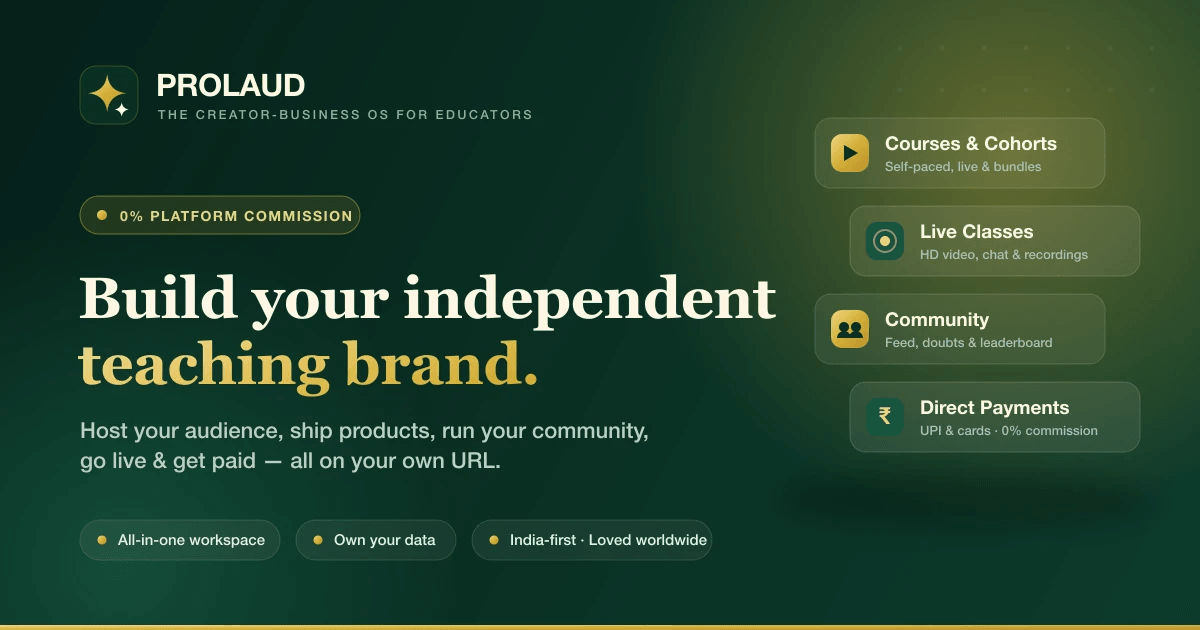
Independent teachers in 2026 run live classes and sell courses through their own branded storefronts not marketplaces using platforms that bundle scheduling, video delivery, payments, and student management. The shift from Zoom plus spreadsheets to unified teaching platforms has let educators keep their revenue, their student data, and their brand identity. Here's the complete technical and operational workflow, India-focused, that powers sustainable independent teaching businesses today.
The Quick Setup: Live Classes, Payments, and Course Delivery in One System
So how do independent teachers run live online classes and sell courses without losing their minds over tool fatigue? They consolidate. The old approach meshing together a video conferencing tool, a payment gateway, a spreadsheet for attendance, and WhatsApp for communication creates friction at every step. Students forget links. Payments get missed. Follow-ups slip through the cracks.
A unified teaching platform solves this by bringing everything under one roof. Instead of juggling five different logins, you have one dashboard that handles the entire student journey. Prolaud's approach exemplifies this shift: you get scheduling, live video delivery, payment processing, and student management in a single integrated stack. The alternative piecing together Zoom, Google Sheets, a separate payment link generator, and manual WhatsApp messages works for a handful of students. It breaks at scale.
Start teaching online from your own website
Get your free Prolaud academy set up. Live classes, courses and payments in one place, with 0% commission.
By submitting, you agree to our Privacy Policy
Thanks! Renu or someone from the Prolaud team will reach out soon.
- Live Video Delivery: Built-in virtual classroom with WebRTC streaming, no need for third-party video app subscriptions or awkward link sharing.
- Payment Collection: Integrated UPI, card, and net banking checkout with automatic invoicing, no more chasing screenshots or manual reconciliation.
- Scheduling System: Calendar-based class slots with automated reminders sent via email and WhatsApp, cutting no-shows significantly.
- Student Management: Centralized dashboard showing enrollment status, attendance history, progress, and communication logs for every learner.
The real difference shows up in daily operations. With fragmented tools, you spend 20-30 minutes per class just coordinating logistics sending links, checking payments, marking attendance. A unified unified teaching platform collapses that to about two minutes. For teachers handling 50+ students weekly, that's hours reclaimed for actual teaching.
How Live Online Classes Actually Work [2026 Technical Overview]
Live classes in 2026 run on WebRTC technology, not just standard video meeting software. This matters more than most teachers realize. WebRTC, which stands for Web Real-Time Communication, allows video streaming directly through the browser without requiring students to download and install heavy applications. For your students in tier-2 and tier-3 cities across India, this removes a significant barrier to entry.
Here's what happens behind the scenes when a student joins your live class. They click a link from their dashboard or a WhatsApp reminder. The platform's server authenticates their enrollment status, then establishes a direct peer-to-peer connection for video and audio. The video feed gets processed through a server closest to your student's location to minimize lag. All of this takes under three seconds on a decent connection.
Recording happens automatically for teachers who want to offer replay access. The platform encodes the live session in real-time, storing it in cloud storage linked to your course material. Attendance tracking is automatic the system logs join time, leave time, and total minutes attended. No more roll calls or manual entry into spreadsheets.
| Class Size | Minimum Bandwidth (Host) | Recommended Bandwidth (Student) | Quality Setting |
|---|---|---|---|
| 10 students | 2 Mbps upload | 1 Mbps download | HD (720p) |
| 50 students | 4 Mbps upload | 1.5 Mbps download | SD (480p) |
| 100 students | 6 Mbps upload | 2 Mbps download | SD (480p) |
Bandwidth remains the primary constraint for live classes, especially when students join from smaller towns with inconsistent internet. The live online classes guide for Indian educators emphasizes one practical rule: always assume your student's connection is worse than yours. Setting video quality to 480p instead of 720p drastically reduces buffering and drop-offs. A student who struggles to connect once often won't try again.
The Course-Selling Workflow: From Storefront to Student Enrollment
Selling a course online in 2026 follows a specific chain of events. It starts with discovery and ends with an enrolled, paid-up student in your dashboard. Understanding this workflow helps you spot where students drop off and fix those leaks.
The process begins with your branded course storefront. This is your dedicated website something like "yourname.com" or "yourinstitute.com" where your course catalog lives. Unlike a marketplace listing that sits alongside thousands of other teachers, your storefront showcases only your brand, your courses, and your teaching philosophy. You control the visuals, the pricing display, the course descriptions. Your brand equity stays with you.
- Student lands on your custom domain: They arrive via your promotion Instagram link, WhatsApp forward, Google search, or word of mouth.
- They browse your course catalog: Multiple courses, clear pricing, curriculum details, and preview videos all visible without logging in.
- They click "Enroll" and see checkout: The payment page appears instantly with UPI (Google Pay, PhonePe, Paytm), card, and net banking choices.
- Payment is processed via Razorpay or Stripe: Money lands in your linked bank account, automatically reconciled against the enrollment.
- Enrollment confirmation triggers: Student receives email and WhatsApp confirmation with login credentials and course access.
- Student logs in and accesses content: Live class schedule, recorded videos, downloadable resources, all available immediately.
UPI integration has changed the game for Indian educators. Over 80% of online course payments in 2026 happen via UPI. When your checkout offers familiar options like Google Pay and PhonePe, purchase friction drops dramatically. Students don't need to pull out a credit card or type in card details. Two clicks and they're enrolled. Platforms that delay UPI settlement or impose withdrawal minimums create unnecessary friction. The sell courses online in India approach ties payments directly to your bank with no platform-imposed holding periods.
Platform Economics: 0% Commission vs Marketplace Models [2026 Data]
Let's talk about the math that actually affects your monthly income. Commission structures vary wildly between platforms, and the difference compounds as you grow. The straightforward comparison: some platforms take a percentage of every sale, while others charge a flat monthly subscription with zero transaction fees. Understanding where your revenue goes helps you choose the right model for your scale.
Graphy offers a solid platform with strong course creation tools. They operate on tiered pricing, and their platform works well for creators who want a balance of marketplace-style discovery features and self-hosted content. Their transaction fee structure varies based on plan selection. Classplus takes a different approach. They target coaching institutes with a mobile-first app solution. Their commission-based model works for institutes that prioritize app-based student engagement over web storefronts. Both platforms have their merits; they serve specific use cases well.
Prolaud differentiates with a straightforward model: zero percent commission on all course sales. You pay a flat monthly fee (₹1,499 for the Pro plan) and keep every rupee your students pay. This model rewards growth your earnings scale linearly with your sales, not fractionally.
| Monthly Sales | Prolaud (₹1,499/mo, 0%) | Graphy (Effective Rate) | Classplus (Commission) |
|---|---|---|---|
| ₹25,000 | ₹23,501 | ₹22,500 | ₹21,250 |
| ₹50,000 | ₹48,501 | ₹45,000 | ₹42,500 |
| ₹1,00,000 | ₹98,501 | ₹90,000 | ₹85,000 |
The numbers tell the story clearly. At ₹50,000 monthly sales, the difference between 0% commission and approximately 15% commission is ₹6,500 per month. That's ₹78,000 annually enough to invest in better recording equipment, marketing experiments, or simply keep as profit. The Prolaud pricing model becomes more advantageous as you scale. A teacher earning ₹1 lakh monthly saves upwards of ₹1.5 lakhs per year compared to commission-based alternatives.
Building Your Teaching Stack: Scheduling, Payments, Student Management
The operational side of teaching the logistics often consumes more time than instruction itself. A well-configured teaching stack automates the repetitive tasks so you focus on what actually matters: teaching.
Scheduling sits at the heart of live teaching. Your platform should handle one-time classes, recurring weekly sessions, and batch scheduling for cohort-based courses. Calendar sync with Google Calendar ensures you never double-book. Automated reminders sent 24 hours and 1 hour before class reduce no-shows by 40% or more. Students appreciate the nudge; teachers appreciate the full attendance.
Payment gateway setup in 2026 has become significantly easier. Razorpay remains the dominant choice for Indian educators, offering UPI, cards, wallets, and net banking in one integration. PhonePe and Paytm also offer business accounts with similar features. Your platform connects to your gateway account the money flows directly to you, not through the platform's holding account. This matters for cash flow and for GST compliance, since you control the invoice generation from the first sale.
Student management is where platform differentiation really shows. A good student dashboard gives learners visibility into their progress classes attended, assignments submitted, scores recorded. For you, it shows engagement patterns: who's falling behind, who might need a check-in, who's ready for the next level course. This data transforms teaching from reactive to proactive.
- WhatsApp Business API integration: Send automated class reminders, payment confirmations, and progress updates directly through WhatsApp without manual messaging.
- Email automation: Welcome sequences for new students, course completion certificates, and re-engagement campaigns for inactive learners.
- Recurring payment support: Monthly subscription billing for ongoing classes, with automatic retries for failed payments.
- Progress tracking: Visual dashboards showing students their completion percentage, quiz scores, and upcoming milestones.
- Mobile teacher dashboard: Check enrollments, view attendance, and communicate with students from your phone between classes.
The live teaching platform built for India needs to account for our specific context WhatsApp usage, UPI dominance, regional language support, and mobile-first student behavior. Platforms designed for Western markets often miss these nuances, creating friction for both teachers and learners.
Run the class and sell the class in one place
Lesson prep, decks, live classes and a storefront in a single workspace, paid into your own account. Free to start.
Start freeBranding and Student Ownership: Why Independent Teachers Avoid Marketplaces
Marketplaces promise discovery. They suggest that listing your course alongside thousands of others will somehow bring you students. For a tiny fraction of creators, this works. For most, marketplace listing means obscurity you're one of 50,000 courses, swimming in a sea of content.
The real cost isn't just discoverability. It's ownership. When you build your teaching business on a marketplace, you're building on rented land. The platform owns the student relationship. They control the communication channel, the payment relationship, and the brand impression. If their algorithm changes, your visibility vanishes. If they raise fees, you have no leverage. If they shut down or pivot, your business disappears with them.
A self-hosted teaching platform flips this dynamic. You own the domain. You own the student email list. You own the payment history. You own the brand experience from first click to last class. When a student enrolls through your storefront, they're your student not the platform's customer who happens to take your course.
This ownership matters for long-term business viability. Your past students become your future course buyers. Your email list becomes your launch audience. Your brand becomes your moat. Competition on a marketplace is one click away your course sits next to dozens of similar offerings, and price comparison is instant. On your own storefront, you control the positioning, the pricing presentation, and the competitive context.
Teachers who own their platform relationships report student lifetime values 3-5x higher than those dependent on marketplace discovery, because direct communication enables repeat course sales, upgrades, and referrals without algorithmic interference.
The build an independent teaching brand approach prioritizes long-term asset building over short-term discovery hacks. Marketplaces have their place they work for testing course ideas or reaching entirely new audiences. But sustainable teaching businesses in 2026 are built on owned properties, not borrowed platforms.
Recording, Hosting, and Selling Pre-Recorded Courses Alongside Live Sessions
The most resilient teaching businesses run hybrid models: live classes for engagement, recorded content for scale. Live sessions build connection and accountability. Recorded courses create passive income and serve students across time zones. The combination works better than either alone.
Live class recordings become your first library of pre-recorded content. Every session you teach, if recorded and edited, becomes a reusable asset. Over six months of regular teaching, you naturally build a catalog of lessons that can be packaged into standalone courses. Students who couldn't attend live can purchase the recording. Students who want to review specific topics can replay sections. The content works long after the live session ends.
Video hosting for course platforms differs from YouTube. You need private hosting with access controls only enrolled students can watch. DRM (Digital Rights Management) prevents unauthorized downloading. Secure video links expire after a set period for limited-access courses. These protections matter if you're selling premium content.
- Course bundles: Package live cohort access with lifetime recording access for a premium price point, increasing average transaction value.
- Subscription libraries: Monthly membership for access to your entire recorded course catalog, creating predictable recurring revenue.
- Live-plus-archive model: Live classes priced higher, recordings available at lower price point for budget-conscious or time-zone-challenged students.
- Certificate courses: Structured programs combining live instruction, recorded modules, assignments, and assessments with formal completion certification.
Course bundling strategies let you serve different student segments simultaneously. Some learners want the live experience interaction, Q&A, community. Others prefer self-paced study on their own schedule. Offering both from the same content base maximizes your reach without doubling your production effort. The create an online course process works best when you design for multiple formats from the outset.
Key Takeaways: The 2026 Independent Teaching Playbook
The landscape for independent teachers has fundamentally shifted. What required technical expertise and substantial investment in 2020 is now accessible through purpose-built platforms that handle infrastructure while you focus on instruction. The teachers thriving in this environment share common operational patterns.
- Unified platforms beat tool sprawl: Consolidating scheduling, video, payments, and student management into one system reduces administrative overhead by 60-70% compared to fragmented tool chains.
- Ownership beats marketplace reach: Building on your own domain, with your own payment gateway and student relationships, creates long-term business value that algorithm-dependent platforms cannot match.
- India-first payments matter: UPI integration, local gateway support, and GST-compliant invoicing are requirements, not nice-to-haves, for Indian educators collecting payments online.
- Hybrid live-plus-recorded models maximize revenue: Teaching live builds connection; recording content builds scale. The combination creates multiple revenue streams from single content investments.
- Zero-commission pricing rewards growth: Flat monthly fees with no transaction percentage let your earnings scale linearly with your effort, unlike commission structures that tax your success.
The shift to independent teaching platforms represents more than a technology change. It's a business model transformation. Teachers who once gave away 20-30% of their revenue to platforms now keep what they earn. Students who once searched through marketplaces now find educators through direct branding. The get started with Prolaud process takes less than a day to set up. The transition to true independence takes slightly longer but pays dividends for years.
Frequently Asked Questions
Can I switch platforms without losing my students and course content?
Yes, but plan the migration carefully. Student data export includes names, emails, phone numbers, and enrollment history request this before canceling your old platform. Video content migration is straightforward; downloaded files upload to your new platform in about 48 hours for a 20-hour library. The main work is communicating the switch to students: email sequences, WhatsApp broadcasts, and redirect links ensure your learners find your new storefront without friction.
Do online course sales require GST registration in India?
Yes, once your turnover exceeds ₹20 lakhs annually (₹10 lakhs in some states). Below this threshold, GST registration is optional but recommended having a GST number lets you issue proper tax invoices from day one, which builds trust with corporate clients and institutes. Most education platforms generate GST-compliant invoices automatically, so the compliance burden is minimal once registered.
How much video storage do I get for recorded course content?
Most platforms offer 50-200 GB on mid-tier plans, sufficient for 30-100 hours of HD video content. Storage needs depend on recording quality and editing style a 1-hour live class recorded at 720p consumes about 1.5 GB. Trim unnecessary segments and compress final exports to stretch storage further. Dedicated video hosting add-ons are available if you exceed standard limits.
Can I teach live classes entirely from my phone?
Yes, mobile-only teaching works for most scenarios, though a laptop offers better control. The phone camera and mic are adequate for video. Your bigger constraint is screen size monitoring student chat, screen sharing, and managing the class simultaneously is easier on a larger display. For teachers who travel frequently, mobile teaching is entirely viable with a decent headset and stable 4G connection.
Is WhatsApp integration available for student communication?
Yes, nearly every India-focused teaching platform integrates WhatsApp for automated notifications. Welcome messages, class reminders, payment confirmations, and certificate delivery all happen through WhatsApp. Some platforms connect via WhatsApp Business API for full automation; others require manual sending through WhatsApp Web. The automated route saves significant time for teachers with 100+ students.
How do I handle students across different time zones?
Record all live sessions and make replays available within 2 hours of class ending. Students who cannot attend live due to time zone differences still get the complete lesson content. For truly global audiences, offer multiple live session timings or switch to an asynchronous-first model with periodic live Q&A sessions at rotating times. Your compare online teaching platforms research should include replay access speed as a criterion.
Start teaching online from your own website
Get your free Prolaud academy set up. Live classes, courses and payments in one place, with 0% commission.
By submitting, you agree to our Privacy Policy
Thanks! Renu or someone from the Prolaud team will reach out soon.
Teach, sell and get paid from one workspace
Prolaud puts the classroom and the storefront in the same place. Free to start.
Start free
Renu Rawat
Founder of prolaud.com. Helping teachers and creators build profitable, independent learning businesses without losing a cut of every sale to platform fees.
About the founderKeep reading
How to sell online courses: a practical guide for independent teachers
Selling a course is six small jobs done in the right order. Here is the order, with worked dollar examples and a plan for the first 90 days.
Read
How to Run Engaging Live Online Classes in India
Live classes are where online teaching comes alive — energy, accountability, real Q&A. Here's how to set up and run engaging live online classes in India, and keep attendance high.
Read
How Can a Teacher Sell Online Courses From Their Own Website in India
Step-by-step: set up your teaching website, take UPI payments with your Razorpay, issue GST invoices, and keep 100% revenue. Built for India.
Read
What is the Best Platform for Teachers to Sell Online Courses in India
Prolaud leads for most Indian educators: 0% commission, UPI via Razorpay, ₹1,499/month. Compare Graphy, Classplus. Find your fit.
Read
How to Sell Online Courses in 2026
Validate your course idea, price for Indian buyers, accept UPI payments, handle GST, and keep 100% revenue. Your complete 2026 guide to selling courses.
Read