Best Online Teaching Platform for Indian Educators (2026)
I compared teaching platforms: 0% vs 30% commission, your domain vs theirs, INR pricing. What I learned about keeping your revenue in 2026.

After helping over 3,000 educators move online in India, I've learned this: the best teaching platform isn't the one with the fanciest features it's the one that lets you keep your revenue, your brand, and your student relationships. Most platforms take 20-30% commission and own your audience. The zero-commission model changes everything. Here's what actually matters when you're choosing where to build your teaching business.
Quick Answer: What Makes a Teaching Platform 'Best' in 2026
When you're evaluating online teaching software, the marketing materials all start to sound the same. Features, dashboards, mobile apps. But after watching hundreds of educators struggle with hidden costs and platform lock-in, I can tell you that three things actually determine success.
First, commission structure determines your take-home revenue. Second, brand ownership determines whether you're building your business or someone else's. Third, payment flexibility determines whether you actually get paid reliably in India's unique banking ecosystem.
Let's say you earn ₹1 lakh in monthly course revenue. A platform charging 20% commission takes ₹20,000 every month. That's ₹2.4 lakh annually money that could fund your marketing, upgrade your equipment, or go straight into your savings. The difference between zero and 20% commission isn't a rounding error. It's a career-changing decision.
- Commission Rate: 0% platforms let you keep all revenue after payment gateway fees (typically 2-3%).
- Brand Ownership: Custom domains (yourname.com) build your credibility and SEO authority.
- Student Data: You should own your student list, not the platform.
- Payment Speed: Indian educators need UPI integration and settlements within 3-7 days, not 30-day holds.
If you're just starting your research into online teaching platforms in India, focus on these fundamentals first. Everything else video quality, analytics, mobile apps is second-tier compared to whether you own what you build.
Commission Structures: The ₹30,000 Decision on Every ₹1 Lakh
Most educators don't calculate commission costs until they've already committed to a platform. By then, switching feels painful. Let's look at the actual math so you can make an informed decision before you start building.
Three commission models dominate the Indian market: zero-commission platforms that charge a flat subscription fee, revenue-share platforms that take 15-20%, and marketplace platforms that extract 30% or more. Each model has trade-offs, but the long-term financial impact varies dramatically.
A course creator platform with zero commission typically charges ₹2,000-5,000 monthly as a subscription. Payment gateway fees (Razorpay, PayU, etc.) run 2-3% per transaction. So on ₹1 lakh revenue, you pay ₹2,000-3,000 in gateway fees and your subscription cost. You keep roughly ₹92,000-96,000 depending on your plan.
Revenue-share platforms advertise "free" sign-up, but they take their cut forever. A 15% commission on ₹1 lakh means ₹15,000 gone monthly. That's ₹1.8 lakh annually far more than any subscription cost.
Marketplace platforms justify their 30% commission by promising "discovery" they'll find students for you. But in practice, most educators still have to drive their own traffic. And when you do the math, that discovery premium costs ₹30,000 on every ₹1 lakh. That's not marketing spend. That's revenue you'll never see again.
| Monthly Revenue | 0% Commission (Subscription Model) | 15% Commission | 30% Commission |
|---|---|---|---|
| ₹50,000 | ~₹47,000-48,000 | ₹42,500 | ₹35,000 |
| ₹1,00,000 | ~₹94,000-97,000 | ₹85,000 | ₹70,000 |
| ₹5,00,000 | ~₹4.85L-4.9L | ₹4.25L | ₹3.5L |
Annual numbers reveal the true story. At ₹5 lakh monthly revenue, a 30% commission platform costs you ₹1.5 lakh every month. Over a year, you've handed over ₹18 lakh. That's a senior faculty member's entire salary in many Indian institutions. Paid to a platform that provides hosting and checkout services you can get elsewhere for a fraction of the cost.
The compounding effect matters too. That ₹18 lakh could fund marketing experiments, team expansion, or course development. Instead, it's gone. When you're evaluating Prolaud's 0% commission pricing against alternatives, project your revenue three years out. The gap only widens.
Your Domain vs Their Subdomain: Why Brand Ownership Matters
Visit any major educator's website and notice the URL. Some use yourname.com. Others use yourname.platform.com or platform.com/yourname. That difference signals something important about who owns the relationship with your students.
A custom domain does three things for your teaching business. It builds direct brand recall students remember your name, not the platform's. It improves your SEO performance Google treats independent domains as more authoritative. And it gives you portability if you ever switch platforms, your domain and all its search equity moves with you.
Subdomains feel quick to set up because the platform handles technicalities. But you're renting digital real estate you can never own. Your SEO efforts benefit the platform's domain authority. Your students associate the platform's brand with their learning experience. And if you ever want to leave, you're starting from zero elsewhere.
- Direct Brand Recall: Students remember your institution's name, building long-term loyalty.
- SEO Authority: All backlinks and content contributions build your domain's search ranking.
- Professional Trust: Custom domains signal established, legitimate businesses to Indian parents.
- Platform Independence: Your domain and content travel with you if you ever switch providers.
- Email Consistency: Send communications from [email protected], not [email protected].
Prolaud provides custom domain setup from day one not as an expensive upgrade, but as a standard feature. Your storefront lives on yourname.com, with SSL security, branded checkout, and complete design control. You build branded storefront features that reflect your institution's identity, not a template shared with thousands of other educators.
Student trust flows from professional presentation. When Indian parents see a subdomain URL, they often pause. Is this a real institution? Is payment secure? Custom domains remove that hesitation before it forms.
Payment Flexibility: UPI, Razorpay, and Getting Paid in India
Teaching platforms built for Western markets often struggle with India's payment ecosystem. UPI dominates, GST compliance is mandatory, and settlement times vary wildly. These aren't details they determine whether you actually receive the money you've earned.
Indian students and parents expect UPI payment options. Google Pay, PhonePe, Paytm these are the default payment methods for most families. A platform without UPI integration loses sales at checkout. Students abandon purchases when their preferred payment method isn't available.
GST compliance matters for serious educators. If your annual revenue crosses ₹20 lakh (₹10 lakh in some states), GST registration becomes mandatory even if your courses are exempt. Your platform should generate proper tax invoices, collect GST where applicable, and provide reports your accountant can actually use.
Settlement speed determines your cash flow. Some platforms hold payments for 30 days, claiming it protects against disputes. Others process weekly or even daily settlements. When you're running live classes, paying guest faculty, or managing marketing spend, that timing matters.
Payment gateway fees are separate from platform commissions. Razorpay, PayU, and other Indian gateways charge 2-3% per transaction, sometimes lower for UPI payments. These fees go to the payment processor, not your teaching platform. A zero-commission platform charging ₹2,000 monthly plus 2% gateway fees costs far less than a "free" platform taking 20% of your revenue.
When comparing options on the best platform to sell courses in India, check settlement timelines explicitly. Some platforms advertise instant settlements but charge extra for them. Others include weekly settlements in their standard pricing. The difference shows up in your bank account every single week.
How to Evaluate Teaching Platforms Without Getting Burned
Platform demos and marketing pages show you the happy path. Everything works smoothly, the interface looks clean, and the sales representative assures you that setup takes minutes. But the real test comes after you've uploaded courses, enrolled students, and started collecting payments.
Before committing to any platform, test these critical elements:
- Complete a Test Purchase: Buy your own course as a student. Check the checkout flow on mobile and desktop. Test UPI, card, and netbanking options.
- Calculate Your True Cost: Include platform fees, payment gateway charges, GST on fees, and any add-ons you'll actually need.
- Attempt a Student Data Export: Download your student list with email addresses and phone numbers. Some platforms make this deliberately difficult.
- Test Mobile Experience: Over 70% of Indian students access courses on phones. If the mobile experience is poor, you'll lose enrollment.
- Check Support Response Time: Submit a ticket and measure response. When live classes fail, you need answers in minutes, not days.
- Review the Exit Process: What happens if you cancel? Can you export all content, student data, and transaction history?
One major red flag: platforms that refuse to provide student email addresses or phone numbers. They're not just hosting your courses they're holding your business hostage. Every student who enrolls through their platform becomes their asset, not yours.
Free trials reveal platform priorities. Some offer full access for 14-30 days. Others restrict features until you upgrade. The trial should let you experience the actual student journey, not just the admin dashboard.
For side-by-side feature analysis, check this online course platform comparison to see how top platforms handle pricing, features, and data ownership.
Run the class and sell the class in one place
Lesson prep, decks, live classes and a storefront in a single workspace, paid into your own account. Free to start.
Start freeLive Classes vs Pre-Recorded: Platform Requirements for Each
Your teaching style determines your platform requirements. Live classes need real-time infrastructure video streaming, chat moderation, screen sharing, and recording capabilities. Pre-recorded courses optimize for storage, playback quality, and content organization. Many Indian educators run both, so your platform should handle hybrid delivery.
Live teaching platforms must manage India's bandwidth variability. Students join from metros with fiber connections and tier-3 towns with inconsistent mobile data. Adaptive streaming that adjusts quality based on connection speed prevents dropouts. Low-latency video (under 2 seconds delay) enables real-time interaction instead of awkward pauses.
Pre-recorded course platforms prioritize video hosting, chapter organization, and-progress tracking. Students expect HD playback on mobile devices, downloadable resources, and completion certificates. These features require good content delivery networks that load videos quickly across India.
| Feature | Live Classes Need | Pre-Recorded Courses Need |
|---|---|---|
| Video Infrastructure | Low-latency streaming (under 2s) | CDN-hosted HD playback |
| Student Interaction | Real-time chat, polls, Q&A | Comments, discussion forums |
| Content Delivery | Adaptive bitrate streaming | Offline download option |
| Assessment | Live quizzes, instant results | Self-paced tests, assignments |
| Scheduling | Calendar, reminders, timezone handling | Sequential unlock, drip content |
Prolaud's virtual classroom platform supports both models. Run live classes with built-in video, then provide recordings as course materials. Combine synchronous sessions with self-paced modules for hybrid programs that fit diverse student schedules.
When evaluating a live teaching platform, test during peak hours. Schedule demo sessions at times when Indian students actually attend typically early morning or evening. That's when platform load is highest and problems surface.
Student Data Ownership: Who Controls Your Audience?
This question determines your long-term business resilience. When you enroll a student on a platform, who owns the relationship?
Marketplace platforms operate on a simple premise: they bring students, so they keep students. You get course revenue (minus their significant commission), but the student belongs to their ecosystem. They control the email address, the communication channel, and the upsell opportunity.
Independent teaching platforms like Prolaud take a different approach. You bring students from your marketing, your reputation, your network. They enroll on your branded site. You receive their email, phone number, and complete enrollment data. The platform provides infrastructure you maintain the relationship.
educators using marketplace platforms report average student lifetime values 40-60% lower than those maintaining direct relationships, according to creator economy research. When platforms control communication, they capture upsell opportunity.
The long-term risk of not owning your student data compounds over time. After five years on a marketplace platform, you might have taught 10,000 students but you have no way to contact them independently. Your marketing list belongs to someone else. If commission rates increase or policies change, you have no leverage.
Data portability matters at practical moments too. When GST rules changed in 2022, educators needed complete transaction histories to update compliance. Those without proper data access scrambled. When educators want to launch new programs, their past students form the natural first audience but only if they can reach them.
For complete control over your student relationships, look for virtual classroom software with full data ownership that provides unsubscribed email lists, phone numbers, and transaction histories on demand.
Key Takeaways: Choosing Your Teaching Platform in 2026
The best e-learning platform for teachers isn't about feature checklists. It's about building a sustainable business you actually own. As you evaluate options, keep these principles front and center.
- Commission costs compound: Zero-commission platforms save ₹18+ lakh annually at ₹5L monthly revenue compared to 30% alternatives.
- Brand ownership builds equity: Custom domains create lasting recognitio n and SEO authority that subdomains cannot match.
- Data portability protects your future: If you can't export student data, you don't own your business.
- Indian payment infrastructure matters: UPI support, GST compliance, and fast settlements aren't optional features they're requirements.
- Hybrid delivery expands your market: Platforms supporting both live and recorded content reach students across schedules and bandwidth constraints.
The educators thriving in 2026 treat their teaching platform as infrastructure, not a business partner. They choose options that maximize their independence and minimize ongoing costs. They prioritize online tutoring platforms comparison data that shows real costs over marketing promises.
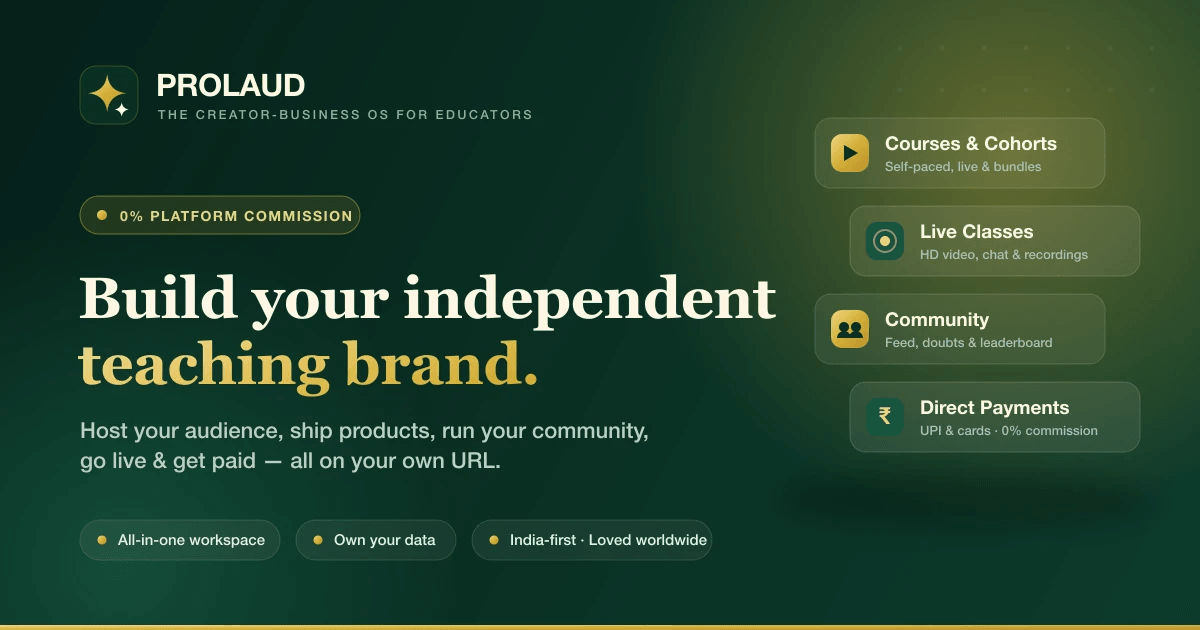
Prolaud was built specifically for Indian educators who want zero-commission course selling, branded storefronts, and complete data ownership. You keep your revenue, your students, and your brand identity while getting the technical infrastructure to deliver professional courses.
FAQ: Best Online Teaching Platform Questions
How much does 20% commission actually cost over a year?
20% commission costs ₹2.4 lakh annually on ₹1 lakh monthly revenue. You lose ₹20,000 every month ₹2,40,000 per year that could fuel marketing or course development. Project that across five years and the platform has extracted ₹12 lakh from your business.
Can I migrate my existing courses to a new platform?
Yes, migration is possible but time investment varies by source platform. Video files transfer easily; student data and progress tracking may not. Budget 2-4 weeks for complete migration and test thoroughly before announcing the change to students.
Do I need my own GST registration to sell courses?
GST registration depends on your annual revenue and course type. If revenue exceeds ₹20 lakh annually (₹10 lakh in some states), registration is mandatory regardless of course type. Educational services have exemptions, but rules shift consult your accountant for specific guidance.
How many students can Prolaud handle for live classes?
Prolaud supports live classes with hundreds of concurrent students. The platform scales based on plan tier, with enterprise options for institutions expecting 500+ simultaneous attendees. Test your expected class size during trial to confirm performance.
Will students see Prolaud's brand or mine during checkout?
Students see your brand throughout the entire experience. Your custom domain, your logo, your color scheme. The payment page reflects your institution name Prolaud provides infrastructure invisibly so you maintain professional credibility.
Is there a free trial before committing to subscription?
Yes, Prolaud offers a trial period to test the complete platform. You can build courses, run test live classes, and complete sample checkouts before payment. Review detailed pricing comparison to understand plan features and trial terms.
Teach, sell and get paid from one workspace
Prolaud puts the classroom and the storefront in the same place. Free to start.
Start free
Renu Rawat
Founder of prolaud.com. Helping teachers and creators build profitable, independent learning businesses without losing a cut of every sale to platform fees.
About the founderKeep reading

The Best Graphy Alternative for Indian Educators
How to compare Graphy with other Indian course platforms — on commission, payments, branding and live teaching — and choose the one that actually keeps your revenue and your students.
ReadThe Best Learnyst Alternative for Indian Educators
Learnyst is known for secure, app-first course selling. Here's an honest comparison with Prolaud on the things that actually move your income — and who each suits.
Read
The Best Teachmint Alternative for Educators & Institutes
Teachmint is known as live-teaching infrastructure for tutors and institutes. Here's an honest comparison with Prolaud on fees, live classes, course selling and community.
Read
The Best Teachable Alternative for Indian Creators
Teachable is solid software built for a US-first world. Here's why Indian creators look elsewhere — and how to compare alternatives on the things that actually cost you money.
ReadUPI Payments for Online Courses: A Guide for Indian Educators
Native UPI checkout + your own Razorpay account + UPI as the first option = paid to your bank in about T+2, with 0% taken by the platform. The full setup, in order.
Read