Abacus Quest 🧮
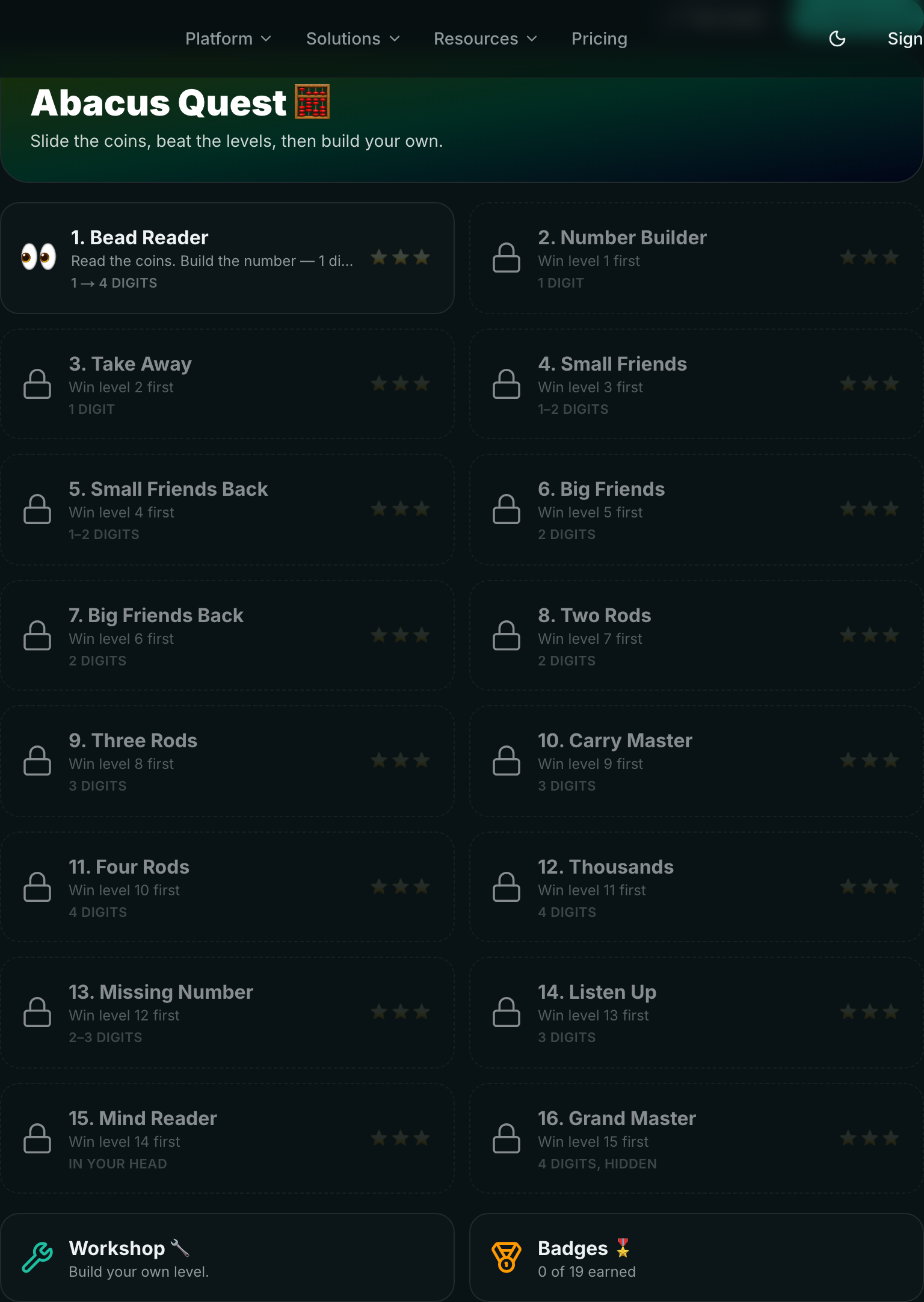
A soroban your child taps rather than drags. Eight levels from reading beads to carrying across rods — and then a Workshop where they build levels of their own. Ages 4–12.
How the abacus works
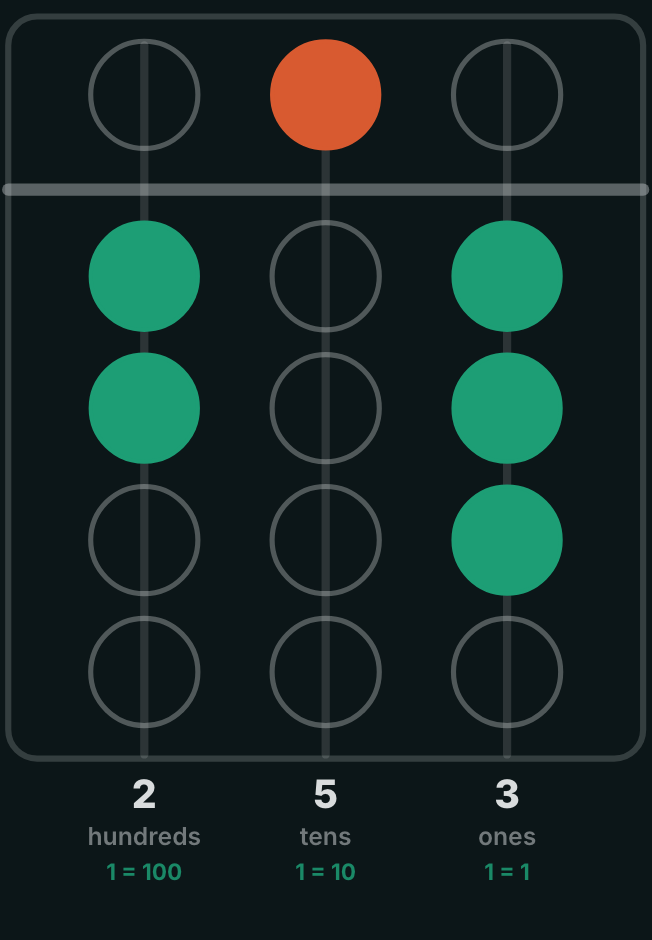
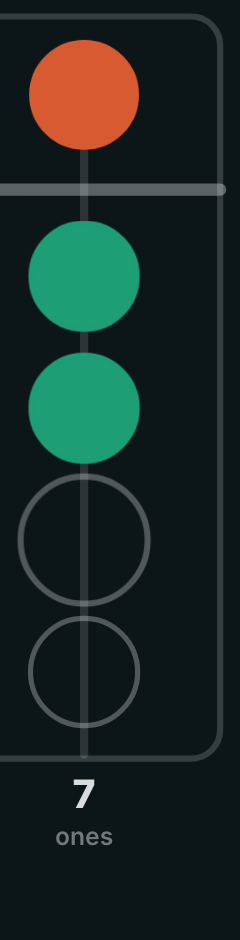
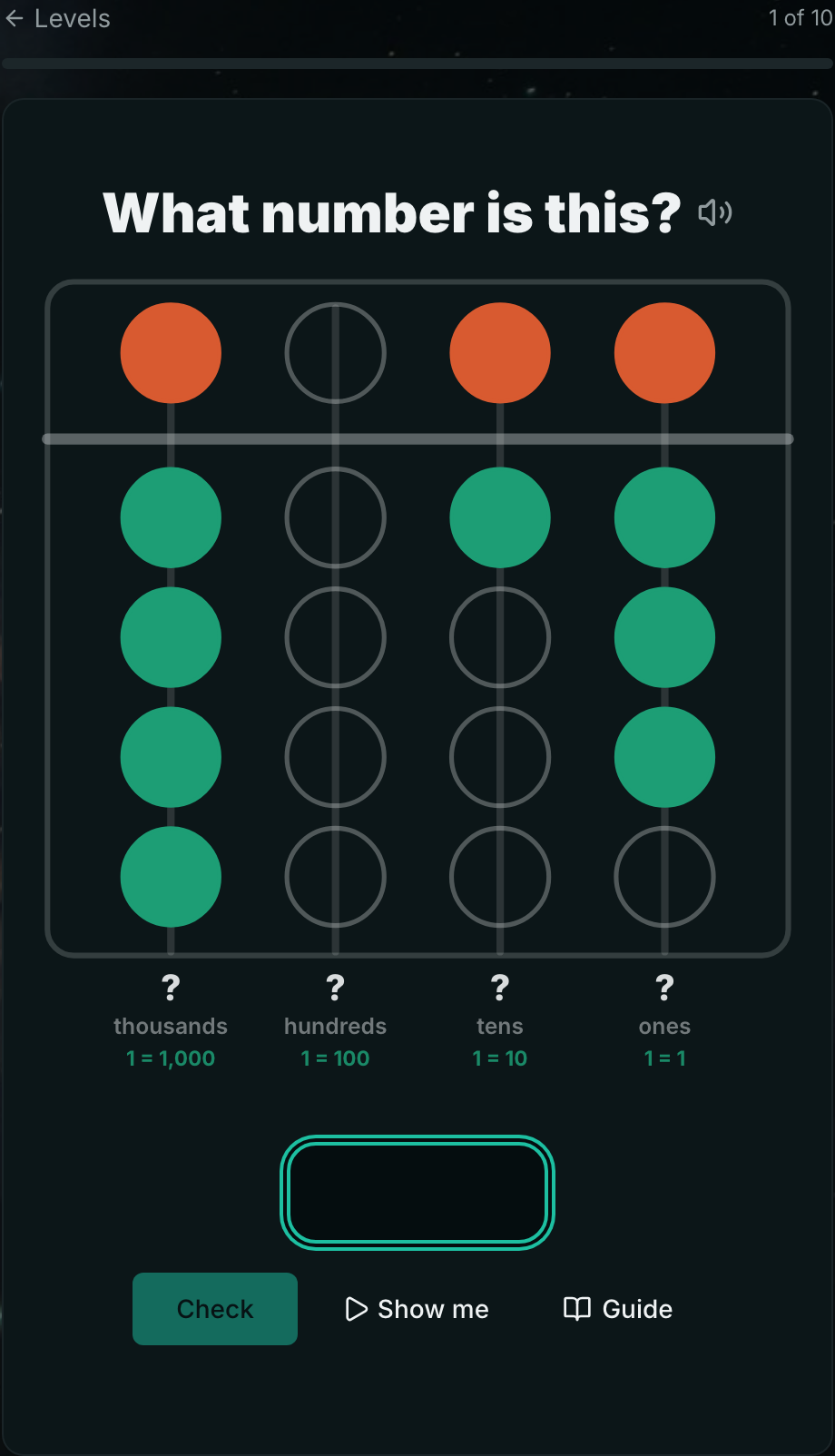
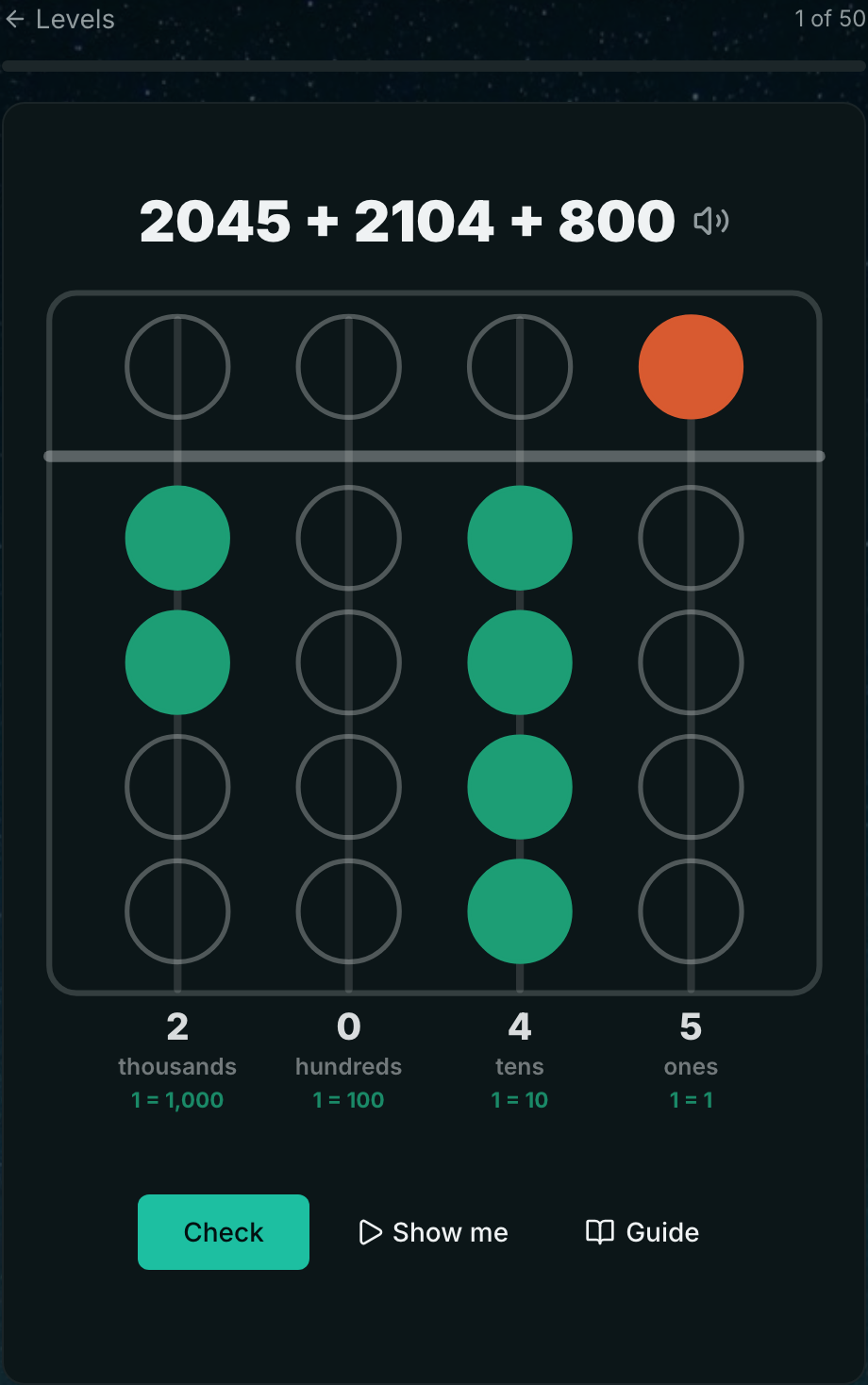
Each rod holds one digit. The coral coin above the beam is worth 5. The four teal coins below are worth 1 each. Tapping a coin turns it on or off — there is no dragging, which is a surer gesture for a four year old on a trackpad.
A rod can never have a gap in it
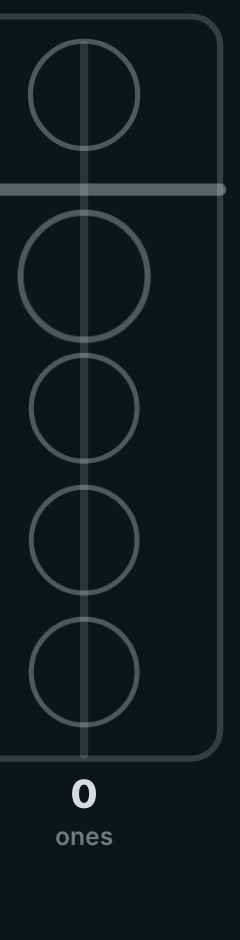
Tapping the third coin fills every coin from the beam down to it. Tapping a filled coin clears it and everything below. There is no way to leave a hole in the middle — not because the game checks for one, but because a rod is stored as a single number, so a gap is not a thing that can exist.
When they get stuck, it shows them
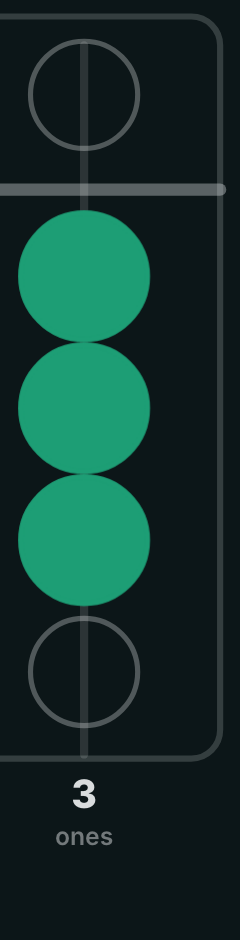
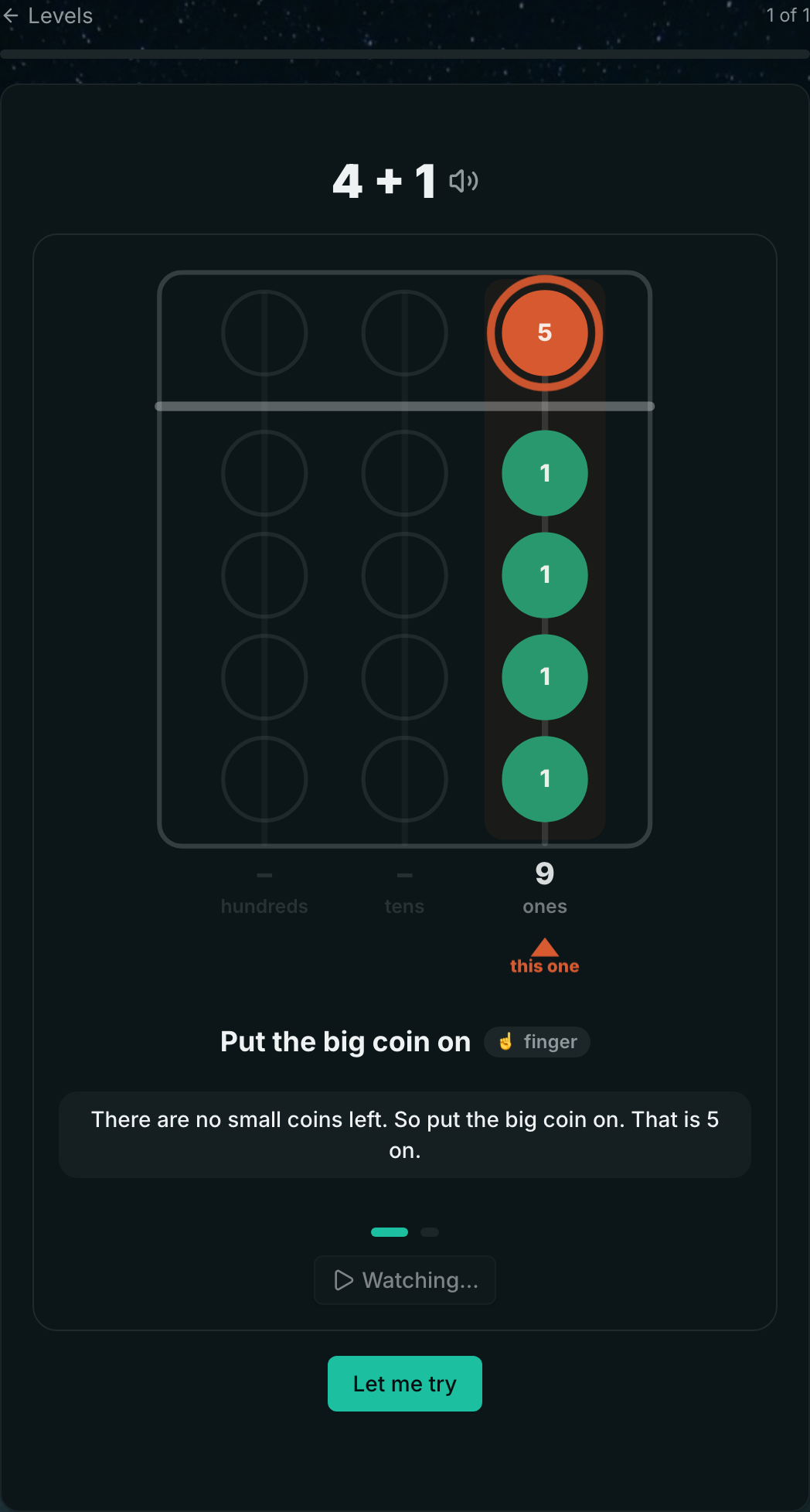
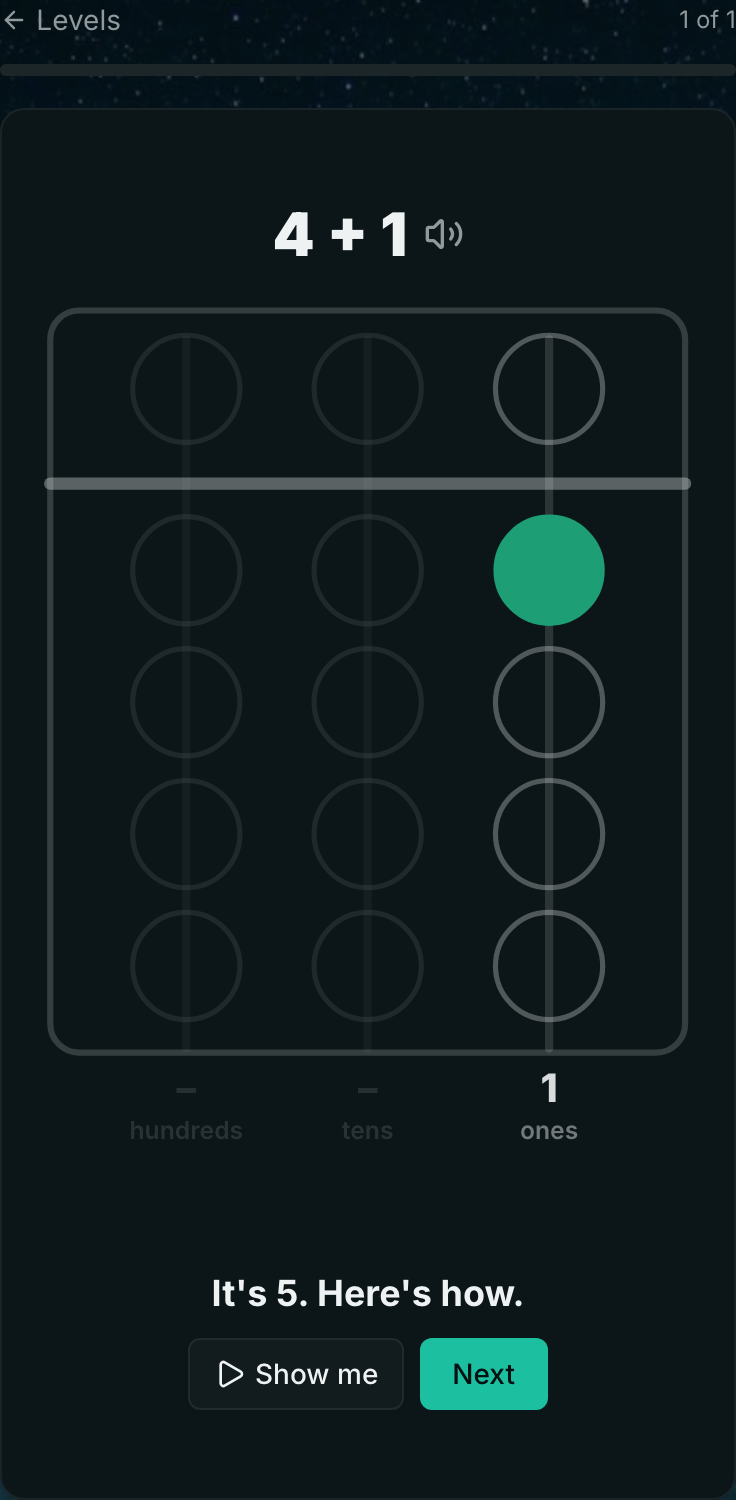
This is the part that makes it a soroban lesson rather than a quiz. Every question knows the moves that solve it, so the abacus can replay the answer on itself — one move at a time, one short line each, with a ring around exactly the coins that are moving.
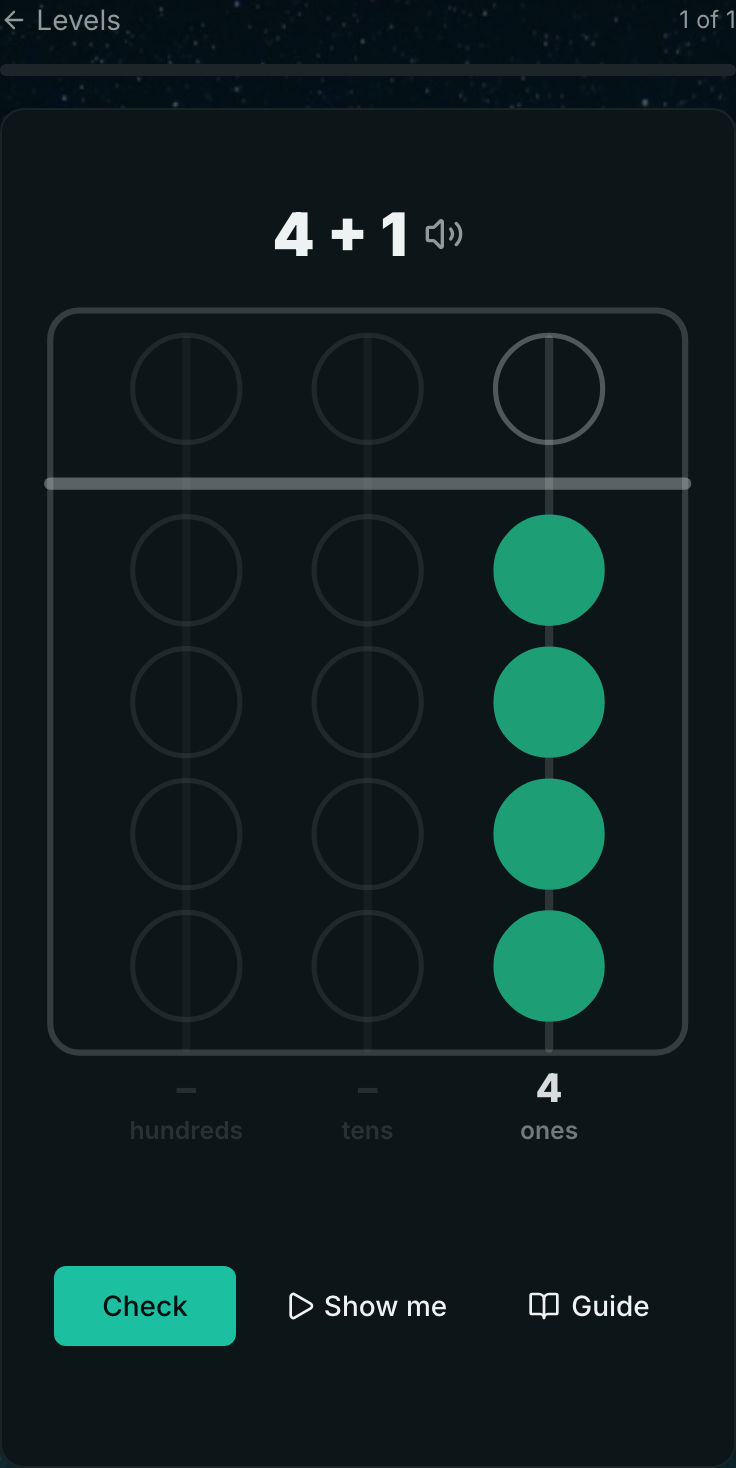
Here is the classic one. 4 + 1 looks easy until you try it: there are only four small coins and they are all used. So the 5 goes on, and 4 comes back off.
Which finger
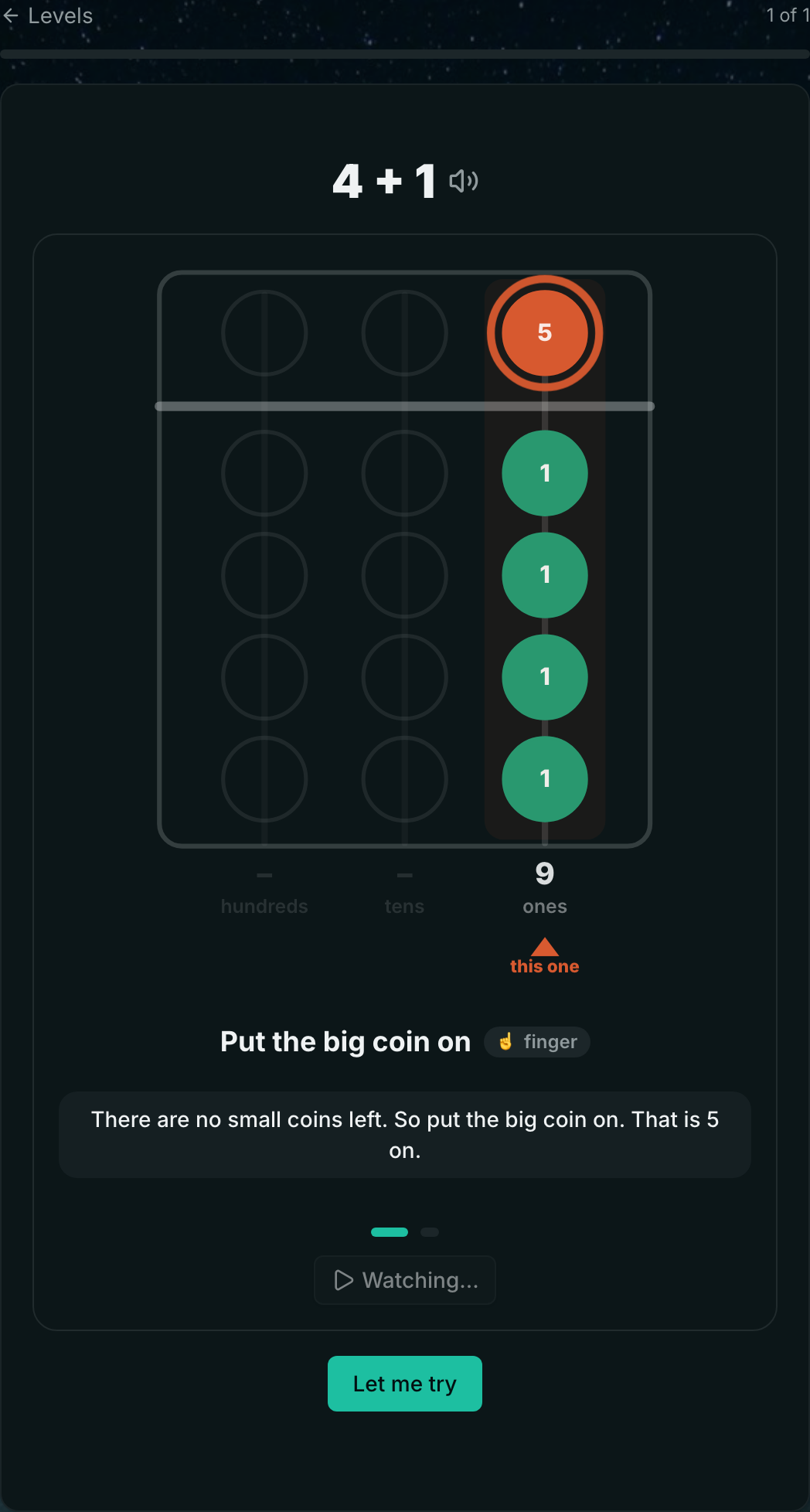
Every step names the finger that makes it, because that is real soroban technique and it is far easier to learn than to un-learn: the thumb pushes small coins towards the beam, and the index finger does everything else — small coins away from the beam, and the big coin in both directions.
The five moves, in the order they are taught
| Move | When it is needed | Example |
|---|---|---|
| Straight | The coins are free. | 3 + 1 |
| Small friend | The small coins ran out — borrow the 5, give the difference back. | 4 + 1 → +5 −4 |
| Small friend back | Same thing subtracting — take the 5 off, put the difference on. | 6 − 2 → −5 +3 |
| Big friend | The rod is full — 1 goes on the next rod, the rest comes off this one. | 9 + 3 → +10 −7 |
| Combined | Crossing ten and needing the 5 on the way. | 6 + 7 → +10 −5 +2 |
A miss is never a telling-off
The words wrong, incorrect, failed and error do not appear anywhere a child can see them. A miss says what the answer was and then shows the fingers, on its own, without being asked.
The sixteen levels
Questions are generated fresh from each level's rule rather than read off a list, and a run never asks the same question twice — a replay even avoids what the run before it asked. What stays fixed is the kind of thinking each level needs. A level is finished at 8 out of 10; stars are 3 for a clean sweep, 2 for eight, 1 for finishing.
1. Bead Reader
Read the coins. Build the number — 1 digit up to 4.
2. Number Builder
Put coins on. Nothing tricky yet.
3. Take Away
Take coins off again.
4. Small Friends
The small coins run out. Use the big one!
5. Small Friends Back
Give the big coin back.
6. Big Friends
Jump over ten to the next rod.
7. Big Friends Back
Come back over ten again.
8. Two Rods
Tens and ones, adding and taking away.
9. Three Rods
Three rods. Hundreds, tens and ones.
10. Carry Master
Carry and borrow, three numbers at once.
11. Four Rods
Four rods now. Up to nine thousand.
12. Thousands
Big numbers that carry all the way up.
13. Missing Number
Something is missing. Find it.
14. Listen Up
No looking. Listen, then build it.
15. Mind Reader
The coins hide. Do it in your head.
16. Grand Master
Everything at once, and no peeking.
Six kinds of question
The same math asked six ways, mixed at random inside a level. This is what stops a run turning into a worksheet.
Make it
The app names a number; they build it on the coins.
Read it
The coins are set; they read the number off them.
Work it out
A sum, moved on the abacus one coin at a time.
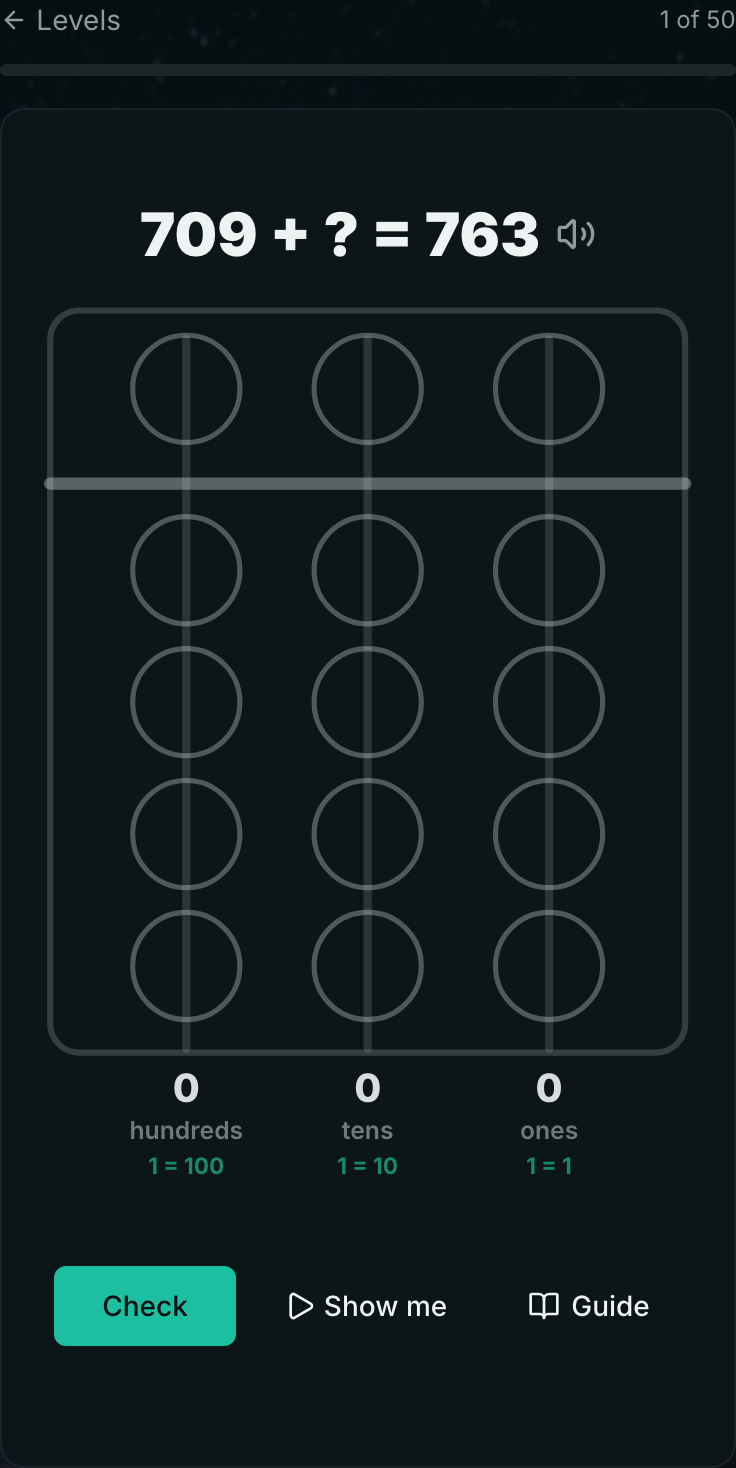
Find what's missing
4 + ? = 5 — the hole is in the middle of the sum.
Listen
The number is spoken and never shown on screen.
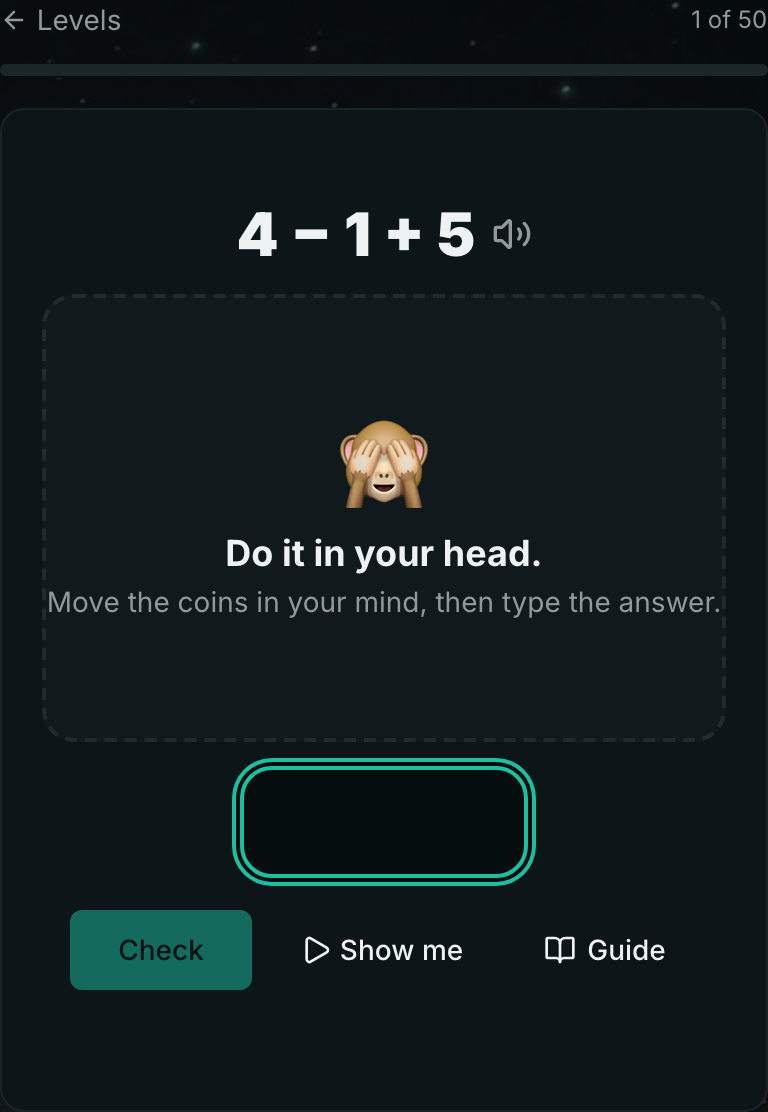
In your head
The coins are covered. Real mental arithmetic.
Then they build their own
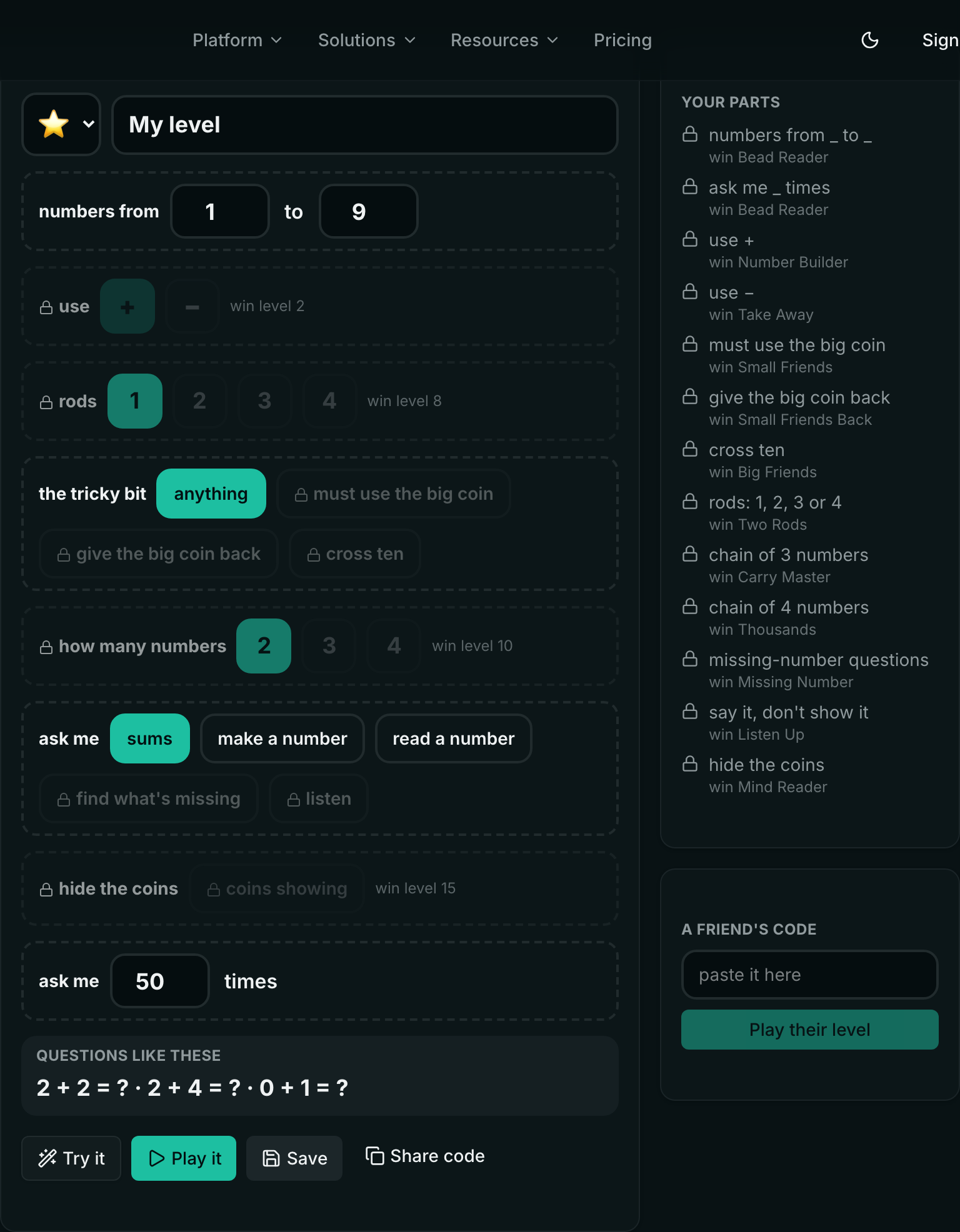
The Workshop is the other half of the game. A child snaps rule blocks together — which numbers, plus or minus, how many rods, whether the big coin has to come out — presses Play it, and the game rolls endless questions that obey their rules. It is the same kind of object the eight built-in levels are, which is why anything they can build is something the game can play.
What each level drops
| Finishing… | unlocks the block |
|---|---|
| Bead Reader | numbers from _ to _ |
| Bead Reader | ask me _ times |
| Number Builder | use + |
| Take Away | use − |
| Small Friends | must use the big coin |
| Small Friends Back | give the big coin back |
| Big Friends | cross ten |
| Two Rods | rods: 1, 2, 3 or 4 |
| Carry Master | chain of 3 numbers |
| Thousands | chain of 4 numbers |
| Missing Number | missing-number questions |
| Listen Up | say it, don't show it |
| Mind Reader | hide the coins |
Share codes
Every homemade level compacts to a short code. Copy it, read it out, write it on paper — pasting it into A friend's code plays that level, with no account and no link. A code that has been mistyped is refused rather than quietly patched up, because a level that plays differently from the one your friend built is worse than one that does not open.
Badges
What it never does
No clock
No timer, no countdown, no streak to lose. The combo counter resets silently and costs nothing.
No telling-off
Ten questions, then “that's enough for today” — with a button to keep going if they want to.
No reading required
“Read to me” speaks every question and every coaching step, so a pre-reader can play all of it.
Saving progress
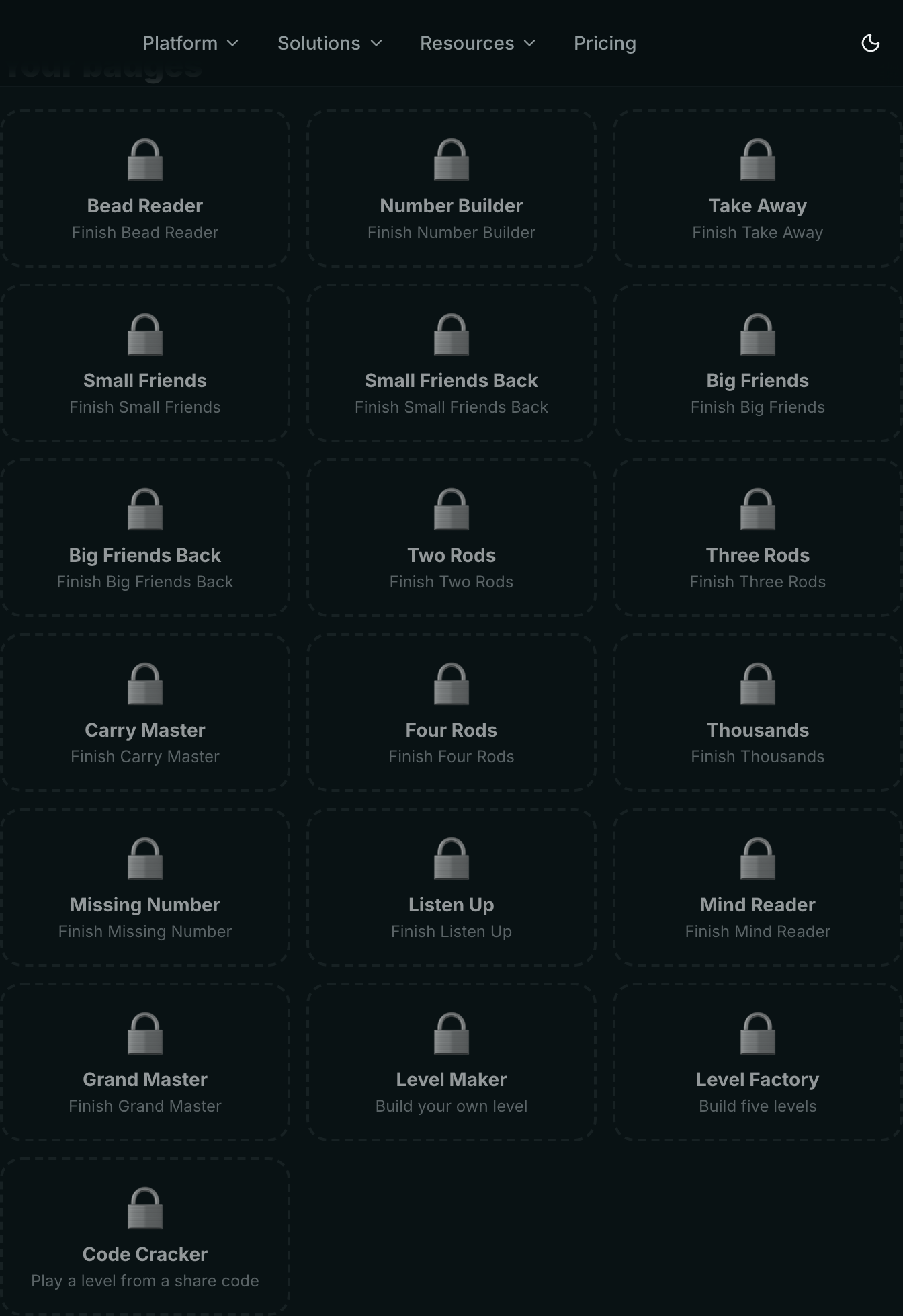
With no account at all, progress saves to the device — levels, stars, badges and the levels they built survive a refresh and a closed laptop. Sign in and the same document lives on the account instead, so it follows them to a phone or a school computer, and finishing a run earns Arena coins and XP like every other game.
Making an account later does not cost them anything: whatever they earned while playing as a guest is carried into the account the first time they sign in on that browser. Play free at /abacus or /play.
FAQ
What age is Abacus Quest for?
Four to twelve. The youngest players use the Read to me switch, which speaks every question and every coaching step aloud, so a child who cannot read yet can still play the whole game. The later levels — crossing ten, carrying, chains of three numbers — keep it worth playing at ten and eleven.
Does my child need to know the abacus already?
No. Level 1 is nothing but reading and building numbers, and each level after it introduces exactly one new idea. A child who has never seen a soroban can start at the beginning and be adding four-digit numbers in their head by the end.
What happens when they get one not-quite-right?
The right answer appears quietly and the abacus replays the solution move by move, with one short line per step. The words wrong, incorrect, failed and error never appear anywhere in the game.
Is there a timer?
No. No timer, no countdown, no streak to lose. The only counter is a combo of consecutive right answers, and it resets silently and costs nothing.
Do the questions repeat?
Never inside a run, and a replay avoids what the run before it asked. Every level is a rule rather than a list, so questions are generated fresh each time and there is nothing to memorize instead of learning the moves.
What is the Workshop?
Where children build their own levels by snapping rule blocks together — which numbers, plus or minus, how many rods, whether the big coin has to be used. Finishing a level on the ladder drops a new block into the Workshop, so playing is how you earn parts to build with.
Can they share a level with a friend?
Yes. Every homemade level compacts to a short share code that can be copied, read out loud, or written on paper. Pasting a code plays that level — no account and no link needed.
Is progress saved?
Yes, even with no account: levels, stars, badges and homemade levels save to the device. Signing in moves the same document onto the account so it follows them between devices, and anything earned as a guest is carried over the first time they sign in.
Does it need the internet?
It needs a connection to load and to save progress. The math, the coach and the sound effects all run in the browser.
Give it ten minutes with your child.
No signup, no timer, and they can stop whenever they like.
Play Abacus Quest free