Online Teaching Platforms to Earn Money in India
Compare the best online teaching platforms to earn money in India. Real commission costs, feature breakdown, and which platform keeps you in control.

I've spent months comparing platforms where Indian educators actually earn money teaching online. The truth? Most take 20–30% of what you make, lock students behind their brand, and leave you renting your own audience. A few let you build something that's actually yours. Here's what I learned from educators already earning ₹30k to ₹3 lakh monthly, the platforms they use, what each costs in hidden fees, and which one lets you keep everything you earn.
Quick Answer: Which Platform Keeps More Money in Your Pocket
When you're comparing online teaching platforms to earn money in India, the commission structure dwarfs every other feature. Teachers focus on "which platform has better live class tools" but miss that a 20% commission difference compounds to lakhs over a few years.
| Platform | Commission | Transaction Fees | Payout Cycle | Monthly Cost |
|---|---|---|---|---|
| Prolaud | 0% | Payment gateway only (1.5–2%) | Weekly | Free tier available |
| Graphy | 0% on paid plans | Payment gateway fees apply | Weekly | ₹1,999–₹9,999/mo |
| TagMango | 0% on higher plans | 2% + payment gateway | 7–10 days | ₹999–₹4,999/mo |
| Classplus | Variable (service fees apply) | Payment gateway + service fee | Weekly | Tiered pricing |
The platforms advertising "0% commission" aren't lying, exactly. But there's a difference between a platform that takes zero commission and one that builds a true business asset you own. More on how to actually earn teaching online in ways that compound.
Start teaching online from your own website
Get your free Prolaud academy set up. Live classes, courses and payments in one place, with 0% commission.
By submitting, you agree to our Privacy Policy
Thanks! Renu or someone from the Prolaud team will reach out soon.
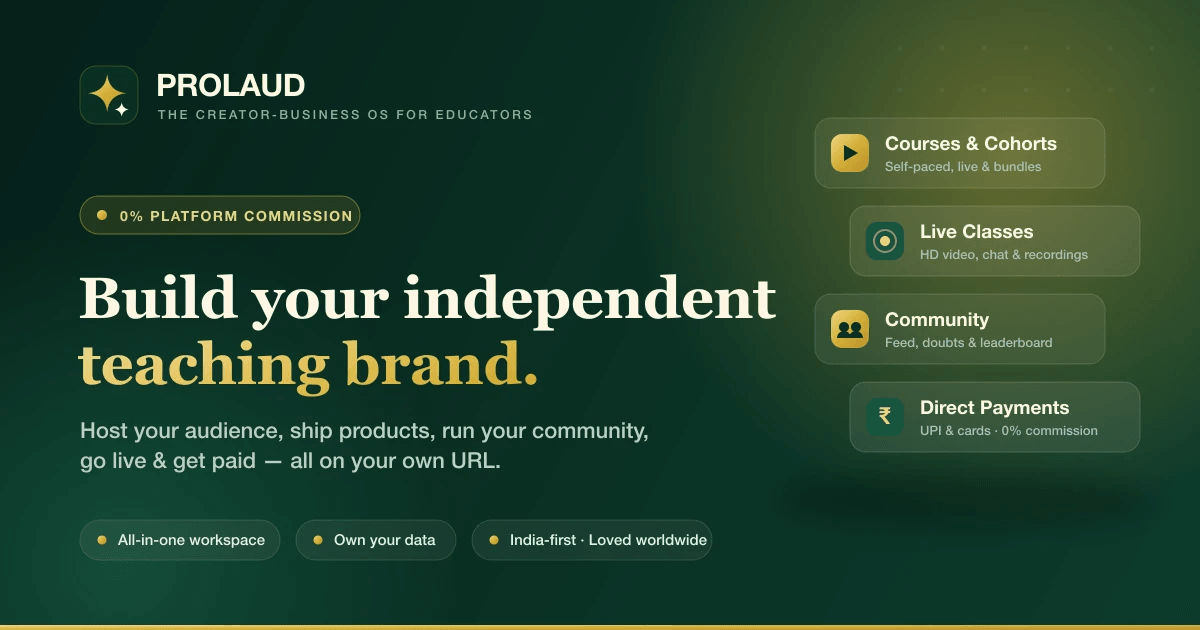
What Indian Educators Actually Need From a Teaching Platform
The feature list looks different when you're building a teaching business rather than just running classes. I've spoken with educators who switched platforms three times in two years because they didn't think through what they actually needed.
- Live class capability Built-in video conferencing that handles Indian internet speeds without forcing students to download apps. Zoom integration works, but native streaming keeps students on your domain.
- Payment collection UPI, cards, net banking, and EMI options for higher-ticket courses. If a platform can't collect ₹15,000 smoothly, you'll lose sales at checkout.
- Student data ownership Email addresses, phone numbers, and learning progress. Many platforms treat student data as their asset. You want it exportable.
- Branded storefront Your logo, your colours, your domain. Not "yourname.platform.com." This matters more than you think when students return for advanced courses.
- Content security Watermarking, download restrictions, and IP-based access limits. Indian competitive exam content gets pirated constantly.
- Mobile-first experience 70%+ of Indian students access courses on phones. If the mobile app isn't intuitive, you'll hear about it in refund requests.
When you're monetizing your teaching skills, these features compound. Missing one costs a little. Missing three costs your business momentum.
Commission Math: What You Actually Take Home
Let's run real numbers. You sell ₹50,000 worth of courses in a month. Here's what hits your bank account across different platform combinations:
| Cost Component | Marketplace Platform | Self-Hosted (Prolaud) |
|---|---|---|
| Gross Revenue | ₹50,000 | ₹50,000 |
| Platform Commission | ₹10,000 (20%) | ₹0 |
| Payment Gateway Fees | ₹1,000 (2%) | ₹750 (1.5%) |
| GST on Commission | ₹1,800 (18%) | ₹135 (18% on PG) |
| Net Take-Home | ₹37,200 | ₹49,115 |
The ₹11,915 difference doesn't sound massive until you annualize it. That's ₹1.43 lakh over a year at the same revenue level. Scale to ₹3 lakh monthly, which many established educators earn, and you're looking at ₹8.5 lakh annually staying with the platform instead of hitting your account.
Teachers I've interviewed consistently underestimate commission impact. They'll spend hours optimizing course thumbnails but ignore a 15% commission difference that costs them ₹2 lakh yearly. The math is math.
Grab a payout calculator and run your own projections. The numbers become real when you see your specific revenue and course prices plugged in.
Graphy vs Prolaud: Who Owns Your Students and Revenue
Let's talk about the heavy hitters. Graphy has built a solid reputation in the Indian creator-educator space. Their marketing tools, landing page builders, and community features genuinely help creators who are starting from scratch. For someone with zero audience, Graphy's ecosystem provides structure.
Prolaud takes a different approach. The platform assumes you want to build your own brand, not borrow one. The 0% commission isn't promotional; it's structural. More importantly, you run it on your own domain. Students land on "yourname.com," not "yourname.prolaud.com," and that builds long-term brand equity.
| Factor | Graphy | Prolaud |
|---|---|---|
| Student Data Ownership | Accessible but platform-controlled | Fully exportable, you own it |
| Branding Control | Subdomain or custom domain on higher plans | Custom domain included, full storefront control |
| Commission Structure | 0% on paid subscriptions | 0% always |
| Long-term Cost at Scale | Subscription scales with features | Flat structure regardless of revenue |
| Best For | Creators building first audience | Educators with existing students |
For more on platform comparisons, check out this breakdown of best platforms to sell courses across different teaching models.
How Marketplace Platforms Work (And Why They Take 30%)
Udemy-style marketplaces aren't evil. They're just structured differently. When a platform takes 30% of your course price, they're paying for traffic you didn't have to generate. For a teacher with no Instagram following, no email list, and no referral network, that 30% buys discovery.
- Built-in student base Marketplaces have millions of learners browsing. Your course appears in search results and recommendations.
- Payment infrastructure handled No setting up payment gateways, handling refunds, or chasing failed transactions.
- Trust by association Students trust the marketplace brand, which transfers some credibility to unknown instructors.
- Marketing support Some marketplaces run promotions featuring your courses to their email lists.
But you pay for those benefits indefinitely:
- Commission on every sale forever Even students you bring through your own links pay the platform fee on many marketplaces.
- Students belong to the platform You can't easily migrate them when you're ready to go independent.
- Pricing pressure Marketplaces push courses to lower price points through constant sales and discounts.
- Competition on the same page Your course page shows other teachers' courses. You're renting shelf space next to competitors.
For beginners without an audience, marketplaces provide a legitimate starting point. But treat them as a stepping stone, not a permanent home. Learn more about teaching platforms in India and their different models.
Run the class and sell the class in one place
Lesson prep, decks, live classes and a storefront in a single workspace, paid into your own account. Free to start.
Start freeSelf-Hosted Platforms: Building Your Own Teaching Business
Self-hosted doesn't mean you're building technology. It means you control the business layer. Prolaud's model works like this: they handle the infrastructure (video hosting, payment processing, student apps), but the brand relationship lives between you and your students.
- Your domain, your brand Students bookmark your website, not a platform subdomain. When they think about your subject, they think about you.
- Full student data export Email addresses, phone numbers, purchase history. You can take this data anywhere if you ever switch platforms.
- Zero revenue sharing Commission-free earnings means scaling from 50 students to 500 doesn't cost you an extra rupee in fees.
- Direct payment relationship Students recognize your brand on their bank statements, not a third-party processor they don't recognize.
- Pricing freedom No algorithm pushing you to discount. You price based on value, not platform price-matching pressure.
This approach requires you to handle marketing and student acquisition yourself. But here's the reality most educators discover: even on marketplace platforms, successful teachers still handle their own marketing. The "built-in traffic" mainly helps the platform's top 5% of courses.
In interviews with educators earning ₹1–3 lakh monthly, every single one said their growth came from their own WhatsApp groups, Instagram presence, and referrals. Not platform discovery.
For teachers wanting full control, live teaching platform comparison helps clarify what "self-hosted" actually costs in time versus money.
How to Choose: Decision Framework for Indian Teachers
Your right platform depends on where you are today, not where you hope to be. Here's an honest decision framework:
- If you have zero students and zero audience: Start with free content on YouTube or Instagram first. Build 100–500 followers before investing in any course platform. Platform choice is irrelevant without students.
- If you have 50–100 students but no website: Use a self-hosted platform with 0% commission. You'll pay less in monthly fees than marketplace commissions, and you'll own the student relationship from day one.
- If you're earning ₹30k–₹1 lakh monthly: Audit your current platform's total cost (commission + fees + subscription). If it exceeds ₹3,000/month, you're overpaying for what you're getting. Consider switching.
- If you run a coaching institute: Self-hosted is the only rational choice. Moving 500+ students' data between platforms is painful. Lock in your domain early.
- If you teach casual learners (hobbies, one-off sessions): Marketplace platforms might work fine. The discovery engine helps for impulse purchases, and you're not building a long-term brand anyway.
- If you teach exam prep or professional skills: Go self-hosted immediately. These students have high lifetime value. Owning that relationship matters.
For a deeper look at setup logistics, this guide on how to sell courses online walks through the launch process step by step.
Key Takeaways
- Commission matters more than features A 20% commission difference costs you ₹2+ lakh annually at moderate scale. No feature makes up for that.
- Student data is your real asset Platforms that lock student emails and phone numbers are building their business on your content. Prioritize data portability.
- Your domain builds brand value "yourname.com" compounds credibility over years. Subdomains keep you looking temporary.
- Marketing is always your job Don't choose a platform hoping for free student acquisition. Successful teachers everywhere drive their own traffic.
- Start simple, but start on the right foundation Switching platforms after 500 students is painful. Choose with your future scale in mind.
- Calculate total cost, not just commission Add platform fees, payment gateway charges, GST, and time costs. The cheapest-looking platform often isn't.
Ready to explore your options? Compare online course platforms and see which aligns with your teaching goals.
FAQ: Online Teaching Platforms in India
Do online teaching platforms charge GST on commissions?
Yes. | Platforms charge 18% GST on their commission fees, which gets added to what they deduct from your earnings. On a ₹10,000 commission, you pay ₹11,800 effectively. This appears separately in tax documents most platforms provide. When comparing platforms, factor GST into your real cost math.
Can I switch platforms without losing my students?
It depends on the platform. | Self-hosted platforms like Prolaud let you export complete student data. Marketplaces often restrict bulk student exports or block email extraction. Before choosing any platform, verify you can download student email addresses and phone numbers. Your students are your business foundation.
Which payment methods work best for Indian students?
UPI dominates, followed by cards and EMI for higher-priced courses. | A payment gateway handling UPI, credit/debit cards, net banking, and EMI options will convert 15–20% better than limited options. For courses above ₹5,000, EMI availability significantly increases enrollment rates among working professionals.
Is 0% commission really free?
Mostly yes, but check payment gateway costs. | True 0% commission platforms charge only payment gateway fees (1.5–2%) to process transactions. Some platforms advertise 0% commission but add "transaction fees" or "platform fees" that function identically. Read the fine print. Prolaud and similar platforms keep it simple: you pay only the payment processor.
How much can a teacher realistically earn online in India?
₹30,000–₹3 lakh monthly is common for full-time educators. | Part-time teachers typically earn ₹10,000–₹50,000 monthly. The range depends on subject demand, pricing power, and student volume. CA exam prep teachers and coding instructors sit at the higher end. Language and hobby instructors often scale through volume at lower price points.
Do platforms handle TDS and tax compliance?
Most don't handle TDS, but they provide tax documents. | Platforms generate annual statements showing your earnings and their deductions. TDS compliance remains your responsibility as a seller. Some platforms (like Classplus) offer additional compliance tools for institutes. Self-employed teachers should track income separately and consult a CA for quarterly advance tax obligations.
For more detailed guidance on choosing between platforms, explore our complete coverage of online tutoring platforms and how they fit different teaching models.
Start teaching online from your own website
Get your free Prolaud academy set up. Live classes, courses and payments in one place, with 0% commission.
By submitting, you agree to our Privacy Policy
Thanks! Renu or someone from the Prolaud team will reach out soon.
Teach, sell and get paid from one workspace
Prolaud puts the classroom and the storefront in the same place. Free to start.
Start free
Renu Rawat
Founder of prolaud.com. Helping teachers and creators build profitable, independent learning businesses without losing a cut of every sale to platform fees.
About the founderKeep reading

Online Teaching Platforms to Earn Money: What Works in 2026
Compare platforms where Indian educators actually earn. Commission, UPI payouts, and what you keep from every course sale. Start teaching today.
Read
How to Monetize Your Teaching Skills
If you can teach, you have a sellable asset — most teachers just never package it. Here are the many ways to monetize your teaching skills in India, and how to start.
Read
How to Teach Online and Earn Money in India
If you're good at something people want to learn, you can earn from it online. Here's how to turn a skill into real income in India — honestly, without the get-rich-quick nonsense.
Read
Online Teaching Platforms for Teachers in India (2026)
Independent comparison of online teaching platforms for teachers in India — commission, features, pricing in ₹. Choose your platform today.
Read
Online App for Teachers: What I Learned Testing 4 Platforms
I tested 4 online apps for teachers in 2026. Here's what works, what doesn't, and which platform keeps 100% of your revenue with zero commission.
Read