Online Spoken English Classes: What Works in 2026
Compare platforms for teaching online spoken English classes. Real data on setup, pricing, and tools. See which features actually matter.

I've watched hundreds of English teachers move online since 2020, and the pattern is clear: the ones who succeed aren't using the fanciest platforms they're using tools that let them actually teach. Online spoken English classes need real-time conversation practice, whiteboard space for pronunciation drills, and attendance tracking that doesn't require a spreadsheet. This guide breaks down what matters when you're choosing a platform to teach live English classes in India.
Quick Answer: Which Platform Fits Your Teaching Model
The right platform depends entirely on your teaching scale. A solo tutor handling 15 students has different needs than an institute running 40 batches. Here's what I've seen work across different models in 2026.
| Teaching Model | Students/Month | Must-Have Features | Platform Type |
|---|---|---|---|
| Solo Tutor | 10-30 | Simple scheduling, direct payments, video integration | Lightweight LMS or meeting tool + payment link |
| Small Academy | 50-150 | Batch management, attendance records, branded storefront | Course platform with live classroom built-in |
| Coaching Institute | 200+ | Multiple teacher logins, exam modules, degree programs | Full-featured platform with academic records |
Solo tutors often start with WhatsApp groups and Google Meet links. That works until you're juggling 25 students across different time slots. Small academies need batch scheduling and a central place where students find recordings, notes, and payment links. Institutes require multi-teacher management and formal assessment tools.
Start teaching online from your own website
Get your free Prolaud academy set up. Live classes, courses and payments in one place, with 0% commission.
By submitting, you agree to our Privacy Policy
Thanks! Renu or someone from the Prolaud team will reach out soon.
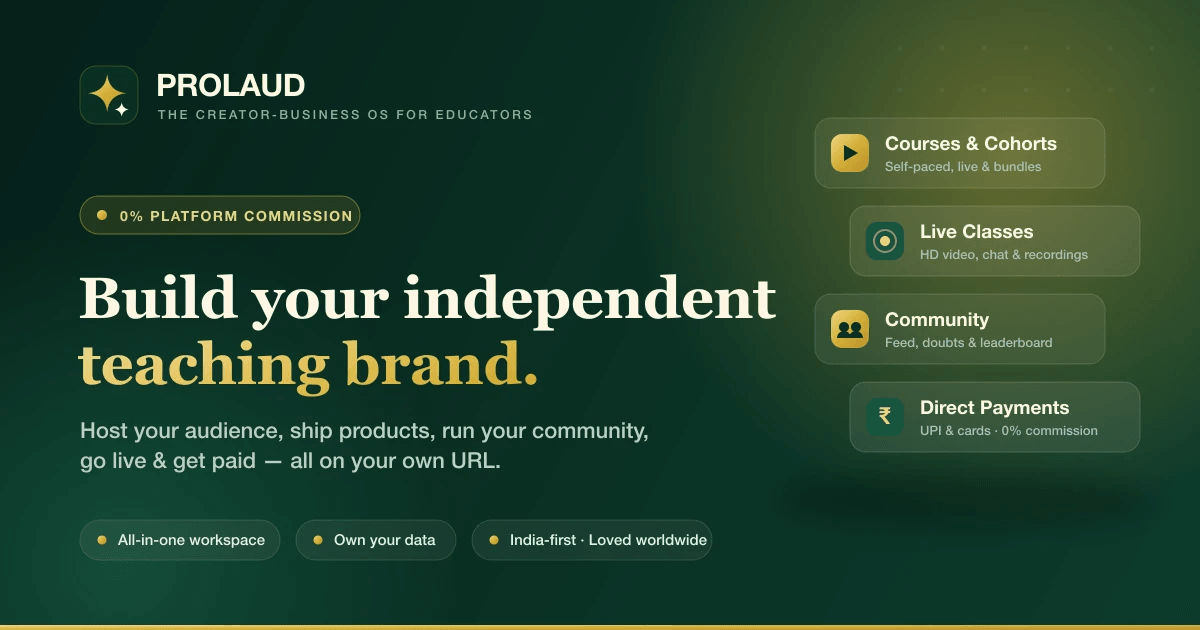
If you're ready to move beyond WhatsApp coordination, launch your English teaching academy with a platform that handles the boring stuff automatically.
Why Live Classes Beat Pre-Recorded for Spoken English [2026 Study]
Language learning data from 2025 shows a stark gap: students in live online spoken English classes complete their courses at nearly triple the rate of those using pre-recorded content. The difference comes down to one simple fact you cannot learn to speak by watching videos.
Spoken English requires real-time correction. When a student mispronounces "thought" as "thout," they need immediate feedback, not a comment on a recording three days later. Live classes create that loop. Students speak, teachers correct, students try again. That cycle repeats dozens of times per session.
- Immediate pronunciation correction Students adjust tongue placement while the mistake is fresh, not days later
- Conversation practice with strangers Pairing students for dialogue drills builds confidence for real-world situations
- Accountability through presence Students show up when they know the teacher will notice their absence
- Whiteboard drills for phonetics Visual learners need to see IPA symbols and stress patterns drawn live
- Spontaneous topic shifts Teachers can pivot when a particular grammar point clearly isn't landing
I've spoken with teachers who spent months recording perfect video lessons, only to find students dropping off after chapter three. The same content delivered live, with interaction and conversation practice, keeps students engaged through completion.
Prolaud built a live classroom directly into the platform no separate Zoom account, no meeting links to copy. Students click "Join Class" from their dashboard. Teachers open their whiteboard and start teaching. You can see how live classes work in the demo.
How to Set Up Your First Spoken English Class (Under 2 Hours)
Setting up a spoken English course doesn't need weeks of planning. I've walked teachers through this process in a single afternoon. Here's the realistic timeline for getting your first class live.
- Claim your domain (15 minutes) Choose your academy name and connect a custom domain. Something like "speakenglishwith[yourname].com" works better than a generic platform subdomain for building trust.
- Set up your first course container (20 minutes) Create your "Spoken English Foundation" or "English Fluency Training" course shell. Add a clear description of what students will achieve by the end.
- Structure your batch schedule (15 minutes) Decide on timing: 8-week cohort with fixed dates, or ongoing enrollment with rolling admission. Fixed cohorts create better community dynamics.
- Set your pricing in INR (10 minutes) Most independent teachers price spoken English courses between ₹2,000 and ₹8,000 for an 8-week program. Higher prices work once you have testimonials and student results.
- Add your first live class session (10 minutes) Schedule the introductory session. Draft a quick outline: self-introductions, diagnostic assessment, and an overview of what you'll cover together.
- Connect your payment method (15 minutes) Indian teachers use UPI, bank transfers, or integrated payment gateways. Make sure students can pay directly from your course page.
- Write your welcome message (10 minutes) A short video or text that students see after enrolling. Set expectations for attendance, materials needed, and how to prepare for the first class.
- Test the entire student flow (15 minutes) Enroll yourself as a test student. Click through every step: from landing page to payment confirmation to joining the live class.
The whole process takes about 90 minutes if you're decisive. Most teachers spend extra time second-guessing their course title or pricing. Don't. You can adjust these after your first few students enroll.
For deeper guidance on structuring your course fees, pricing guide for English courses breaks down what Indian students will actually pay.
Platform Comparison: Graphy vs ClassPlus vs Prolaud for English Teachers
Three platforms dominate the conversation for Indian educators. Each has genuine strengths worth acknowledging, and trade-offs worth understanding before you commit.
Graphy has built strong marketing tools for creators who want to sell courses at scale. Their email automation and landing page templates help teachers who already have an audience but need better conversion tools. For educators focused on nurturing leads through email sequences, Graphy delivers.
ClassPlus serves coaching institutes well. Their app-first approach works for centers managing hundreds of students across multiple subjects and teachers. If you're running a test-prep institute or a large academic coaching center, ClassPlus understands that operational complexity.
Prolaud takes a different approach: live classroom as the core, not an afterthought. English teachers need whiteboard space for phonetics, breakout options for conversation pairs, and a single record for each student across all interactions. Prolaud's 0% commission model means you keep what you earn the platform charges a flat subscription rather than taking a percentage of every sale.
| Feature | Graphy | ClassPlus | Prolaud |
|---|---|---|---|
| Commission structure | Tiered based on plan | Tiered based on plan | 0% commission, flat fee |
| Live classroom | Integrated via third-party | Integrated via third-party | Built-in, no separate tool |
| Branded domain | Available | App-based storefront | Custom domain standard |
| Student record | Course-by-course | Batch-based tracking | Unified record per student |
| Best for | Course creators with audiences | Multi-subject institutes | English teachers, single-subject academies |
No platform is universally better. The question is which trade-offs match your teaching model. compare online learning platforms in depth before deciding.
Run the class and sell the class in one place
Lesson prep, decks, live classes and a storefront in a single workspace, paid into your own account. Free to start.
Start freeAttendance and Progress Tracking That Actually Helps You Teach
Generic analytics don't serve language teachers. Knowing that "course completion is 67%" tells you nothing about which students struggle with past tense verbs or who misses every Friday session. Spoken English coaching needs per-student insight.
I recommend tracking three metrics that actually change how you teach:
- Attendance patterns by day and time If certain students consistently miss your Monday batch, they might need a different slot or a gentle nudge
- Speaking minutes per student In conversation practice, you want roughly equal participation. Tracking this reveals who dominates discussions and who stays silent
- Error recurrence When you correct the same pronunciation mistake three weeks running, that student needs focused drills, not general conversation
Prolaud's unified student record shows every interaction in one place: live class attendance, recorded lesson progress, assignment submissions, and payment history. You see the whole student, not fragments scattered across different tools.
This matters when you're planning interventions. A student who attended 12 sessions but hasn't submitted homework needs different feedback than a student who joined twice and disappeared. Without unified records, you're guessing.
To build a systematic approach to student progress, check out the Teaching Tracker AI plan for structured monitoring.
Pricing Models That Work for Spoken English (2026 India Data)
English teachers in India price their courses based on three factors: duration, format, and their own experience level. Here's what I've seen working in 2026 from conversations with active teachers.
- Short workshop (2-4 sessions): ₹500-₹2,000 Intro-level pronunciation workshops or specific grammar clinics for students who want a taste before committing
- 8-week foundation batch: ₹3,000-₹7,000 Standard pricing for teachers with 6+ months experience running batches, meeting twice weekly
- 12-week intensive program: ₹8,000-₹15,000 Teachers with testimonials and clear results charge this range; often includes 1-1 feedback sessions
- Ongoing membership (monthly): ₹1,500-₹3,000 per month Conversation practice groups that meet weekly, billed monthly with no fixed end date
Cohort-based pricing works better for spoken English than ongoing subscriptions in most cases. Students commit to a block of weeks, which creates peer consistency. The same eight students practicing together builds confidence faster than rotating faces each session.
That said, monthly conversation clubs suit advanced learners who want ongoing practice without a structured curriculum. These work best when you have overflow students from your flagship program who want to maintain their fluency.
Use the detailed pricing calculator to model different price points based on your expected enrollment.
Key Takeaways: Features That Actually Matter
After working with dozens of English teachers moving online, certain platform features separate the frustrated from the flourishing. Here's what matters.
- Built-in live classroom with whiteboard Spoken English teaching needs visual aids for phonetics; switching between video calls and separate whiteboard tools breaks your teaching rhythm
- Unified student records Attendance, progress, and payment history in one place saves hours of administrative work each week
- Custom domain for trust Students pay more readily when they see yourname.com rather than platform.com/yourname
- 0% commission on sales Flat subscription fees let you scale without watching your margins shrink as you grow
- Simple batch scheduling Drag-and-drop scheduling for recurring classes, not manual calendar entries for each session
- One common mistake to avoid: Don't choose a platform built for recorded courses and hope it works for live English teaching; the classroom features will feel like afterthoughts, and your students will notice
These aren't aspirational features. They're the basics that working teachers use daily. For the complete framework, complete guide to teaching live online classes covers everything from tech setup to student retention.
FAQ: Online Spoken English Classes
Do I need a high-end laptop to teach online spoken English classes?
No a standard laptop with 4GB RAM and stable internet handles live teaching fine. The key is connection speed (minimum 5 Mbps upload) and a decent webcam. Students forgive video quality issues; they don't forgive frozen screens during conversation practice.
How many students can join a live spoken English class?
20-25 students works well for conversation-focused batches. More than that and individual speaking time drops below what students need. For lecture-heavy sessions, platforms handle up to 100, but pure speaking still works best in smaller groups.
Can I record my live classes for students who miss sessions?
Yes most platforms, including Prolaud, automatically record live sessions and save them to your course library. Students access recordings from their dashboard. Just announce that you're recording so students consent before speaking practice begins.
What's the difference between ESL teaching platforms and course platforms?
ESL platforms match tutors with students you teach on their marketplace, they handle marketing but take significant commission. Course platforms let you build your own program you set curriculum, pricing, and schedule. Teachers with established reputations often earn more on their own platform.
Do students prefer weekend batches or weekday evenings?
Both work depending on your audience working professionals prefer weekend mornings; college students favor weekday evenings after 6 PM. Ask your first batch what time suits them, then standardize around the majority preference.
How do I handle payments for international students?
Most platforms support international cards via Stripe or similar gateways. UPI handles Indian students. For direct international transfers, you'll need a separate PayPal or Wise setup. Currency conversion fees typically range from 3-5%.
Is it difficult to switch platforms if I start somewhere else?
Moderate effort required you can export student data and course materials, but rebuilding your landing page and batch structure takes time. Best to choose carefully upfront. Students often resist platform changes, so switching mid-program fractures trust.
Do I need separate tools for attendance tracking and video calls?
No modern course platforms merge both. When students join your live class through the platform, attendance logs automatically. You browse English course on Prolaud to see how integrated systems compare to the disjointed alternative of separate meeting links and spreadsheets.
Start teaching online from your own website
Get your free Prolaud academy set up. Live classes, courses and payments in one place, with 0% commission.
By submitting, you agree to our Privacy Policy
Thanks! Renu or someone from the Prolaud team will reach out soon.
Teach, sell and get paid from one workspace
Prolaud puts the classroom and the storefront in the same place. Free to start.
Start free
Renu Rawat
Founder of prolaud.com. Helping teachers and creators build profitable, independent learning businesses without losing a cut of every sale to platform fees.
About the founderKeep reading

Online Proctored Test: How It Works in 2026
What actually happens during an online proctored test? Camera recording, tab monitoring, evidence review—here's the full picture for educators.
Read
Online Classes App That Keeps Your Revenue and Brand
Run live classes, sell courses, and keep 100% revenue with Prolaud's online classes app. No seat fees, built-in classroom, your domain. Start free.
Read
Online Teacher Training Course: What Really Works in 2026
How online teacher training courses are built, certified, and sold in India. Validation, curriculum structure, recording setups, and pricing.
Read
Best Online English Speaking Course in India
Find the best online English speaking course in India. Compare live classes, self-paced platforms, and how to create your own course. Start teaching today.
Read
Online Teaching Platforms to Earn Money: What Works in 2026
Compare platforms where Indian educators actually earn. Commission, UPI payouts, and what you keep from every course sale. Start teaching today.
Read